

 Summary Box [In a hurry? Just read this⚡]
- Alibaba released Qwen3-Coder-Next, an open-weight coding agent model with 80B total parameters but only 3B active, delivering high performance with low resource usage.
- It is optimized for agentic coding tasks and supports tools like OpenClaw, Qwen Code, Claude Code, web development, browser automation, and Cline.
- Trained on over 800,000 verifiable tasks in executable environments using a Mixture of Experts (MoE) architecture for efficient inference.
- Achieves leading results on SWE-Bench, reaching 44.3% success rate and topping the Pareto Frontier in the low-parameter regime.
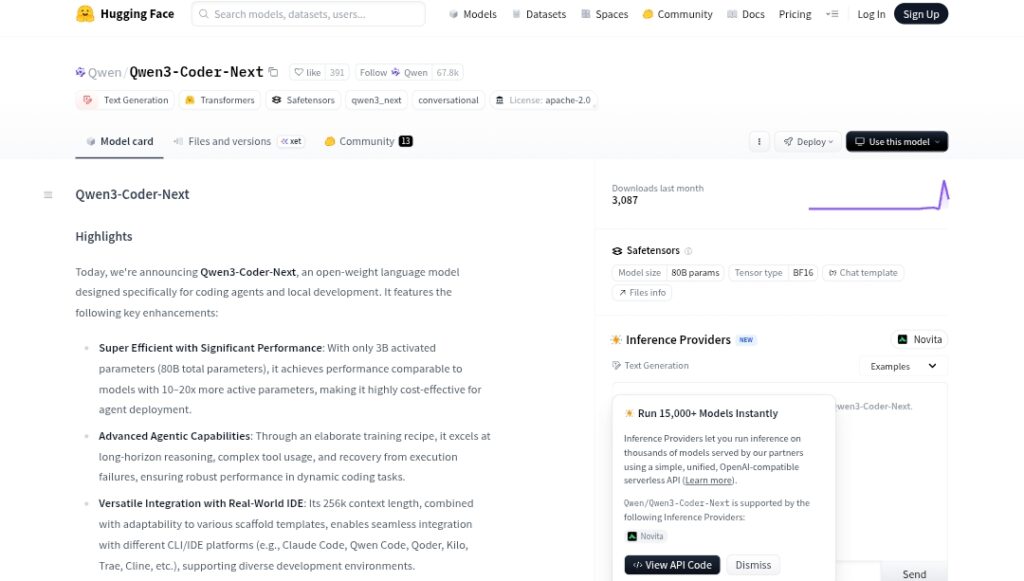
- Available on platforms like Hugging Face and ModelScope, enabling developers to run powerful coding agents locally or on modest hardware.
Alibaba has launched Qwen3-Coder-Next, a groundbreaking open-weight language model optimized for coding agents and local development environments.
This release emphasizes agentic training at scale, enabling the model to handle complex coding tasks with remarkable efficiency.
With a total of 80 billion parameters but only 3 billion active, it strikes an ideal balance between performance and resource demands, making it suitable for deployment on standard hardware without sacrificing capability.
Designed for real-world coding workflows, Qwen3-Coder-Next supports a wide array of tools and frameworks, including OpenClaw, Qwen Code, Claude Code, web development, browser automation, and Cline.
This versatility positions it as a powerful asset for developers building autonomous agents that can execute code, debug issues, and manage projects end-to-end.
Key Innovations in Training and Design
The model’s strength lies in its advanced training methodology, which includes:
- Massive Agentic Dataset: Trained on over 800,000 verifiable tasks within executable environments, fostering robust problem-solving skills.
- MoE Architecture: Utilizes a Mixture of Experts approach to activate only a fraction of parameters during inference, reducing computational overhead while maintaining high output quality.
- Tool Integration Focus: Built to seamlessly interact with external tools, enhancing its utility in agent-based systems for tasks like code generation, testing, and deployment.
These features enable Qwen3-Coder-Next to perform competitively against larger models, proving that smarter training can outperform sheer scale.
Read More: Intern-S1-Pro Is Now Open-Source: Here Is How This 1T MoE Model Can Transform Scientific Research
Dominating the Pareto Frontier on SWE-Bench
Qwen3-Coder-Next has pushed the boundaries on the SWE-Bench benchmark, a challenging evaluation suite for software engineering tasks that tests models on real-world GitHub issues involving code understanding, editing, and verification.
The Pareto Frontier chart illustrates how it achieves superior efficiency, plotting model size against performance.
Here’s a table summarizing key models from the Pareto Frontier (as of February 2026):
| Model Name | Active Parameters (Billions) | SWE-Bench Performance (%) |
|---|---|---|
| Qwen3-Coder-Next | 3 | 44.3 |
| Claude-Opus-4.5 | ? | 46.0 |
| Claude-Sonnet-4.5 | ? | 44.5 |
| DeepSeek-V3.2 | 37 | 40.5 |
| GLM-4.7 | 328 | 40.0 |
| Kimi K2.5 | 32 | 39.5 |
| MiniMax M2.1 | 108 | 34.0 |
The frontier curve shows Qwen3-Coder-Next leading in the low-parameter regime, outperforming models like DeepSeek-V3.2 (37B active) and even challenging frontier giants with far more resources.
Benchmark Achievements and Practical Implications
On agent-centric evaluations, Qwen3-Coder-Next excels:
- SWE-Bench Verified: Over 70% success rate using the SWE-Agent scaffold, demonstrating strong agentic capabilities.
- Efficiency Gains: Matches or surpasses larger open-source models on various benchmarks while running on modest setups, ideal for local inference.
- Broad Applicability: Excels in web development, browser-based tasks, and multi-tool orchestration, reducing latency in production environments.
For developers, this means faster iteration cycles and lower costs. Available on platforms like Hugging Face and ModelScope, the model invites community contributions, potentially accelerating innovations in AI-assisted coding.