

Alibaba’s Qwen team has made a significant contribution to the open-source AI community by releasing Qwen3-ASR, a suite of advanced speech recognition models designed to handle diverse audio inputs with exceptional precision.
Launched in late January 2026, these models build on the Qwen3-Omni foundation, offering robust performance across 52 languages and dialects, including English, Chinese, and various regional accents.
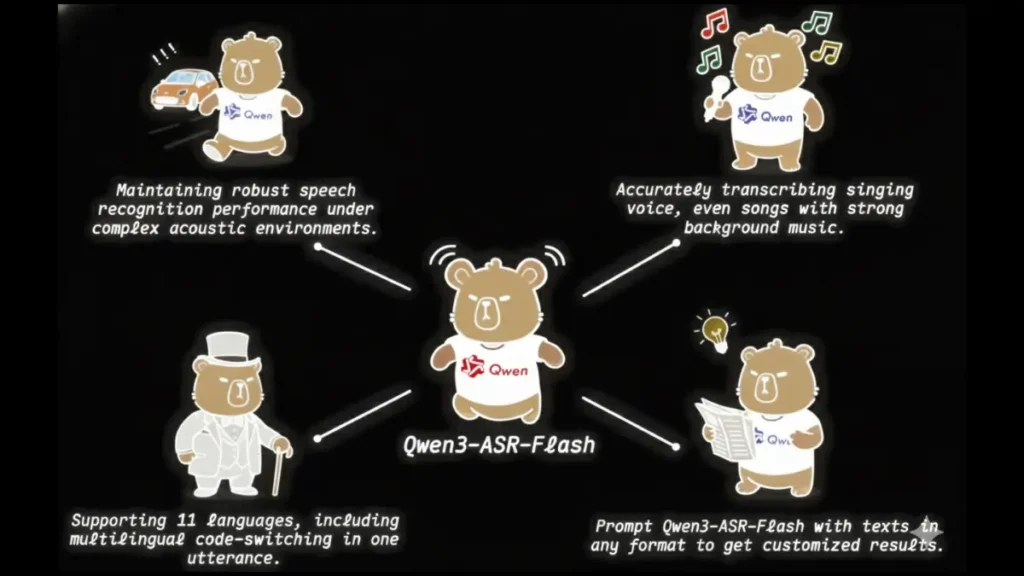
With a 97.9 percent language detection accuracy, Qwen3-ASR addresses key challenges in global audio processing, making it a valuable tool for developers building inclusive applications.
The release includes two primary model sizes: a 1.7 billion parameter version for high-fidelity tasks and a lightweight 0.6 billion parameter variant optimized for resource-constrained environments like mobile devices.
Additionally, a dedicated word aligner enhances timestamp accuracy, crucial for applications such as subtitling and voice search. All components are licensed under Apache 2.0, promoting free commercial use and collaborative improvements.
Read More: OpenAI Launches ChatGPT Translate: Revolutionizing Language Conversion with AI Precision
Benchmark Performance Against Competitors
Qwen3-ASR demonstrates superior results on multiple datasets, often surpassing established models like OpenAI’s Whisper-large-v3.
The following table summarizes word error rates (WER) and character error rates (CER) across key benchmarks, showcasing Qwen3-ASR-1.7B’s edge in multilingual, noisy, and singing audio scenarios:
| Dataset/Category | Qwen3-ASR-1.7B | Whisper-large-v3 | GLM-ASR-Nano-2512 | GPT-4o-Transcribe | Gemini-2.5-Pro | Doubao-ASR |
|---|---|---|---|---|---|---|
| MLS (Multilingual) | 8.55 | 8.62 | 13.32 | N/A | N/A | N/A |
| CommonVoice (CV) | 9.18 | 10.77 | 19.40 | N/A | N/A | N/A |
| LibriSpeech test-other (English) | 3.38 | 3.97 | 5.70 | 3.75 | 3.56 | 5.70 |
| GigaSpeech (English) | 8.45 | 9.76 | 9.55 | 7.50 | 9.37 | 9.55 |
| WenetSpeech (WS) (Chinese) | 4.97/15.88 | 15.30/32.27 | 14.43/13.47 | N/A | N/A | N/A |
| AISHELL-2 test (Chinese) | 2.71 | 5.06 | 2.85 | 4.24 | 11.62 | 2.85 |
| CV-zh (Chinese) | 5.35 | 12.91 | 5.95 | 6.32 | 7.70 | 5.95 |
| M4Singer (Singing) | 5.98 | 13.58 | 7.88 | 16.77 | 20.88 | 7.88 |
| OpenCpop (Singing) | 3.08 | 9.52 | 3.80 | 7.93 | 6.49 | 3.80 |
| EntireSongs-en (Songs with BGM) | 14.60 | 93.08 | 33.51 | 30.71 | 12.18 | 33.51 |
Lower values indicate better performance; metrics are macro-averaged WER/CER where applicable.
Notably, Qwen3-ASR excels in singing audio, achieving a 5.98 percent WER on M4Singer compared to Whisper’s 13.58 percent, highlighting its robustness for music and entertainment apps.
Key Features for Practical Deployment
Qwen3-ASR supports real-time streaming transcription, enabling live captioning in video calls or broadcasts. It handles up to 20 minutes of offline audio processing, ideal for edge computing scenarios without cloud dependency.
Integration is streamlined via vLLM for efficient inference, allowing developers to deploy models on standard hardware. The system also manages noisy environments effectively, with features like extreme noise tolerance and dialect recognition, ensuring reliability in real-world settings such as podcasts, virtual assistants, and accessibility tools.
Availability and Developer Resources
Models are readily accessible on GitHub for code and documentation, Hugging Face for easy downloads, and ModelScope for Alibaba-specific integrations.
Tutorials cover fine-tuning for custom dialects, and pre-trained weights facilitate quick prototyping. This release completes Qwen’s open audio ecosystem, complementing prior tools like Qwen-Audio for comprehensive multimodal AI pipelines.
Broader Implications for AI Accessibility
By open-sourcing these models, Alibaba fosters innovation in underrepresented languages, potentially bridging digital divides in regions with diverse dialects.
Developers can now create cost-effective speech apps without proprietary dependencies, accelerating advancements in education, healthcare, and media.
As AI speech tech evolves, Qwen3-ASR sets a new standard for accuracy and efficiency, empowering global creators to build more inclusive systems.