


Imagine generating photorealistic images from a simple text prompt in under a second, right on your everyday laptop.
That’s the game-changing reality Black Forest Labs just dropped with FLUX.2 Klein, their latest AI image powerhouse released on January 15, 2026.
As someone who’s experimented with countless AI tools for creative projects, I was blown away by how this model turns rapid ideation into a seamless reality.
No more waiting minutes for renders; it’s like having a turbocharged artist at your fingertips, perfect for designers, marketers, and hobbyists alike who crave instant feedback without compromising on stunning quality.
This isn’t just an incremental tweak, it’s a leap forward in accessible visual AI.
Building on the success of FLUX.1, which set benchmarks in photorealism and prompt adherence, FLUX.2 Klein amps up speed by over 30% while maintaining exceptional detail in lighting, textures, and composition.
What’s New in FLUX.2 Klein
At its core, FLUX.2 Klein introduces unified generation and editing in a compact architecture, distilled from larger models for efficiency. Key highlights include:
- Blazing Speed: Inference times under one second on consumer hardware, think RTX 4070 or better.
- Multi-Reference Support: Blend up to multiple images for precise edits, preserving identities, styles, or elements.
- High-Fidelity Outputs: Photorealistic results with improved text rendering and spatial reasoning, even at high resolutions.
- Model Variants: The 4B parameter version (Apache 2.0 licensed) runs on ~13GB VRAM, while the 9B offers flagship quality as open weights.
Read More: Google DeepMind Unleashes TranslateGemma: Breaking Language Barriers with Open AI Power
Compared to FLUX.1, this version slashes latency dramatically, FLUX.1 took seconds to minutes, but Klein delivers instant gratification without quality dips. It’s like upgrading from a bicycle to a sports car for creative workflows.
How It Helps Users Like Me (and You)
For me, FLUX.2 Klein means faster prototyping: I can iterate on product designs or social media visuals in real-time, saving hours. Users benefit from:
- Rapid Editing: Change styles, add elements, or refine ideas on the fly, ideal for e-commerce photos or concept art.
- Local Accessibility: Run it offline on your GPU, no cloud dependency, reducing costs and privacy concerns.
- Developer-Friendly: Open-source options for fine-tuning, perfect for building custom apps.
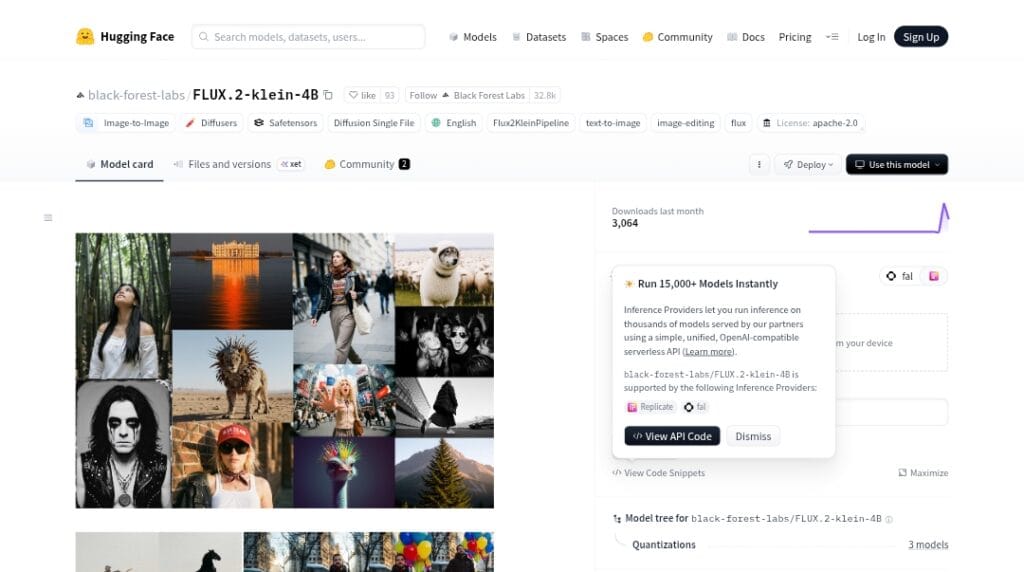
Everything you need to know: It’s free to download from Hugging Face or GitHub, with a no-signup demo app for testing. API access is available for production, though pricing starts low for scaled use.
Performance Comparison Table
| Aspect | FLUX.1 (Previous) | FLUX.2 Klein (New) |
|---|---|---|
| Inference Speed | 2-10 seconds | Under 1 second |
| VRAM Requirement | 20GB+ for full models | ~13GB for 4B variant |
| Editing Capabilities | Basic single-reference | Multi-reference unified |
| License | Mixed open/commercial | Apache 2.0 (4B), Open Weights (9B) |
| Use Cases | Static generation | Real-time interactive |
In essence, FLUX.2 Klein democratizes pro-level AI imagery, making it a must-try for anyone pushing creative boundaries in 2026.