

Recent data from web analytics firm SimilarWeb reveals a dynamic shift in the generative AI landscape, with OpenAI maintaining dominance while newer players chip away at its market share.
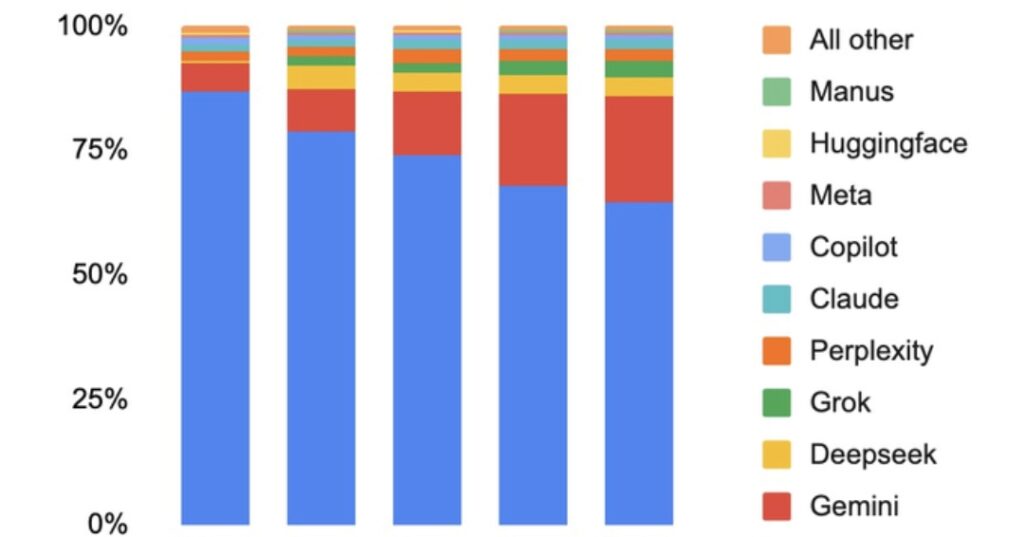
The stacked bar chart tracks traffic distribution among top AI platforms over the past year, highlighting how user engagement has evolved from 12 months ago to today.
This metric, based on website visits, offers insights into consumer preferences and the competitive intensity in AI tools for content creation, coding, and more.
Understanding traffic share is crucial: it reflects real-world adoption, influenced by factors like ease of use, feature innovation, pricing, and integration with ecosystems.
Read More: Apple Poised to Unveil Gemini-Powered Siri Revamp in February 2026
High traffic indicates strong user retention and word-of-mouth growth, essential for AI companies scaling their models.
Key Trends Over Time
The chart shows OpenAI’s blue segment shrinking from nearly 100% a year ago to about 50% today, as diversified options emerge.
Here’s a breakdown of approximate shares based on the visual data:
- 12 Months Ago: OpenAI commanded almost the entire market, with minimal competition.
- 6 Months Ago: Slight diversification begins, with Gemini and others capturing small slices.
- 3 Months Ago: Competitors like Gemini, Deepseek, and Grok start gaining noticeable ground.
- 1 Month Ago: OpenAI’s share dips below 60%, with Gemini rising prominently.
- Today: OpenAI at around 50%, Gemini at 20-25%, followed by Deepseek, Grok, Perplexity, Claude, Copilot, Meta, Huggingface, Manus, and a collective “All Other” category.
| Platform | Current Share Estimate | Growth Trend |
|---|---|---|
| OpenAI | 50% | Declining from near-monopoly |
| Gemini | 20-25% | Rapid rise in recent months |
| Deepseek | 5-10% | Steady increase |
| Grok | 5% | Emerging presence |
| Perplexity | 5% | Consistent growth |
| Claude | 3-5% | Moderate uptick |
| Copilot | 3% | Stable but small |
| Meta | 2% | Niche gains |
| Huggingface | 2% | Developer-focused rise |
| Manus | 1-2% | Minor but growing |
| All Other | 5-10% | Collective challengers |
Major Players and Their Strengths
OpenAI remains the benchmark, powered by models like GPT-5, with broad applications in chat, image generation, and APIs. Its lead stems from first-mover advantage and integrations like ChatGPT‘s massive user base.
Gemini, from Google, has surged thanks to seamless ties with Android, Workspace, and search, emphasizing multimodal capabilities (text, image, video).
Deepseek appeals to coders with specialized programming tools, while Grok from xAI stands out for its uncensored, witty responses and real-time knowledge.
Perplexity excels in research-oriented AI with citation-backed answers, and Claude from Anthropic prioritizes safety and constitutional AI principles.
Copilot (Microsoft) integrates deeply with Office suites for productivity, Meta focuses on open-source models like Llama, Huggingface serves as a hub for community-driven AI hosting, and Manus targets niche creative workflows.
Implications for Users and Industry
For users, this fragmentation means more choices: free tiers from Grok or Claude for casual needs, enterprise-grade from Copilot, or research-focused from Perplexity.
It drives innovation, potentially lowering costs and improving features like accuracy and speed.
Industry-wide, it signals a maturing market where no single player dominates forever. Challenges include energy consumption for training, ethical concerns around bias, and regulatory scrutiny.
Future growth could hinge on advancements in efficiency, like smaller models matching large ones’ performance.
As generative AI integrates further into daily life from education to business tracking these trends helps users select tools aligned with their needs, ensuring they stay ahead in an evolving tech ecosystem.