

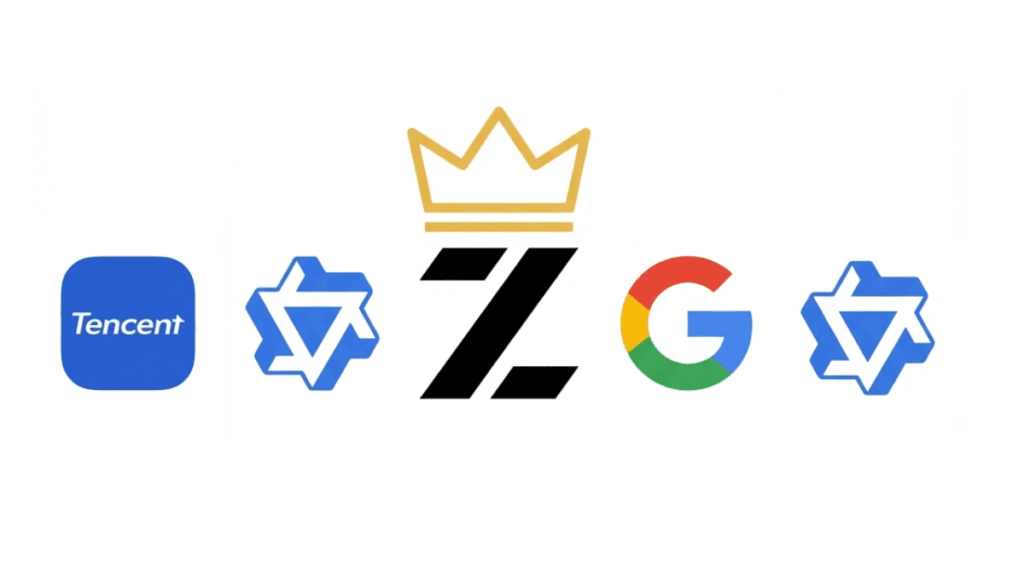
The open-source AI leaderboard now has a huge new player. GLM-4.7, and the 358-billion-parameter behemoth behind it via Beijing-based Z.ai, have exploded onto the trending charts, heralding a new age of open-weight coding-and-reasoning models.
But a look at the top 5 trending models on Hugging Face tells a more interesting story: the AI ecosystem is diversifying quickly.
While GLM-4.7 flexes raw power, the leaderboard is full of highly specialized tools, from lightning-fast image generators to tiny edge-device controllers and interactive world builders.
And here you have it, my rundown of the 5 current hottest models in the game.
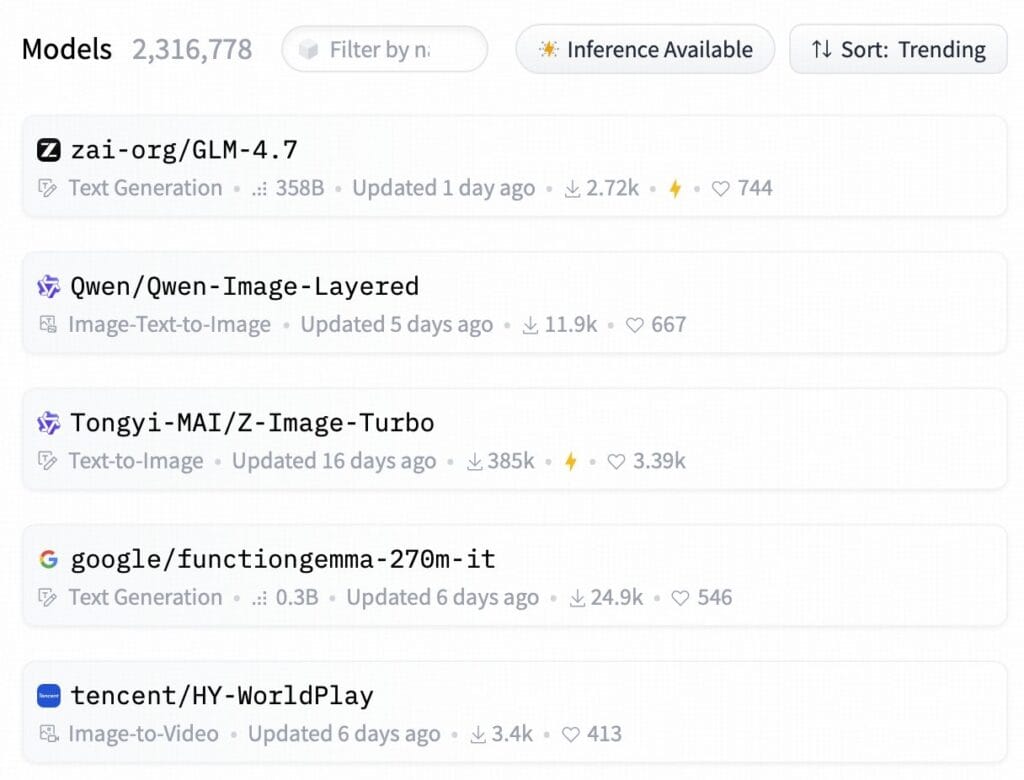
1. The Heavyweight Champion: GLM-4.7 (Z.ai)
Resting easy at #1 is GLM-4.7, which devotes more to deep reasoning and software engineering than to casual chat.
- Coding Dominance: It is powerful and attains a whopping 73.00% in the SWE-bench Verified benchmark, placing it among the strongest open models for tackling real GitHub issues.
- Reasoning Power: It offers competitive reasoning abilities on the GPQA-Diamond benchmark with 85.7% accuracy, competing with state-of-the-art proprietary frontier models in logical problem-solving.
- Scale: With its 128K context window, the model is able to ingest entire codebases, enabling “agentic” workflows where it plans bug fixes or refactoring opportunities as it thinks.
2. The Editor: Qwen-Image-Layered (Qwen)
On the #2 spot is something that revolutionizes graphic designers’ work. Qwen-Image-Layered isn’t an image generator; it is an image breakdown tool.
- Transparent Layers: This model doesn’t bake everything into a “flat” image like other models. Instead, its images are made from clear, individual RGBA layers.
- Non-Destructive Editing: Build, move, resize within the scene, or delete certain objects (for example, a person or a car) without ruining the background, a task that is currently impossible with standard diffusion-based models.
Also Read: Why Al Jazeera Built Its Own AI Instead of Relying on ChatGPT or Gemini?
3. The Speedster: Z-Image-Turbo (Tongyi-MAI)
The #3 spot is occupied by the most-downloaded model on this list by a long shot. Z-Image-Turbo is a stripped-down 6B-parameter model designed for a single purpose: speed.
- Flash Efficiency: Thanks to a “distilled” design, the system needs only 8 inference steps to produce better visuals than older models that may have required 30–50 steps.
- Production Ready: Works on consumer-grade hardware, requires no more than 16GB VRAM, and outputs photorealistic images with accurate bilingual text (Chinese/English) within one second, making it a first choice for real-time applications.
4. The Tiny Titan: FunctionGemma-270m-it (Google)
At #4, Google demonstrates that bigger is not always better. FunctionGemma-270m is tiny next to GLM-4.7 and is meant to run directly on your laptop or Internet of Things (IoT) devices.
- Pure Action: It’s not a chatbot. It functions as a “function caller,” converting plain language (like “Turn the AC on”) into structured code that machines can execute locally.
- Privacy Matters: Commands are processed on-device instead of being sent to the cloud, helping protect user privacy.
5. The World Builder: HY-WorldPlay (Tencent)
At #5 is HY-WorldPlay, a model that sits on the boundary between video generation and video games.
- Playable Video: Generated videos run at 24 frames per second (24p) with user interaction enabled. You can “play” the video using keyboard controls (WASD) to walk around and explore the generated world.
- Consistency: The method reduces the “dream-like” inconsistency of AI video by preserving 3D geometric coherence. If you walk away from a building and return, it still appears exactly as before.