

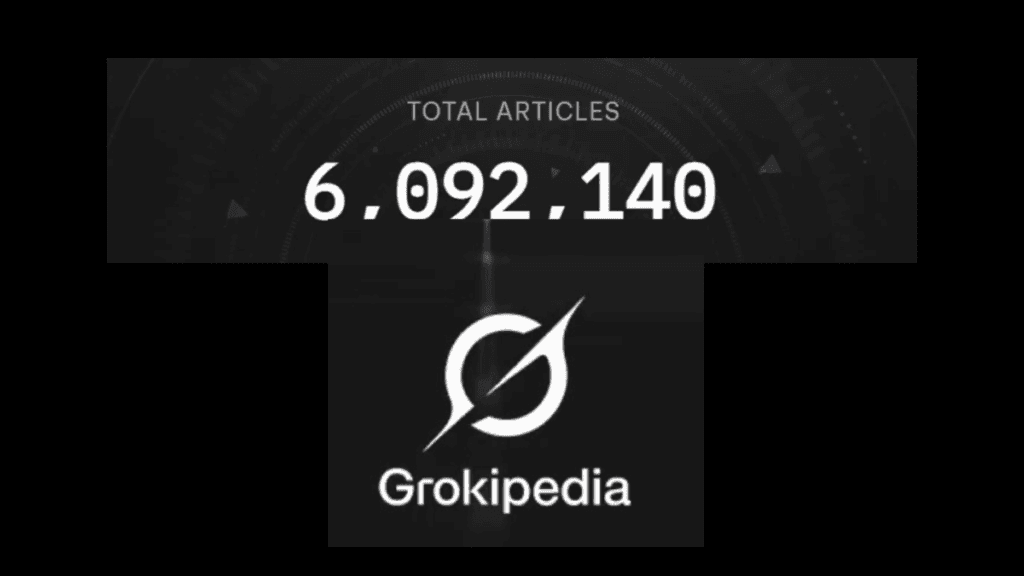
Launched just two months ago, xAI’s Grokipedia has expanded from under one million to more than 6 million AI-generated articles, offering real-time updates and a truth-seeking alternative that is already drawing comparisons with Wikipedia.
As a tech enthusiast who has spent more hours than want to admit going down the rabbit hole of an online encyclopedia, I couldn’t be happier that xAI’s Grokipedia had a coming out party this week.
Launched barely two months ago on October 27, 2025, this AI-based academic search engine has grown from an archive of approximately 885,000 articles to more than 6.1 million at the beginning of January 2026.
That is growth that dwarfs Wikipedia’s 7.12 million English entries, and it has sparked discussions about the future of access to information.
What Sets Grokipedia Apart
Grokipedia is not your average encyclopedia; it’s designed entirely around xAI’s Grok model.
AI produces AI writes and updates articles in real time using data from an enormous database for factual accuracy.
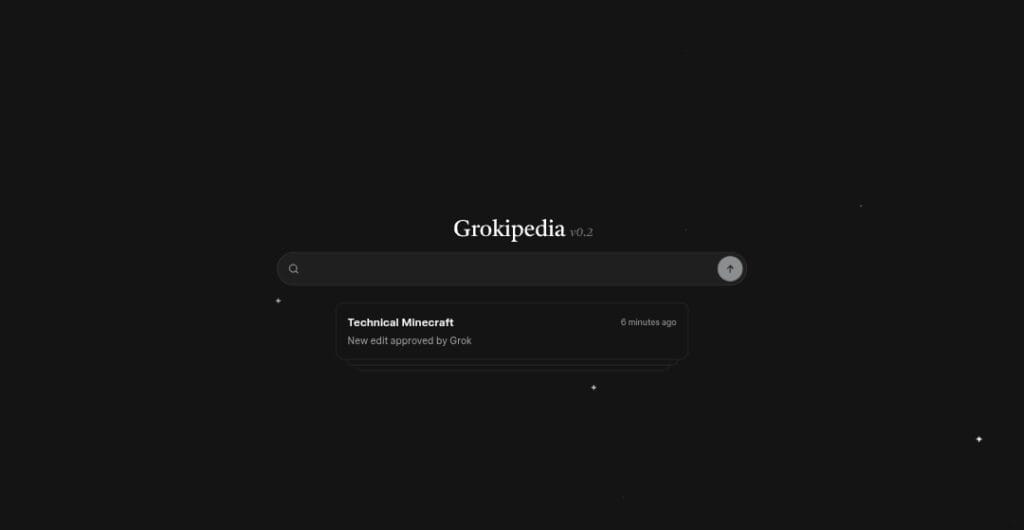
Users can propose changes are approved quickly by Grok, and removes drawn-out arguments.
Initial entries were copied from Wikipedia’s freely-licensed content and cleaned up for readability and factuality.
As I played around with it myself, the interface seemed clean and intuitive to me; little touches like “Fact-checked by Grok” timestamps added a layer of transparency.
Key highlights include:
- Real-time updates: AI makes revisions a snap, too: Information stays up to date for fast-moving subjects like technology advances or world events.
- Bias reduction: By framing itself as “maximally truth-seeking,” it hopes to dodge the kinds of ideological slants that some critics decry on human-edited platforms.
- User-friendly tools: Make direct suggestions and Grok the reasons for approve or reject.
Grokipedia vs. Wikipedia: A Side-by-Side Comparison
To help you decide which to use, here’s a practical breakdown based on my own comparisons:
| Aspect | Grokipedia | Wikipedia |
|---|---|---|
| Article Count | ~6.1M (growing rapidly) | ~7.12M (steady growth) |
| Editing Process | AI-reviewed user suggestions | Community consensus and debates |
| Update Speed | Instant, AI-driven | Slower, human-vetted |
| Bias Concerns | AI-inherited (potentially selective) | Human systemic (e.g., edit wars) |
| Sourcing | AI-synthesized with timestamps | Rigorous citations, transparent history |
| Accessibility | Free, open-source, no ads | Free, donation-funded, no ads |
In my experience, Grokipedia is best for rapid, fresh takes on new trends and events; Wikipedia is better for thoroughly sourced knowledge on long-established topics.
Potential Impacts and Challenges
This expansion could democratize knowledge even more, allowing accurate info to be available without bureaucratic hurdles.
Yet there are quibbles: early reviews registered some occasional factual slips in nichier topics, and the centralized AI control raises questions about long-term objectivity.
For me, it’s thrilling to watch innovation stretching its limits, ”imagine an ’Encyclopedia Galactica’ for the AI age.
If you’re studying, I would say to cross-reference both for the best results. Grokipedia only accelerates the growth of that hate into a need to kill everything in sight.