

 Summary Box [In a hurry? Just read this⚡]
- OpenAI has started testing sponsored advertisements inside ChatGPT for a limited group of free and Go plan users in the United States as of February 9, 2026.
- Ads appear as clearly labeled, visually separate elements after the main response and do not change or influence ChatGPT‘s actual answers.
- The goal is to reduce usage limits on the free tier, make ChatGPT more widely accessible, and help cover the high cost of running the service.
- Ads are shown contextually, for example, suggesting a grocery kit during a meal-planning conversation but sensitive or personal topics remain completely unaffected.
- OpenAI promises that user privacy is protected, conversation quality stays the same, and ads are optional enhancements rather than forced interruptions.
OpenAI has begun testing sponsored advertisements within ChatGPT, targeting a select group of free and Go subscribers in the United States.
This initiative, launched on February 9, 2026, aims to expand access to the popular AI chatbot by reducing usage restrictions while maintaining user trust in its core functionality.
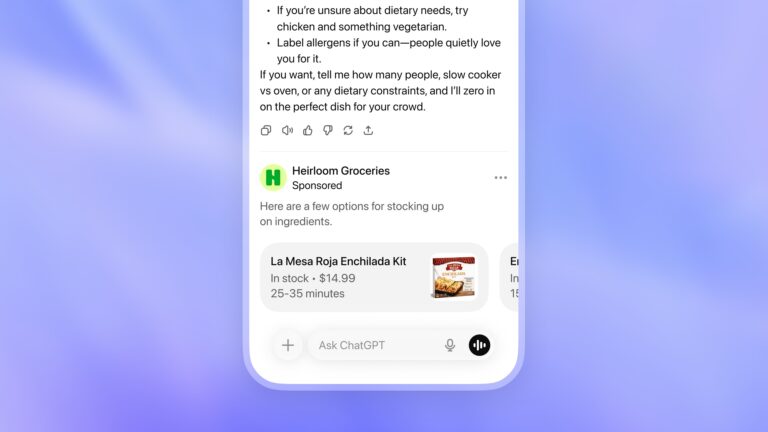
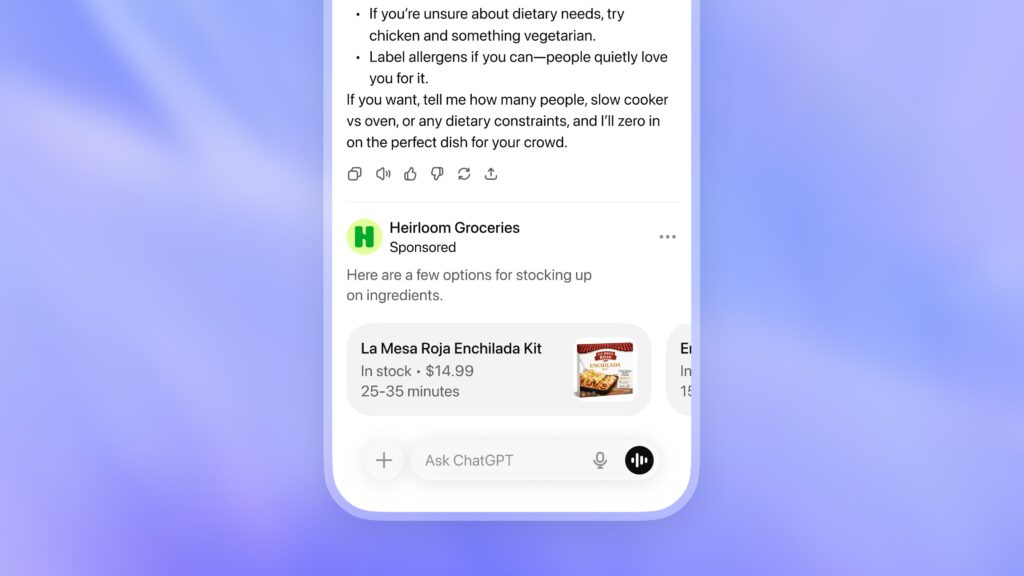
The new ads appear as visually distinct elements separate from ChatGPT responses, clearly marked as sponsored content.
For instance, during a conversation about meal planning, the system might display a relevant product recommendation, such as a grocery kit, without altering the actual advice provided.
OpenAI emphasizes that these promotions do not influence the model’s answers, ensuring that queries on sensitive or personal topics remain unbiased and reliable.
This move reflects OpenAI‘s broader strategy to sustain free-tier operations amid rising computational costs.
By incorporating ads, the company seeks to offset expenses and offer unlimited interactions to more users, potentially democratizing advanced AI tools.
However, the rollout is limited to the U.S. initially, with no immediate plans for global expansion mentioned.
How Ads Integrate into Conversations
Ads are triggered contextually based on the discussion, appearing after the main response.
Users discussing dietary preferences or recipes might see suggestions for related products from partnered brands like Heirloom Groceries.
Each ad includes details such as pricing, preparation time, and availability, encouraging seamless transitions from query to purchase if desired.
OpenAI assures that user data privacy remains a priority, with ads served without compromising conversation integrity.
Subscribers can expect the same high-quality, helpful replies, now supplemented by optional commercial insights.
Read More: Grok Climbs to #3 Rank in Global AI Traffic Rankings While Dominating Trading Benchmarks
What will change for Users and the AI Industry
Professionals relying on ChatGPT for research or creative tasks will appreciate the unchanged response quality. Yet, some may view ads as intrusive, prompting concerns about commercial influence in AI interactions.
In the competitive AI landscape, this positions OpenAI alongside platforms like Google and Microsoft, which already monetize through integrated promotions.
It could pave the way for sustainable free models, but success hinges on balancing revenue with user satisfaction.
Pros and Cons of Ads in ChatGPT
| Aspect | Pros | Cons |
|---|---|---|
| Accessibility | Enables fewer limits on free usage | May feel distracting in focused queries |
| Relevance | Provides useful product suggestions | Risk of perceived bias if not managed well |
| Privacy | No impact on core responses | Potential for increased data tracking |
| Revenue Model | Supports ongoing development | Could alienate ad-averse users |
| User Experience | Adds convenience for shopping-related talks | Visual separation might clutter interface |
As OpenAI gathers feedback from this test phase, future adjustments could refine the feature, ensuring it enhances rather than hinders the ChatGPT experience. This development signals a maturing AI ecosystem where innovation meets practical economics.