

The days of a completely ad-free ChatGPT seem to be ending. OpenAI is said to be actively considering ways to integrate sponsored content directly into the responses of its chatbot, which would represent a radical change to the user experience of one of the world’s most popular AIs.
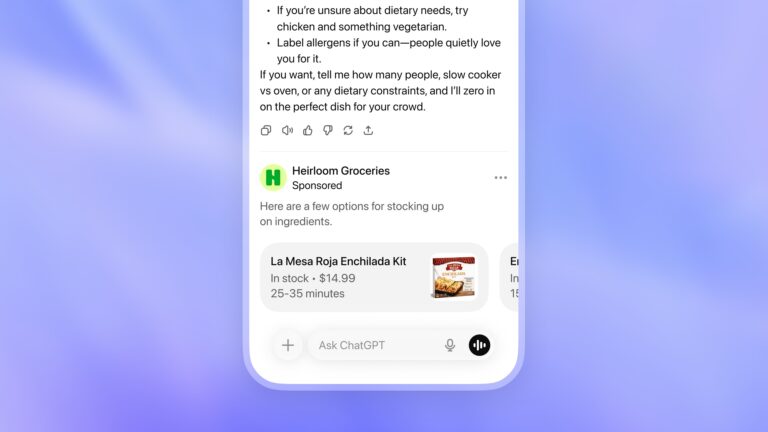
Although live ads are not yet a reality, internal discussions and mockups demonstrate an intent to focus on what they call “intent-based monetization”.
In this model, ChatGPT would parse user queries for shopping or commercial intent and mix in relevant sponsored leads into the discourse.
Also Read: Alibaba Qwen’s New Flash Models Clone Voices in Just 3 Seconds
Generative Ads and the Sephora Illustration
OpenAI’s concept is very different from that of traditional search engines, which separate ads into banners or sponsored links. The idea is to move toward “generative ads,” where the AI writes the ad, so to speak, in order to match the context of the conversation.
For example, when a user asks which mascara to use, ChatGPT can produce an answer that not so subtly emphasizes a sponsored recommendation from brands like Sephora.
Internal mockups also display ads in the form of conversational recommendations that surface only after a user has delved deeply into a topic, like clicking on one travel recommendation for Barcelona and then being shown sponsored tour packages.
Financial Reality vs. the “Dystopian” Fear
This is a major about-face for OpenAI. “I think we’d be interested in helping,” Sam Altman, CEO of the organization behind GPT-3, has said.
For his part, he has called AI responses driven by advertising “a dystopian future” and favored a subscription model. But the financial cost of operating vast AI models is sobering.
OpenAI has “planet-scale costs” and a valuation it needs to live up to for investors, so “we definitely need multiple sorts of revenue beyond the $20 per month subscription,” Brockman says.
Also Read: Gemini Narrows the Gap with ChatGPT as GenAI Traffic Market Fragments
The Trust Paradox
For OpenAI, the big obstacle is trust. A spokesman for OpenAI stressed that any ad product would be created to “respect the trust” that people place in the platform.
Privacy advocates and users fear, however, that an ad-supported model will create a financial incentive for the company to mine personal data out of conversations in order to serve more targeted ads, a possibility the company has discussed internally, according to reports.
The existence of internal mockups indicates that it’s just a matter of when, not if, ads will be rolled out, though VP of Product Nick Turley has publicly said, “there are no live tests for ads right now”.