

OpenAI is now in healthcare for good.
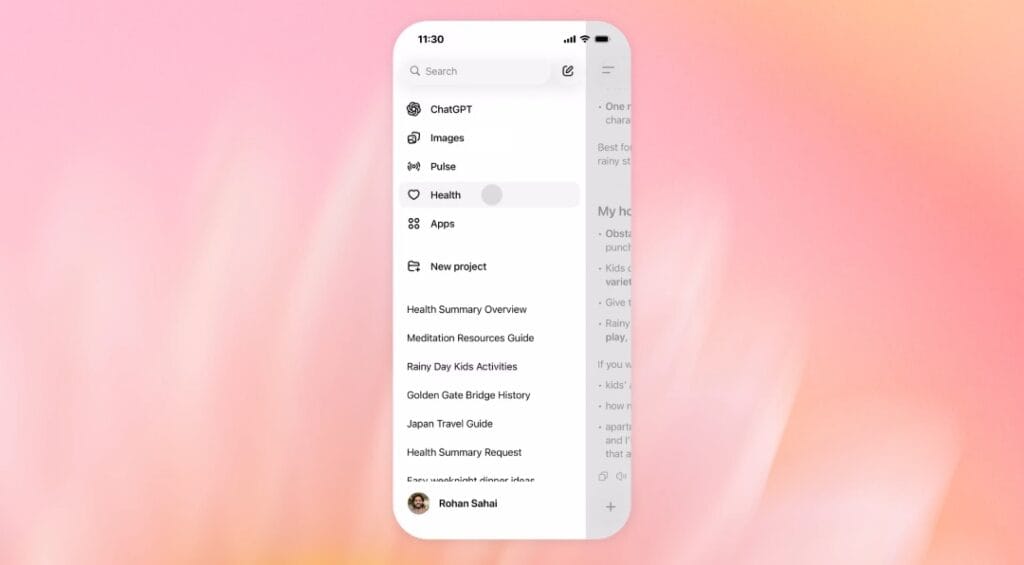
In a surprise announcement this morning, the company unveiled ChatGPT Health, a standalone app that’s available right now on iOS and Android devices as well as desktop web browsers and is tailored to field medical and wellness questions.
The change marks a significant strategic shift, in that it formalizes all the health-based traffic which has long been passing through its general-purpose chatbot.
Formalizing the “Unofficial Doctor”
The launch comes days after it was discovered that its standard ChatGPT model had already been processing over 40 million health-related queries daily globally.
By breaking this traffic into a discrete product, OpenAI hopes to create a more enclosed, auditable and self-contained environment for sensitive medical data.
ChatGPT Health is separate from the regular model, according to the release notes.
Also Read: Grok Imagine Update 1.3.28 Brings Faster Image and Video Generation on iOS
It has been optimized for medical literature and clinical guidelines, favoring cautious answers based on consensus over generative creativity.
The interface is supposed to help users make sense of symptoms, decipher obtuse medical lingo from lab results and find nearby health facilities.
Enhanced Safety Protocols Following Scrutiny
They’ll now use a separate health app, which seems to be something of a direct response to long-standing safety concerns.
And after facing intense regulatory scrutiny and several negative headline-grabbing incidents including one widely publicized case in 2025 where incorrect medical advice bad been given. OpenAI is heavily emphasizing the safety features in ChatGPT Health.
To make sure users can’t miss them, the new platform comes with giant disclaimers that warn people about what it is: an informational tool, not a stand-in for real medical advice.
The “temperature” of the model, its openness to creative risk has also been turned down so that the generated medical facts are not too often wildly hallucinated.
Narrowing the Digital Divide or Expanding the Threat?
OpenAI executives billed the rollout as a crucial instrument for global health equity, specifically in hospital deserts where patients already depend on AI for after-hours guidance.
But the launch is likely to immediately provoke hostile responses from medical associations and regulators around the world.
Also Read: Claude Code 2.1.1 Update: What’s New, Key Fixes, and Why Developers Are Upgrading
For years, critics have warned that formalizing AI as a health adviser with no overseeing comparable to federal rules for medical devices would be unsafe.
And though ChatGPT Health is currently accompanied with an informational disclaimer, it has potential to change the way billions of people make their first-ever medical decisions.