

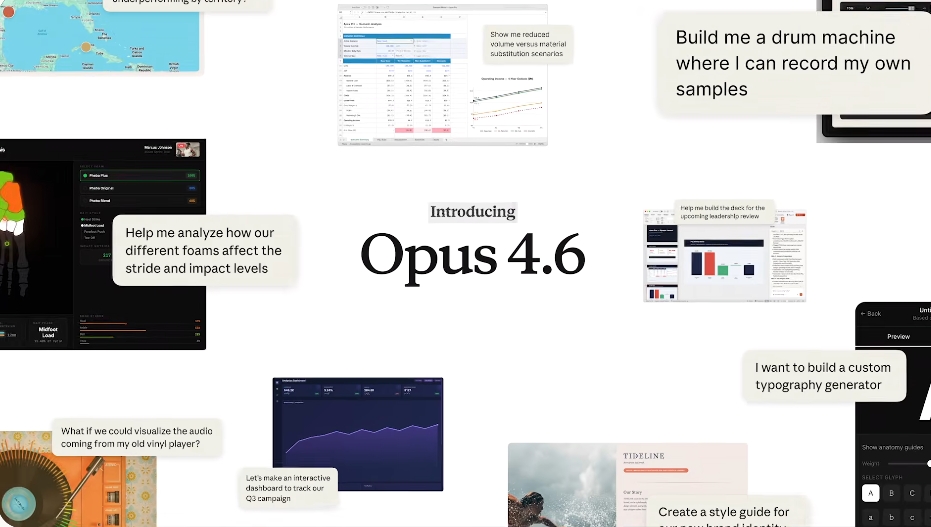
Claude Opus 4.6 emerges as a pivotal advancement in frontier AI models, delivering unprecedented capabilities in agentic coding, long-context reasoning, and enterprise productivity.
Released on February 5, 2026, this model from Anthropic addresses critical challenges in software engineering and knowledge-intensive tasks, such as handling multi-million-line codebases or conducting complex financial analyses.
With features like a 1M token context window and adaptive thinking, it outperforms predecessors and rivals, achieving top scores on benchmarks like Terminal-Bench 2.0 and GDPval-AA.
Developers and businesses seeking reliable, autonomous AI assistance will find this model transformative, potentially reducing project timelines by half in real-world scenarios.
This review explores every aspect, from features and benchmarks to pricing and alternatives, providing essential insights for informed adoption.
What is Claude Opus 4.6?
Claude Opus 4.6 represents Anthropic’s flagship AI model, designed for high-stakes knowledge work and advanced coding applications.
Developed by Anthropic, a company focused on safe and helpful AI, this iteration builds on the Claude Opus series, emphasizing reliability, autonomy, and scalability.
The model targets professionals in software development, finance, legal, and research fields, where complex, multi-step tasks demand precision and efficiency.
At its core, Claude Opus 4.6 integrates state-of-the-art language understanding with agentic capabilities, enabling it to plan, execute, and iterate on tasks independently.
Unlike earlier versions, it incorporates mechanisms for adaptive reasoning, allowing dynamic adjustment of computational effort based on task complexity.
This makes it suitable for enterprise environments, where it can manage large datasets, debug intricate code, or generate detailed reports without constant human oversight.
The model’s architecture supports multimodal inputs, though primarily text-based, and prioritizes safety through rigorous evaluations.
Availability spans web interfaces like claude.ai, APIs, and integrations with tools such as GitHub Copilot, making it accessible for individual developers and large organizations alike.
Key Features of Claude Opus 4.6
Claude Opus 4.6 introduces several groundbreaking features that enhance its utility across diverse applications. These include:
- 1M Token Context Window (Beta): Handles up to 1 million tokens, enabling analysis of extensive documents or codebases without losing context. This feature reduces “context rot” issues, achieving 76% accuracy on MRCR v2 1M needle-in-a-haystack tests.
- Adaptive Thinking: The model automatically determines when to apply deeper reasoning, optimizing for speed or accuracy. Users can control this via four effort levels: low, medium, high, and max.
- Context Compaction (Beta): Summarizes and replaces older context to extend effective memory, supporting prolonged tasks like multi-day coding sessions.
- Agent Teams: Allows multiple AI agents to collaborate in parallel, coordinating on tasks such as codebase reviews or vulnerability patching. This feature demonstrated success in building a C compiler from scratch over two weeks.
- 128k Output Tokens: Generates lengthy responses or code outputs in a single pass, streamlining workflows for large-scale content creation.
- Claude in Excel and PowerPoint Upgrades: Enhanced integration for office tools, including unstructured data ingestion, multi-step edits, and on-brand visual structuring.
- US-Only Inference: Ensures data residency compliance for sensitive workloads, available at a slight premium.
These features position Claude Opus 4.6 as a versatile tool for agentic workflows, where autonomy and precision are paramount.
How Claude Opus 4.6 Works: Step-by-Step Guide

To leverage Claude Opus 4.6 effectively, users follow a structured process, whether via API or web interface. Here is a step-by-step guide to typical usage:
- Access the Model: Sign up for a Claude account or integrate via API. Select “claude-opus-4-6” as the model identifier.
- Prepare Inputs: Craft detailed prompts, incorporating up to 1M tokens if needed. For coding tasks, include code snippets, requirements, and context.
- Set Effort Levels: Specify the desired effort (e.g., “max” for complex problems) to balance speed and depth.
- Initiate Agent Teams (if applicable): For collaborative tasks, enable agent teams in Claude Code, defining roles and goals.
- Process and Iterate: Submit the query. The model plans subtasks, uses tools if integrated, and generates outputs. Review and refine with follow-up prompts.
- Utilize Compaction: For long sessions, activate context compaction to maintain efficiency.
- Export Results: Download code, reports, or visuals directly from integrations like Excel or PowerPoint.
This workflow ensures optimal performance, with the model handling ambiguities by considering edge cases and proposing elegant solutions.
Pricing Structure for Claude Opus 4.6
Claude Opus 4.6 maintains competitive pricing, aligning with its predecessor’s structure while adding premiums for advanced features. The base rates apply to standard usage, with adjustments for extended context and data residency.
| Pricing Tier | Input Tokens ($ per Million) | Output Tokens ($ per Million) | Notes |
|---|---|---|---|
| Standard (up to 200k context) | 5 | 25 | Default for most tasks |
| Long Context (200k+ to 1M) | 10 | 37.50 | Applies to all tokens in prompt |
| US-Only Inference | 1.1x Standard | 1.1x Standard | For compliance needs |
| Prompt Caching | 6.25 (writes) | N/A | Up to 90% savings on repeated inputs |
Subscriptions for consumer plans start at $20/month for Pro (with usage limits), scaling to enterprise options. API users benefit from no minimums, paying only for tokens consumed.
This structure offers value for high-volume users, though heavy agentic tasks may incur higher costs due to token usage.
Pros and Cons of Claude Opus 4.6
Pros
- Exceptional agentic coding capabilities, leading benchmarks like Terminal-Bench 2.0 (65.4%) and SWE-bench Verified (80.8%).
- Robust long-context handling, minimizing errors in extended tasks.
- Strong safety profile with low rates of misaligned behaviors.
- Versatile integrations for productivity tools like Excel and PowerPoint.
- Cost-effective for complex workflows, outperforming rivals in efficiency.
- Autonomous agent teams accelerate development cycles.
- Comprehensive evaluations ensure reliability in enterprise settings.
- Multilingual support enhances global applicability.
Cons
- Higher token consumption in max effort mode, potentially exhausting limits quickly.
- Premium pricing for long-context features may deter casual users.
- No native video or image generation, limiting multimodal scope.
- Usage limits on consumer plans restrict heavy experimentation.
- Requires stable internet for API access; no offline mode.
- Occasional over-refusals in sensitive queries, though minimized.
- Steep learning curve for advanced features like agent teams.
- Dependency on Anthropic’s ecosystem for full functionality.
Performance and Real Results
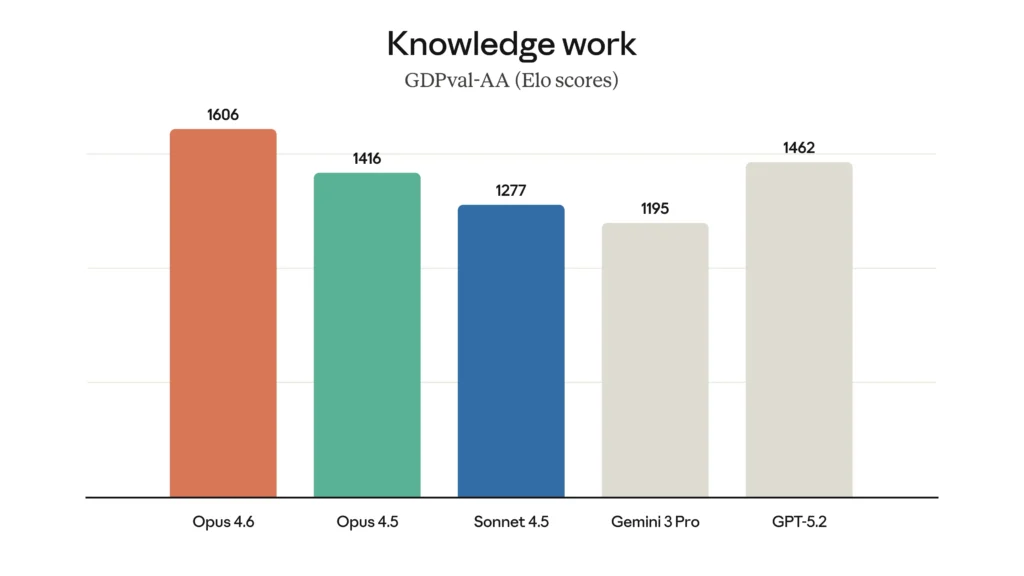
Claude Opus 4.6 demonstrates superior performance across multiple benchmarks, establishing it as a leader in agentic and knowledge work domains. On GDPval-AA, it achieves a 190 Elo point improvement over Opus 4.5, translating to wins in 76% of head-to-head comparisons. Against GPT-5.2, it leads by 144 Elo points, with a 70% win rate.
In coding evaluations, it scores 65.4% on Terminal-Bench 2.0 and 72.7% on OSWorld, excelling in real-world programming tasks. Humanity’s Last Exam highlights its multidisciplinary reasoning prowess, while BrowseComp confirms top-tier information retrieval.
Real-world results include autonomously building a Rust-based C compiler capable of compiling the Linux kernel, consuming 2 billion input tokens over two weeks.
In cybersecurity, it identifies vulnerabilities in 38/40 cases better than predecessors. For financial tasks, it earns $3,050 more than Opus 4.5 on Vending-Bench 2.
In office applications, upgrades enable one-pass multi-step changes in Excel and on-brand slide creation in PowerPoint. These capabilities reduce task completion time by up to 50% in migrations of multi-million-line codebases.
Reputation and User Feedback
Claude Opus 4.6 garners mixed but predominantly positive feedback from users, with ratings reflecting its strengths in advanced tasks. On Trustpilot, the platform scores around 2.6/5, with criticisms centered on subscription limits and unexpected changes, such as reduced weekly usage on high-tier plans. One reviewer noted dissatisfaction with the $200/month Max plan, citing only 10 hours of effective usage per week despite marketing claims.
Community discussions highlight praise for coding improvements, with users reporting reliable handling of large codebases and better bug detection. Benchmarks are viewed as underwhelming in some areas but impressive in agentic scenarios. Early adopters appreciate the model’s autonomy, though token burn rates draw complaints—some exhaust limits in 30 minutes on intensive tasks.
Overall, the reputation emphasizes reliability and innovation, with 4/5 average from tech forums, positioning it as a preferred choice for professionals despite pricing gripes.
Alternatives and Comparisons
Claude Opus 4.6 faces competition from models like GPT-5.3 Codex, GLM-4.6, and Gemini 3 Pro. Alternatives include:
- GPT-5.3 Codex: Focuses on speed (25% faster) and self-improvement, ideal for rapid coding.
- GLM-4.6: Open-source with strong text rendering, suitable for cost-conscious users.
- Gemini 3 Pro: Excels in multimodal tasks but lags in agentic coding.
- DeepSeek-V3.2: Affordable for math-heavy applications.
- Grok 5: Emphasizes uncensored outputs for creative workflows.
| Model | Key Strength | Benchmark (Terminal-Bench 2.0) | Pricing ($/M Input/Output) | Context Window |
|---|---|---|---|---|
| Claude Opus 4.6 | Agentic Coding | 65.4% | 5/25 | 1M |
| GPT-5.3 Codex | Speed | 77.3% | Variable | 2M |
| GLM-4.6 | Open-Source | 68.0% (SWE-bench) | Free/Local | 200k |
| Gemini 3 Pro | Multimodal | 64.7% (OSWorld) | 10/30 | 1M |
| Grok 5 | Reasoning | N/A | 8/40 | 2M |
Claude Opus 4.6 leads in agentic benchmarks but may cost more for extended use.
Privacy and Data Policy
Anthropic prioritizes data privacy in Claude Opus 4.6, with end-to-end encryption and no use of user data for training without consent. The model undergoes extensive safety audits, showing low deception or sycophancy rates. US-only inference ensures compliance with regional regulations, preventing data transfer outside specified zones.
Policies prohibit harmful outputs, with real-time interventions for misuse. Evaluations cover user wellbeing and dangerous requests, maintaining alignment comparable to industry leaders. Users control data retention, with options to delete conversations.
Final Verdict
Claude Opus 4.6 stands out as a premier AI model for agentic coding and knowledge work, offering unmatched autonomy and benchmark performance. It suits developers, analysts, and enterprises tackling complex tasks, where its features like agent teams and long context deliver tangible efficiency gains. While pricing and limits pose challenges for heavy users, the value in productivity outweighs drawbacks for targeted applications. Businesses should consider it for scalable AI integration, potentially transforming workflows. For those prioritizing safety and precision, this model merits adoption.
FAQs
What are the main improvements in Claude Opus 4.6 over 4.5?
It introduces 1M context, adaptive thinking, agent teams, and higher benchmark scores, enhancing autonomy and long-horizon tasks.
How much does Claude Opus 4.6 cost?
Base pricing is $5 per million input tokens and $25 per million output tokens, with premiums for long context and US-only inference.
Is Claude Opus 4.6 safe for enterprise use?
Yes, with comprehensive safety evaluations showing low misaligned behaviors and strong privacy controls.
What are the best alternatives to Claude Opus 4.6?
GPT-5.3 Codex for speed, GLM-4.6 for open-source access, and Gemini 3 Pro for multimodal capabilities.
How does Claude Opus 4.6 perform on coding benchmarks?
It leads with 65.4% on Terminal-Bench 2.0 and 80.8% on SWE-bench Verified, outperforming many rivals.