
What is Caribou?
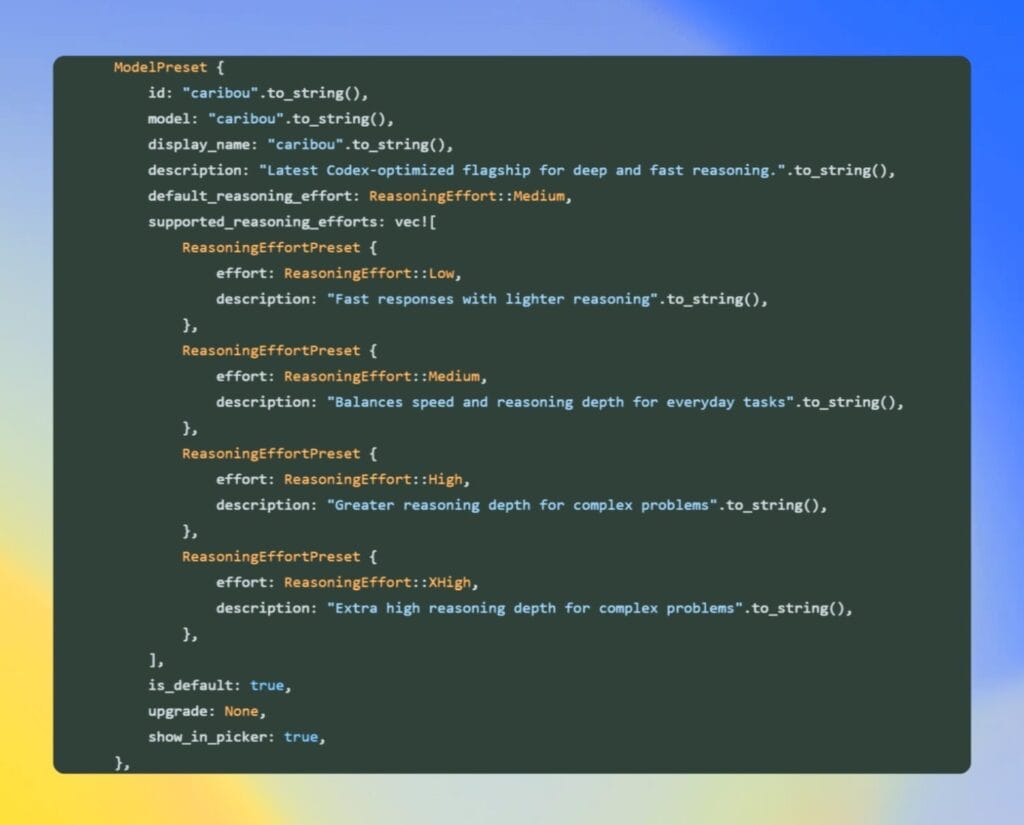
Caribou is the leaked/internal name for OpenAI’s advanced agentic coding model built on GPT-5.2, designed for autonomous software engineering tasks across large codebases.
When was Caribou released or leaked?
Discovered via GitHub log leaks in December 2025; expected rollout late 2025 or early 2026 as part of GPT-5.2-Codex.
Is Caribou free to use?
No, it is paid: access through GitHub Copilot subscription or OpenAI API token billing (approx $1.75/1M input tokens).
What makes Caribou different from previous Codex models?
It handles repository-scale context, multi-step agentic tasks, reduced hallucinations, and defensive security coding in a unified high-performance model.
How do I access Caribou?
Via GitHub Copilot in VS Code/JetBrains (subscription required) or directly through OpenAI API with the appropriate model name once released.
What are Caribou’s key strengths?
Massive codebase understanding, autonomous refactoring, vulnerability detection, and low-latency IDE integration for professional engineering.
Are there privacy concerns with Caribou?
Yes, enterprises should be cautious uploading proprietary code to OpenAI servers; review privacy policies for sensitive projects.
Who is Caribou best for?
Professional software engineers, DevOps teams, and architects working on large, complex, or legacy codebases needing AI autonomy.

Caribou

About This AI
Caribou is the internal codename and leaked name for OpenAI’s breakthrough agentic coding model, built on the GPT-5.2 architecture and positioned as the next evolution of Codex.
It shifts from simple code completion to full autonomous software engineering, capable of handling complex, long-running tasks across hundreds of files while maintaining deep context, dependencies, and variable awareness.
Unlike earlier split-tier models, Caribou unifies high performance into a single powerful system optimized for repository-level understanding, multi-step refactoring, test updates, vulnerability detection, and secure/defensive code writing.
It integrates natively with GitHub Copilot and IDEs like VS Code/JetBrains for low-latency, in-editor execution of instructions such as “refactor this module and update all tests” or entire codebase migrations.
Trained with specialized focus on real-world messy codebases, it significantly reduces hallucinations in complex logic and excels on SWE-Bench-like multi-file editing benchmarks.
Discovered via GitHub log leaks in December 2025, Caribou represents OpenAI’s push toward truly agentic developer tools amid competition from open-source and other frontier models.
Access occurs through GitHub Copilot subscriptions or OpenAI API (model likely gpt-5.2-codex), with commercial token-based pricing.
Ideal for professional engineers, DevOps teams, and architects managing large-scale, legacy, or enterprise codebases needing an AI partner for autonomous refactoring and secure development.
Key Features
- GPT-5.2 foundation architecture: Leverages state-of-the-art reasoning and instruction following for coding tasks
- Repository-level context handling: Understands and edits across massive projects without losing dependencies or variables
- Agentic multi-step execution: Performs complex workflows like full module refactoring plus test updates autonomously
- Unified high-performance model: No separate tiers; single powerful system for all advanced coding needs
- Defensive security focus: Specialized training to identify vulnerabilities and generate secure code
- Deep IDE integration: Optimized low-latency performance inside VS Code, JetBrains, and GitHub Copilot
- Reduced hallucinations in logic: Better accuracy on intricate, real-world codebases and edge cases
- Multi-file editing prowess: Excels at tasks requiring changes across hundreds of files with consistency
Price Plans
- GitHub Copilot (Paid Subscription): Monthly fee for IDE access (exact price not specified in leaks; typically around $10-20/user/month historically)
- OpenAI API (Token-based): Approx $1.75 per 1M input tokens; output pricing similar; billed per usage for heavy agentic tasks
Pros
- Handles real messy codebases: Major leap in dealing with legacy, large-scale, or poorly structured projects
- Strong multi-step autonomy: Executes end-to-end engineering tasks without constant human intervention
- Deep GitHub/Copilot ecosystem: Seamless integration with industry-standard developer tools
- Improved reasoning accuracy: Fewer errors in complex logic compared to prior Codex/GPT versions
- Secure code emphasis: Built-in vulnerability detection and defensive programming strengths
Cons
- Agentic tasks can be slower: Multi-step reasoning takes longer than simple autocomplete
- High cost for heavy use: API token pricing adds up quickly for large-scale operations
- Privacy risks for code: Enterprises may hesitate uploading sensitive proprietary codebases
- Still emerging rollout: Leaked status means full features and stability not yet widely tested
- IDE dependency: Best experience requires GitHub Copilot subscription and supported editors
Use Cases
- Full repository refactoring: Rewrite modules, update dependencies, and fix tests across large projects
- Legacy code modernization: Migrate old codebases to new frameworks while preserving functionality
- Vulnerability auditing: Scan and patch security issues with defensive code suggestions
- Multi-file feature implementation: Add features requiring changes in many related files
- Enterprise code maintenance: Automate routine updates, cleanups, and optimizations at scale
- DevOps automation: Script CI/CD improvements or infrastructure-as-code tasks
Target Audience
- Professional software engineers: Needing AI for complex, real-world coding challenges
- DevOps and platform teams: Managing large-scale infrastructure and codebase health
- Technical architects: Overseeing system-wide changes and refactoring strategies
- Enterprise development teams: Handling legacy migrations and security hardening
- Open-source contributors: Accelerating contributions to big repositories
How To Use
- Access via Copilot: Enable GitHub Copilot in VS Code/JetBrains; model rolls out as Caribou/GPT-5.2-Codex
- API direct use: Call OpenAI API with model name like gpt-5.2-codex for custom agents/tools
- Give repository context: Provide full codebase or key files via Copilot workspace or API uploads
- Issue agentic commands: Prompt with multi-step instructions like 'refactor auth module and add tests'
- Review and iterate: Accept suggestions, run diffs, and refine with follow-up prompts
- Monitor security: Explicitly ask for vulnerability scans or secure rewrites
How we rated Caribou
- Performance: 4.8/5
- Accuracy: 4.7/5
- Features: 4.9/5
- Cost-Efficiency: 4.2/5
- Ease of Use: 4.5/5
- Customization: 4.6/5
- Data Privacy: 4.3/5
- Support: 4.4/5
- Integration: 4.8/5
- Overall Score: 4.6/5
Caribou integration with other tools
- GitHub Copilot: Native deep integration for real-time agentic coding in IDEs
- VS Code and JetBrains: Full support in popular editors for low-latency suggestions
- OpenAI API: Direct programmatic access for custom agents and tools
- GitHub Ecosystem: Works with repositories, pull requests, and workflows
- Custom Tooling: Compatible with LangChain, AutoGPT, or other agent frameworks via API
Best prompts optimised for Caribou
- Refactor this entire authentication module to use JWT instead of sessions, update all related tests, and ensure backward compatibility
- Scan the whole repository for SQL injection vulnerabilities and suggest secure fixes with input validation
- Migrate this legacy Python 2 codebase to Python 3.10 while preserving functionality and adding type hints
- Implement a new caching layer for API endpoints and update all dependent services and tests
- Optimize performance in this slow data processing pipeline by refactoring loops and adding parallelism
FAQs
Newly Added Tools




About Author