
What is Claude Sonnet 4.5?
Claude Sonnet 4.5 is Anthropic’s advanced frontier model released September 29, 2025, excelling in coding, complex agents, computer use, and long-running reasoning tasks.
When was Claude Sonnet 4.5 released?
It was officially announced and released on September 29, 2025, available immediately via API and Claude apps.
What is the context window for Claude Sonnet 4.5?
Primary 200K tokens, with high-compute support up to 1M tokens for extended tasks.
How much does Claude Sonnet 4.5 cost?
API pricing is $3 per million input tokens and $15 per million output tokens; same as Sonnet 4, with caching and batch discounts.
Is Claude Sonnet 4.5 better than previous Claude models?
Yes, it leads on SWE-bench (77.2 percent), OSWorld (61.4 percent), and sustains 30 plus hour autonomy, outperforming Sonnet 4 and Opus 4.1 in key areas.
How can I access Claude Sonnet 4.5?
Available on claude.ai (paid plans), Anthropic API, Claude Code (VS Code/CLI), and platforms like Amazon Bedrock and Snowflake Cortex.
What are the key new features in Claude Sonnet 4.5?
Agent SDK, computer use, checkpoints in Claude Code, parallel execution, extended thinking, and domain expertise in coding/finance/security.
Who is using Claude Sonnet 4.5?
Adopted by enterprises like ServiceNow, UK Government, and Canva (impacting 240M plus users), plus developers via API and tools.

Claude Sonnet 4.5

About This AI
Claude Sonnet 4.5 is Anthropic’s most advanced Sonnet model released on September 29, 2025, optimized for coding, complex agentic workflows, and computer use.
It features hybrid reasoning with superior intelligence for multi-step agents, enhanced domain knowledge in coding, finance, cybersecurity, and more, and supports up to 1M token context (200K primary) for long-running tasks.
Key strengths include state-of-the-art performance on SWE-bench Verified (77.2 percent, up to 82.0 percent high compute), OSWorld (61.4 percent), and extended autonomous operation (30 plus hours on complex tasks).
The model excels at code execution, file creation (spreadsheets, slides, documents), tool orchestration, parallel execution, memory management, and reducing errors in security and reasoning tasks.
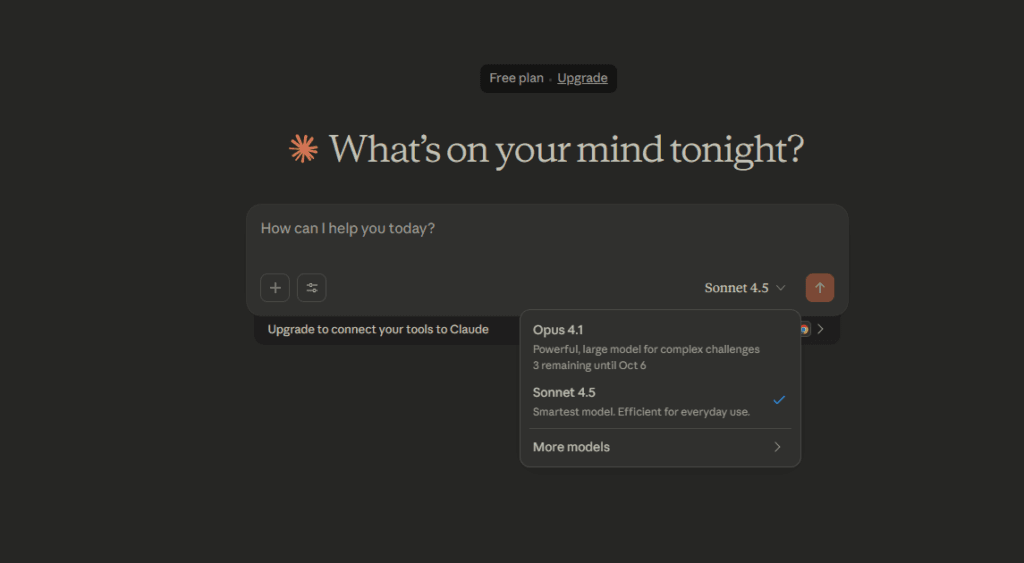
Available immediately via Claude API (claude-sonnet-4.5), Claude apps (web, iOS, Android), Claude Code with VS Code extension and terminal updates, and Claude Agent SDK for developers.
It maintains ASL-3 safety with improved classifiers and defenses against prompt injection.
Pricing remains $3 per million input tokens and $15 per million output tokens, same as Sonnet 4, with prompt caching and batch savings.
Integrated into Claude.ai for all paid users, with Max subscribers getting extras like Chrome extension and temporary previews.
Adopted widely in enterprise (ServiceNow, UK Government) and creative tools (Canva impacting 240M plus users), it represents a major leap for professional AI use in development, analysis, and automation.
Key Features
- Hybrid reasoning engine: Combines fast and deep thinking for superior agentic and long-task performance
- 1M token context support: Handles massive codebases or documents with high-compute modes
- Advanced coding excellence: Leads on SWE-bench Verified and internal editing benchmarks with zero errors in tests
- Computer use capabilities: Native control of browsers, apps, and OS-level tasks via screenshots and actions
- Agent SDK integration: Build autonomous agents with memory, permissions, and subagent coordination
- Claude Code 2.0 enhancements: Checkpoints, VS Code extension, parallel agents, and automation hooks
- Domain-specific knowledge: Strong gains in finance, cybersecurity, law, medicine, and STEM reasoning
- Extended autonomy: Maintains focus for 30 plus hours on multi-step projects without guidance
- Prompt caching and batch: Up to 90 percent savings on repeated prompts and 50 percent on large workloads
- Safety alignment: ASL-3 compliant with reduced false positives in CBRN classifiers and injection defenses
Price Plans
- Free ($0): Limited access to lighter Claude models; Sonnet 4.5 restricted or capped on free tier
- Claude Pro ($20/Month): Full access to Sonnet 4.5, higher limits, priority features, and apps
- API Usage ($3 input / $15 output per million tokens): Pay-per-use for developers; same as Sonnet 4 with caching/batch discounts
- Claude Max/Enterprise (Custom): Highest limits, previews, and team features for heavy or business use
Pros
- Top coding performance: Outperforms rivals on real-world benchmarks like SWE-bench and OSWorld
- Agentic leadership: Best for complex multi-step agents and computer interaction
- Cost-effective frontier: Same pricing as Sonnet 4 with major capability jumps
- Long-task reliability: Sustains hours-long autonomous operation with memory and checkpoints
- Developer-friendly: SDK, extensions, and API make it easy to integrate and build upon
- Enterprise adoption: Used by ServiceNow, UK Gov, Canva (240M plus impact), and more
- Balanced intelligence: Fast enough for everyday, deep for professional demands
Cons
- Paid access priority: Full capabilities require Claude paid plans or API usage
- High output costs: $15 per million output tokens can add up for verbose agents
- Compute-intensive modes: High-effort reasoning slower on complex queries
- No free unlimited: Free tier limited; Pro/Max needed for heavy use
- Knowledge cutoff: Not specified but likely mid-2025, missing very recent events
- Web/app reliant: No offline; requires internet for full features
- Potential verbosity: Extended thinking can produce longer traces
Use Cases
- Software engineering: Code generation, debugging, refactors, and full app building
- Agent development: Build autonomous multi-step agents with tool orchestration
- Computer use tasks: Browser automation, OS navigation, app interaction via screenshots
- Security and finance: Vulnerability analysis, financial modeling, compliance checks
- Research and analysis: Long-document synthesis, math/science reasoning, data tasks
- Productivity workflows: Spreadsheets, slides, reports with sustained focus
- Enterprise automation: Integrate via API for customer apps and internal tools
Target Audience
- Software developers and engineers: Needing top coding and agentic assistance
- AI agent builders: Creating complex autonomous systems and workflows
- Security and finance professionals: Domain-specific reasoning and analysis
- Researchers and analysts: Handling long-context and multi-step tasks
- Enterprises and teams: Scaling AI in production with API and integrations
- Productivity-focused users: Automating work with reliable long-running AI
How To Use
- Access on Claude.ai: Log into claude.ai; select Sonnet 4.5 from model picker (paid required for full access)
- API integration: Use Anthropic API with model 'claude-sonnet-4.5'; authenticate and set context up to 1M
- Prompt for agents: Use detailed instructions for multi-step tasks; enable computer use via tools
- Run Claude Code: Install VS Code extension or CLI; invoke Sonnet 4.5 for coding sessions
- Build agents: Use Agent SDK on developer platform for memory and subagents
- Refine outputs: Request checkpoints, rollbacks, or extended thinking for complex work
- Monitor usage: Track tokens and costs in API dashboard or Claude app
How we rated Claude Sonnet 4.5
- Performance: 4.9/5
- Accuracy: 4.8/5
- Features: 4.9/5
- Cost-Efficiency: 4.6/5
- Ease of Use: 4.7/5
- Customization: 4.8/5
- Data Privacy: 4.9/5
- Support: 4.6/5
- Integration: 4.8/5
- Overall Score: 4.8/5
Claude Sonnet 4.5 integration with other tools
- Claude API: Full developer access for custom apps, agents, and enterprise integrations
- VS Code Extension: Native Claude Code integration for IDE-based coding and debugging
- Amazon Bedrock: Hosted availability for secure enterprise deployment on AWS
- Snowflake Cortex AI: Integration for data cloud workflows and analytics
- Claude.ai Apps: Web, iOS, Android with seamless model selection and features
Best prompts optimised for Claude Sonnet 4.5
- Act as a senior software engineer. Build a full-stack web app for task management using React and Node.js, including authentication, database schema, and deployment instructions. Use computer use to test and debug as needed.
- Analyze this codebase [upload files]. Identify security vulnerabilities, suggest fixes with code patches, and explain reasoning step-by-step. Maintain focus for deep audit.
- Create a detailed financial model in spreadsheet format for startup valuation with DCF, scenarios, and sensitivity analysis. Output as executable Python or describe steps for Excel.
- You are an autonomous agent. Navigate to example.com, log in with credentials, scrape data from dashboard, summarize KPIs, and email results to [email protected]. Use tools and checkpoints.
- Solve this advanced math problem [insert IMO-level question] with chain-of-thought, verify each step, and provide proofs. Use extended thinking mode.
FAQs
Newly Added Tools







About Author