



Zelili AI

CogVLM2

GPT-4V Level Open-Source Multimodal Vision-Language Model – Advanced Image and Video Understanding with Llama3 Backbone
Tool Release Date

20 May 2024

Tool Users
N/A
0.0
๐Ÿ‘ 44

About This AI

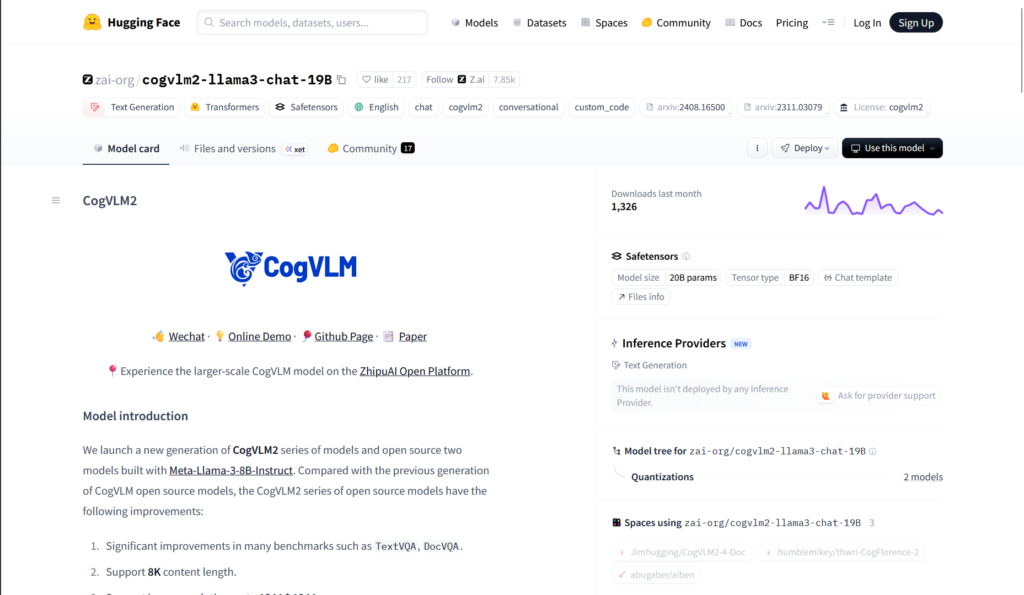
CogVLM2 is a new generation open-source multimodal model family from THUDM and Zhipu AI, built on Meta-Llama-3-8B-Instruct, achieving performance equivalent or superior to GPT-4V in many vision-language tasks.

The series includes image-focused models (CogVLM2-Llama3-Chat-19B English and bilingual Chinese-English versions) and video understanding variants (CogVLM2-Video).

It supports high-resolution images up to 1344×1344, 8K text context length, multi-turn dialogue, and pixel-only processing without external OCR.

Key strengths include exceptional OCR, document/chart understanding, visual question answering, and reasoning across TextVQA (84.2-85.0), DocVQA (92.3), ChartQA (81.0), OCRbench (756-780), and more.

CogVLM2-Video handles up to 1-minute videos via keyframe extraction, leading benchmarks like MVBench (62.3), VideoChatGPT-Bench (3.41), and zero-shot VideoQA.

Released in May 2024 (image models) with video additions in 2024/2025, it offers efficient Int4 quantization for 16GB VRAM inference, CLI/web demos, OpenAI-style API server, and PEFT fine-tuning examples.

Available on Hugging Face, ModelScope, and ZhipuAI platform for larger deployments, CogVLM2 emphasizes open-source accessibility for developers, researchers, and applications needing strong visual reasoning without proprietary dependencies.

Key Features

  1. High-resolution image understanding: Processes images up to 1344x1344 without external OCR tools
  2. Long context support: 8K token text length for detailed multi-turn dialogues
  3. Multilingual capabilities: English primary, bilingual Chinese-English variant available
  4. Video comprehension: CogVLM2-Video variant handles up to 1-minute clips via keyframe extraction
  5. Strong OCR and document analysis: Excels in TextVQA, DocVQA, ChartQA, and OCRbench
  6. Multi-turn dialogue: Supports conversational image/video question answering
  7. Efficient quantization: Int4 versions run on 16GB VRAM for accessible inference
  8. Deployment options: CLI, Chainlit web demo, OpenAI-format API server, multi-GPU support
  9. Fine-tuning support: PEFT-based examples for custom adaptation
  10. Benchmark leadership: Competitive with GPT-4V/Claude 3 on open multimodal tasks

Price Plans

  1. Free ($0): Full open-source access to models, code, weights, demos, and inference tools under Apache 2.0/Llama 3 license; no fees
  2. ZhipuAI Platform (Paid): Hosted larger-scale versions and API access via ZhipuAI Open Platform with token-based pricing

Pros

  1. GPT-4V competitive performance: Matches or exceeds on key vision-language benchmarks
  2. Fully open-source: Weights, code, and demos freely available under permissive license
  3. Efficient inference: Quantized models enable deployment on consumer hardware
  4. Multimodal versatility: Handles images, videos, multi-turn chat, and high-res inputs
  5. Strong community resources: Hugging Face integration, online demos, and active GitHub
  6. Video understanding excellence: SOTA on MVBench and VideoChatGPT-Bench for open models
  7. No external dependencies: Pixel-only processing for pure end-to-end capabilities

Cons

  1. Requires GPU for best speed: Full precision needs significant VRAM; quantization helps
  2. Setup complexity: Local inference involves dependencies and model download
  3. Video limited to short clips: Up to 1 minute via keyframes; not for long videos
  4. English focus stronger: Chinese variant good but primary model optimized for English
  5. No native mobile/edge support: Primarily server/desktop deployment
  6. Potential inference latency: High-res or video processing slower without optimization
  7. License restrictions: Complies with Llama 3 terms; some commercial use caveats

Use Cases

  1. Visual question answering: Answer complex questions about images or videos
  2. Document and chart analysis: Extract insights from PDFs, charts, tables without OCR
  3. OCR and text recognition: Read and understand text in natural images
  4. Video summarization and QA: Understand short clips and respond to temporal queries
  5. Multimodal research: Benchmarking or extending vision-language capabilities
  6. Content understanding: Captioning, grounding, or reasoning over visual data
  7. Developer integrations: Build apps with vision-language API or fine-tuned models

Target Audience

  1. AI researchers: Studying multimodal models and vision-language fusion
  2. Developers: Integrating vision understanding into applications
  3. Computer vision practitioners: Needing strong OCR/document/video analysis
  4. Open-source enthusiasts: Running or fine-tuning high-performance VLMs locally
  5. Students and educators: Learning about advanced multimodal AI
  6. Businesses: Exploring hosted versions via ZhipuAI for production use

How To Use

  1. Clone repo: git clone https://github.com/zai-org/CogVLM2
  2. Install dependencies: pip install requirements from repo
  3. Download model: Use Hugging Face (e.g., THUDM/cogvlm2-llama3-chat-19B)
  4. Run CLI demo: python basic_demo/cli_demo.py --model_path path/to/model --image_path example.jpg
  5. Quantize for efficiency: Add --quant 4 for Int4 version on lower VRAM
  6. Launch web demo: cd basic_demo && chainlit run web_demo.py
  7. For video: Use video_demo scripts with video path and query

How we rated CogVLM2

  • Performance: 4.8/5
  • Accuracy: 4.7/5
  • Features: 4.6/5
  • Cost-Efficiency: 5.0/5
  • Ease of Use: 4.4/5
  • Customization: 4.8/5
  • Data Privacy: 4.9/5
  • Support: 4.5/5
  • Integration: 4.7/5
  • Overall Score: 4.7/5

CogVLM2 integration with other tools

  1. Hugging Face: Direct model download and inference pipelines for easy use
  2. ModelScope: Alternative hosting from ZhipuAI for Chinese users
  3. Chainlit: Web demo framework for quick interactive interfaces
  4. TGI (Text Generation Inference): Optimized weights for fast server deployment
  5. PEFT: Efficient fine-tuning support for custom adaptations

Best prompts optimised for CogVLM2

  1. Describe this image in detail, including all visible text, objects, and scene context: [upload image]
  2. Answer the question based on the image: What is the main subject doing, and what text is visible? [upload image] [question]
  3. Perform OCR on this document image and summarize the key points: [upload scanned page]
  4. Analyze this chart: What trends do you see, and what conclusions can be drawn? [upload chart image]
  5. Watch this short video and answer: What happened at timestamp 0:15? [upload video clip]
CogVLM2 delivers GPT-4V competitive multimodal performance in an open-source package, excelling in image/video understanding, OCR, and reasoning. With efficient quantization and strong benchmarks, it’s ideal for developers and researchers seeking powerful vision-language capabilities without proprietary costs. Setup is technical but rewarding for local deployment.

FAQs

  • What is CogVLM2?

    CogVLM2 is an open-source multimodal vision-language model family based on Llama3-8B, achieving GPT-4V level performance in image and video understanding tasks.

  • When was CogVLM2 released?

    The image models were released on May 20, 2024, with video variants and updates following in 2024-2025.

  • Is CogVLM2 free to use?

    Yes, fully open-source with weights and code available on Hugging Face under permissive license; no fees for local use.

  • What are the key models in CogVLM2?

    Main variants include cogvlm2-llama3-chat-19B (English), cogvlm2-llama3-chinese-chat-19B (bilingual), and CogVLM2-Video for video tasks.

  • What hardware does CogVLM2 require?

    Int4 quantized versions run on 16GB VRAM GPUs; full precision needs more powerful hardware for optimal speed.

  • Does CogVLM2 support video understanding?

    Yes, CogVLM2-Video processes up to 1-minute videos via keyframe extraction, leading on MVBench and VideoChatGPT benchmarks.

  • How does CogVLM2 compare to GPT-4V?

    It matches or exceeds GPT-4V on many benchmarks like DocVQA (92.3), TextVQA (84-85), and OCR tasks while being fully open-source.

  • Where can I try CogVLM2 online?

    Online demos available at cogvlm2-online.cogviewai.cn:7861 (image) and :7868 (video); also via ZhipuAI platform.


Newly Added Toolsโ€‹

Qwen-Image-2.0

$0/Month

Qodo AI

$0/Month

Codiga

$10/Month

Tabnine

$59/Month
CogVLM2 Alternatives

Cognosys AI

$0/Month

AI Perfect Assistant

$17/Month

Intern-S1-Pro

$0/Month

CogVLM2 Reviews

0.0
0.0 out of 5 stars (based on 0 reviews)
Excellent0%
Very good0%
Average0%
Poor0%
Terrible0%

There are no reviews yet. Be the first one to write one.