



Zelili AI

D4RT

Unified Fast 4D Scene Reconstruction and Tracking – Enabling AI to Perceive Dynamic Worlds in Space and Time
Tool Users
N/A
0.0
๐Ÿ‘ 148

About This AI

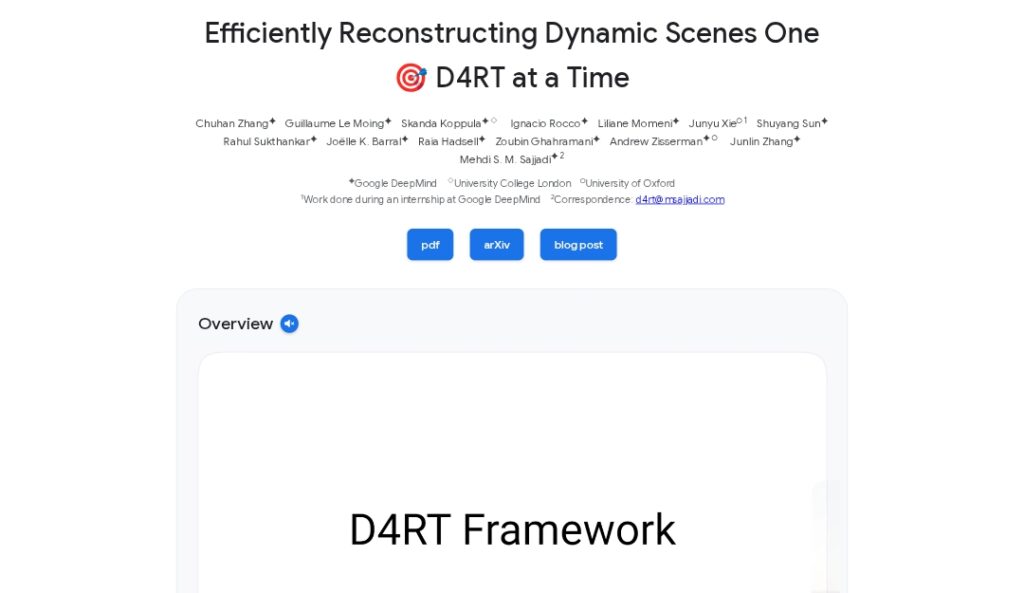
D4RT (Dynamic 4D Reconstruction and Tracking) is a groundbreaking unified AI model from Google DeepMind that enables machines to understand dynamic scenes captured in 2D videos by reconstructing a coherent 4D representation (3D space plus time).

It disentangles camera motion, object motion, and static geometry in a single feedforward process, providing a flexible query-based interface to answer questions like ‘Where is a given pixel located in 3D space at any time from any camera viewpoint?’.

Built on a Transformer encoder-decoder architecture, D4RT compresses input videos into a compact latent representation and uses lightweight querying for parallel, efficient inference across multiple 4D tasks.

Capabilities include all-pixels 3D point tracking (even through occlusions), point cloud reconstruction at arbitrary time steps, long-term prediction, and camera pose estimation, all from monocular video without heavy optimization.

It processes one-minute videos in roughly 5 seconds on a single TPU (up to 300x faster than prior SOTA methods), achieves state-of-the-art results on benchmarks like MPI Sintel (complex motion), Aria Digital Twin (household ego-motion), and RE10k (diverse scenes), and excels at handling fast motion blur, non-rigid deformation, occlusions, and dynamic objects.

Announced January 22, 2026, D4RT advances toward robust world models for AI, with strong potential in robotics (spatial awareness for navigation/manipulation), augmented reality (low-latency scene understanding), and broader perception for physical intelligence.

While not open-source or publicly available yet, the technical report is on arXiv, and the project page offers visuals and comparisons.

Key Features

  1. Unified query interface: Single encoder-decoder handles multiple 4D tasks via flexible pixel queries
  2. All-pixels 3D tracking: Predicts 3D trajectories for every pixel across time, even occluded
  3. Point cloud reconstruction: Generates accurate 3D structure at any frozen time and viewpoint
  4. Camera pose estimation: Recovers full camera trajectory by aligning 3D snapshots
  5. Long-term prediction: Maintains coherent future scene understanding beyond input frames
  6. High efficiency: Processes 1-minute video in 5 seconds on single TPU (18x to 300x faster than SOTA)
  7. Robust to dynamics: Handles fast motion blur, non-rigid deformation, occlusions, and object motion
  8. Feedforward architecture: No iterative optimization needed for inference
  9. Disentangled representation: Separates camera, object motion, and static geometry

Price Plans

  1. Research/Non-Commercial ($0): Announced as a research model with no public access or pricing; technical report free on arXiv
  2. Potential Future Enterprise (Custom): DeepMind may offer access via API or partnerships (not available yet)

Pros

  1. Extreme speed gains: Up to 300x faster inference than previous dynamic 4D methods
  2. Superior benchmark performance: SOTA on MPI Sintel, Aria Digital Twin, RE10k for tracking and reconstruction
  3. Unified flexible interface: One model for tracking, reconstruction, pose estimation without task-specific heads
  4. Handles complex dynamics: Robust to occlusions, fast motion, non-rigid objects, and ego-motion
  5. Advances world models: Step toward AI with true 4D physical understanding for robotics and AR
  6. Research impact potential: Enables safer robotics, better AR overlays, and physical intelligence progress

Cons

  1. Not publicly available: No code, weights, or demo released as of announcement
  2. Research-stage only: Focused on academic benchmarks; real-world deployment not yet demonstrated
  3. Compute-intensive training: Likely requires massive resources (though inference is efficient)
  4. Limited to monocular video: Relies on single-view input without depth sensors
  5. No open-source access: Unlike many DeepMind releases, no GitHub or Hugging Face repo mentioned
  6. Early announcement: Full capabilities and limitations still under exploration

Use Cases

  1. Robotics navigation: Enable robots to perceive and predict dynamic environments with moving objects
  2. Augmented reality overlays: Provide low-latency 4D scene understanding for accurate digital object placement
  3. Autonomous systems simulation: Reconstruct 4D scenes for testing and training in varied conditions
  4. Video analysis and editing: Track objects in motion, estimate camera paths, or predict future frames
  5. Physical world modeling: Build toward AI agents with true spatiotemporal awareness
  6. Research in perception: Advance dynamic scene understanding and world models for AGI

Target Audience

  1. Robotics researchers and engineers: Needing fast, accurate 4D perception for real-world interaction
  2. AR/VR developers: Requiring low-latency dynamic scene reconstruction for immersive experiences
  3. Computer vision scientists: Exploring unified models for tracking, reconstruction, and pose estimation
  4. Autonomous vehicle teams: Simulating complex dynamic environments from video
  5. AI research community: Studying advances in world models and spatiotemporal understanding
  6. DeepMind collaborators: Potential access through partnerships or future releases

How To Use

  1. Read the blog: Visit deepmind.google/blog/d4rt-teaching-ai-to-see-the-world-in-four-dimensions for overview and visuals
  2. Review paper: Access technical report at arXiv.org/abs/2512.08924 for architecture and results
  3. Explore project page: Check d4rt-paper.github.io for demos, videos, and comparisons
  4. Wait for potential release: Monitor DeepMind announcements for code, weights, or API availability
  5. Reproduce results: Use described querying mechanism if/when implementation released
  6. Apply in research: Reference D4RT baselines for new 4D reconstruction or tracking work

How we rated D4RT

  • Performance: 4.9/5
  • Accuracy: 4.8/5
  • Features: 4.7/5
  • Cost-Efficiency: 4.5/5
  • Ease of Use: 3.5/5
  • Customization: 4.2/5
  • Data Privacy: 4.0/5
  • Support: 4.0/5
  • Integration: 4.3/5
  • Overall Score: 4.4/5

D4RT integration with other tools

  1. Research Frameworks: Potential compatibility with computer vision libraries like PyTorch or JAX for reproduction/experiments
  2. Simulation Environments: Designed for integration with robotics sims (e.g., MuJoCo, Isaac Sim) for dynamic perception testing
  3. AR/VR Platforms: Future low-latency 4D understanding suitable for Unity/Unreal Engine plugins
  4. Video Processing Pipelines: Could feed into tools like OpenCV or FFmpeg for preprocessing input videos
  5. DeepMind Ecosystem: Likely ties into broader Google AI research tools and datasets

Best prompts optimised for D4RT

  1. N/A - D4RT is a research model for 4D scene reconstruction from video input, not a text-to-video or prompt-based generative tool. It processes existing videos to query 3D positions over time, without user text prompts for content creation.
  2. N/A - This is a unified feedforward model for dynamic scene understanding; usage involves feeding monocular video and querying specific points/time/camera views, not descriptive prompts.
  3. N/A - No generative prompting interface; it's designed for reconstruction and tracking tasks from video data directly.
D4RT from Google DeepMind is a breakthrough in efficient 4D scene understanding, unifying reconstruction and tracking up to 300x faster than prior methods with SOTA results on key benchmarks. While currently research-only without public access, it advances robotics, AR, and world models significantly. Exciting potential once available for real-world applications.

FAQs

  • What is D4RT?

    D4RT (Dynamic 4D Reconstruction and Tracking) is a unified AI model from Google DeepMind that reconstructs dynamic 4D scenes (3D space plus time) from monocular video, disentangling camera and object motion efficiently.

  • When was D4RT announced?

    D4RT was introduced by Google DeepMind on January 22, 2026, via their official blog post.

  • Is D4RT open-source or publicly available?

    No, D4RT is currently a research model with no code, weights, or public demo released; only the technical report and project page are available.

  • How fast is D4RT compared to previous methods?

    It processes one-minute videos in about 5 seconds on a single TPU, up to 300x faster than prior state-of-the-art approaches.

  • What tasks does D4RT support?

    It enables all-pixels 3D tracking, point cloud reconstruction, camera pose estimation, and long-term prediction through a single query interface.

  • What are D4RT’s main applications?

    Primarily robotics (dynamic navigation/manipulation), augmented reality (low-latency scene understanding), and advancing AI world models for physical perception.

  • What benchmarks does D4RT excel on?

    It achieves SOTA on MPI Sintel (complex motion), Aria Digital Twin (ego-motion/occlusions), and RE10k (diverse scenes) for 4D reconstruction and tracking.

  • Who developed D4RT?

    D4RT was developed by Google DeepMind researchers Guillaume Le Moing and Mehdi S. M. Sajjadi.

Newly Added Toolsโ€‹

CodeRabbit

$0/Month

Code Genius

$0/Month

AskCodi

$20/Month

PearAI

$0/Month
D4RT Alternatives

Seedance 2.0

$0/Month

VideoGen

$12/Month

WUI.AI

$10/Month

D4RT Reviews

0.0
0.0 out of 5 stars (based on 0 reviews)
Excellent0%
Very good0%
Average0%
Poor0%
Terrible0%

There are no reviews yet. Be the first one to write one.