
What is GlimpRouter?
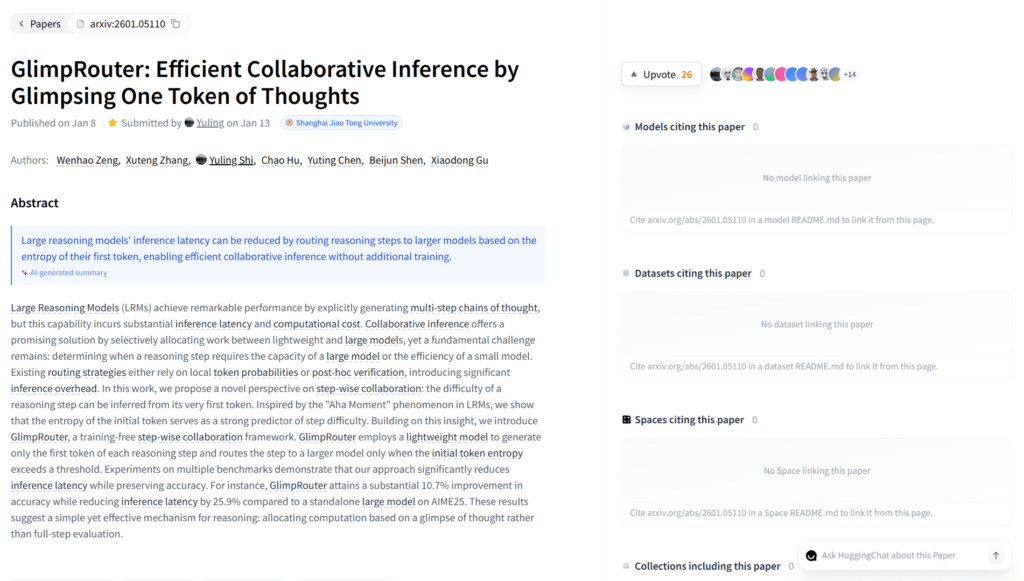
GlimpRouter is a training-free collaborative inference framework that routes reasoning steps between small and large models based on the entropy of the first generated token, improving efficiency in LRMs.
When was GlimpRouter released?
The paper introducing GlimpRouter was published on arXiv on January 8, 2026, with code released shortly after.
Is GlimpRouter free to use?
Yes, it is fully open-source with code available on GitHub under a permissive license; no costs for use or modification.
How does GlimpRouter work?
It lets a lightweight model generate the first token of each step, computes its entropy, and routes to the large model only if entropy is high (indicating difficulty).
What performance gains does GlimpRouter provide?
On AIME25 benchmark, it achieves 10.7 percent higher accuracy and 25.9 percent lower latency compared to standalone large model inference.
Where can I find the GlimpRouter code?
The official code repository is at github.com/Zengwh02/GlimpRouter, including implementation details and examples.
Who created GlimpRouter?
It was developed by researchers including Wenhao Zeng, Xuteng Zhang, and others affiliated with academic institutions like Shanghai Jiao Tong University.
What models can use GlimpRouter?
It is model-agnostic and works with various large reasoning models paired with a small lightweight one; no specific fine-tuning needed.

GlimpRouter

About This AI
GlimpRouter is a lightweight, training-free framework for collaborative inference in Large Reasoning Models (LRMs), introduced in a January 2026 arXiv paper.
It optimizes multi-step chain-of-thought reasoning by routing difficult steps to a large model while handling easy ones with a small lightweight model.
The core innovation is using the entropy of the very first token generated in each reasoning step as a difficulty signal: low entropy means confidence/easy (continue with small model), high entropy means uncertainty/hard (route to large model).
This ‘glimpsing’ mechanism avoids full-step computation on the large model for simple parts, significantly reducing latency and cost while preserving or even improving accuracy.
The approach is inspired by the ‘Aha Moment’ phenomenon where models suddenly gain confidence after initial uncertainty.
No additional training or fine-tuning is required; it works plug-and-play on existing models.
Benchmarks on AIME25 show 10.7 percent accuracy improvement and 25.9 percent latency reduction compared to standalone large model use.
Code is open-sourced on GitHub under the repository Zengwh02/GlimpRouter, making it accessible for developers and researchers to implement and experiment with.
As a research framework rather than a hosted product, it targets efficiency in agentic and long-reasoning workflows, particularly useful for cost-sensitive deployments or edge scenarios.
Affiliated with academic contributors (Shanghai Jiao Tong University and others), it represents a step toward more economical compound AI systems.
Key Features
- Training-free step-wise routing: No model fine-tuning needed; plug-and-play on existing LLMs
- First-token entropy routing: Uses entropy of initial token to decide difficulty and route to large/small model
- Collaborative inference: Lightweight model handles easy steps; large model only for hard ones
- Latency and cost reduction: Significantly lowers inference time and compute without accuracy loss
- Accuracy preservation or gain: Can improve overall performance by allocating compute smarter
- Simple implementation: Open-source code available for easy integration into LLM pipelines
- General applicability: Works with various LRMs for multi-step reasoning tasks
- Aha moment exploitation: Leverages model confidence patterns for efficient routing
Price Plans
- Free ($0): Fully open-source code and framework under permissive license; no costs for use, modification, or deployment
Pros
- Significant efficiency gains: 25.9 percent latency reduction on AIME25 benchmark
- Accuracy boost: 10.7 percent improvement in reasoning performance
- Zero training overhead: No need for retraining or adapters; immediate use
- Open-source and accessible: Full code on GitHub for experimentation and deployment
- Cost-effective for inference: Reduces large model calls, ideal for API-heavy or edge use
- Simple yet effective: Relies on a single entropy metric for smart routing
- Generalizable: Applicable to many chain-of-thought and agentic setups
Cons
- Research-stage tool: Not a production-ready hosted service; requires custom implementation
- Requires two models: Needs both small and large LLMs to run collaboratively
- Entropy threshold tuning: May need manual calibration for optimal performance per model pair
- Limited benchmarks: Primarily evaluated on AIME25; broader testing ongoing
- No hosted demo: Users must set up locally or via own infrastructure
- Potential edge cases: Very ambiguous first tokens may lead to suboptimal routing
- No user stats: As a recent academic release, no widespread adoption numbers
Use Cases
- Multi-step reasoning optimization: Speed up complex math, coding, or logic problems
- Cost-sensitive LLM deployments: Reduce API calls and tokens in production agents
- Edge and low-resource inference: Enable large-model quality on constrained hardware
- Agentic workflows: Improve efficiency in long-horizon task planning
- Research and experimentation: Test collaborative inference ideas on various models
- Hybrid model pipelines: Combine small/fast and large/accurate LLMs intelligently
- Academic benchmarking: Extend or compare with other routing methods
Target Audience
- AI researchers: Studying efficient inference and collaborative systems
- LLM developers: Optimizing reasoning chains for production or research
- Cost-conscious teams: Reducing inference expenses in agentic apps
- Edge AI practitioners: Running high-quality reasoning on limited resources
- Open-source contributors: Building upon or extending the framework
- Students and academics: Exploring metacognition and entropy in LLMs
How To Use
- Visit GitHub: Go to github.com/Zengwh02/GlimpRouter for code and README
- Clone repo: Download or clone the repository locally
- Install dependencies: Set up required libraries (likely PyTorch, transformers, etc.)
- Prepare models: Load a small lightweight model and a large reasoning model
- Configure threshold: Set entropy threshold for routing decisions
- Run inference: Feed prompt to GlimpRouter pipeline for collaborative generation
- Evaluate outputs: Compare latency, cost, and accuracy against baseline
How we rated GlimpRouter
- Performance: 4.6/5
- Accuracy: 4.7/5
- Features: 4.4/5
- Cost-Efficiency: 4.9/5
- Ease of Use: 4.2/5
- Customization: 4.5/5
- Data Privacy: 5.0/5
- Support: 4.1/5
- Integration: 4.3/5
- Overall Score: 4.5/5
GlimpRouter integration with other tools
- Hugging Face Transformers: Compatible with standard LLM loading and inference pipelines
- GitHub Repository: Full open-source code for custom integrations and extensions
- PyTorch Ecosystem: Built on PyTorch for seamless use with existing LLM stacks
- Local Inference Servers: Can be integrated into vLLM, TGI, or other serving frameworks
- Agent Frameworks: Potential plug-in for LangChain, LlamaIndex, or AutoGen for efficient routing
Best prompts optimised for GlimpRouter
- N/A - GlimpRouter is a routing framework for LLM inference, not a generative tool requiring user prompts. It operates on existing reasoning prompts by glimpsing first tokens.
- N/A - This is a backend inference optimization method; no direct user-facing prompts needed. It automatically applies to chain-of-thought or multi-step LLM queries.
- N/A - The system works transparently on any complex reasoning task prompt passed to the large model.
FAQs
Newly Added Tools




About Author