



Zelili AI

GLM-4.7 Flash

Fast and Efficient 30B MoE Open-Weight Model – Top-Tier Coding, Reasoning, and Agentic Performance in Lightweight Deployment
Tool Release Date

19 Jan 2026

Tool Users
N/A
0.0
๐Ÿ‘ 40

About This AI

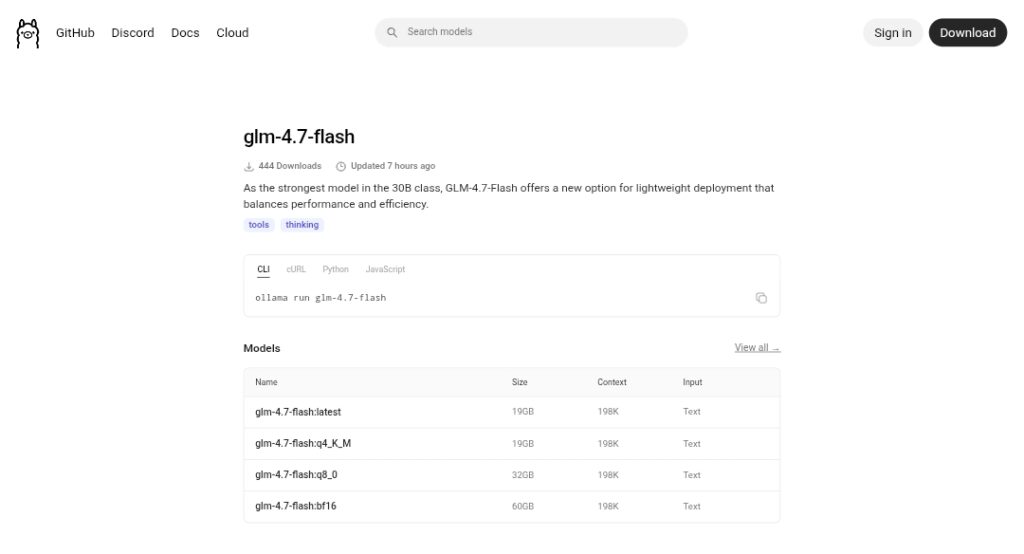
GLM-4.7 Flash is a high-performance, open-weight Mixture-of-Experts (MoE) language model from Z.ai (Zhipu AI), released on January 19, 2026, as a speed-optimized variant in the GLM-4.7 series.

With approximately 30 billion total parameters but only about 3 billion active per token, it delivers exceptional efficiency, low-latency inference, and strong capabilities in coding, agentic workflows, tool use, reasoning, and general chat tasks.

It achieves open-source state-of-the-art results in the 30B class on benchmarks like SWE-bench Verified, GPQA, AIME, LCB v6, and ฯ„ยฒ-Bench, often outperforming similarly sized models and competing closely with larger dense ones.

Key strengths include enhanced programming (frontend/backend excellence), long-context handling up to 200K tokens, stable multi-step reasoning, natural conversational tone, and superior tool invocation.

Fully open weights under MIT license on Hugging Face (zai-org/GLM-4.7-Flash), it supports easy local deployment via Transformers, vLLM, SGLang, and frameworks like Unsloth for fine-tuning.

The model offers unlimited free API access through Z.ai (no credit card required), zero-cost inference for many users, and is ideal for developers seeking fast, capable local or cloud AI without heavy compute.

Popular for coding assistants, agentic applications, UI generation, creative writing, Chinese/English tasks, translation, and role-playing, with strong community adoption since launch.

Key Features

  1. 30B MoE architecture with 3B active: Efficient inference activating only a fraction of parameters for speed and low resource use
  2. 200K token context window: Handles long documents, codebases, conversations, and complex tasks without truncation
  3. Superior coding capabilities: Excels in frontend/backend development, agentic coding, tool use, and benchmarks like SWE-bench
  4. Strong reasoning and agentic performance: Multi-step planning, tool invocation, error recovery, and stable execution
  5. Multilingual excellence: High performance in English and Chinese, including writing, translation, and role-playing
  6. Low-latency inference: Designed for responsive UI assistants, chat, and real-time applications
  7. Open weights and free API: MIT license with unlimited free access via Z.ai API (no card needed) and local deployment
  8. Support for major frameworks: Transformers, vLLM, SGLang, Unsloth fine-tuning, speculative decoding (mtp, EAGLE)
  9. Chat template and tool parsers: Built-in support for glm47/glm45 parsers and conversational formatting
  10. High benchmark leadership: SOTA in 30B class on GPQA, AIME, LCB, ฯ„ยฒ-Bench, and more

Price Plans

  1. Free ($0): Unlimited free local inference (open weights), zero-cost API access via Z.ai (no card required), full model capabilities without limits
  2. Cloud/Enterprise (Custom): Potential premium hosted options or scaled API through Z.ai partners (not primary focus)

Pros

  1. Best-in-class 30B performance: Outperforms GPT-OSS-20B and similar models in reasoning, coding, and efficiency
  2. Extremely cost-effective: Completely free local use and unlimited API access without credits or payment
  3. Fast and lightweight: Low active parameters enable quick inference on consumer hardware
  4. Strong open-source ecosystem: Easy Hugging Face integration, community fine-tunes, and quantizations
  5. Versatile for agents and coding: Native tool calling, long-horizon planning, and programming excellence
  6. Multilingual strength: Balanced English/Chinese capabilities with natural tone
  7. Rapid community adoption: Quick popularity on Hugging Face with high downloads since January 2026 launch

Cons

  1. Requires decent hardware for best speed: Optimal real-time use needs good GPU despite efficiency
  2. Smaller active params trade-off: May lag behind much larger dense models on ultra-complex reasoning
  3. Recent release: Limited long-term user data and third-party benchmarks at early stage
  4. English/Chinese focus: Other languages may not perform as strongly
  5. No hosted playground emphasis: Primarily for local/API devs; less plug-and-play for casual users
  6. Potential output verbosity: Reasoning modes can produce longer responses unless tuned
  7. Setup for local: Needs dependencies and config for optimal deployment

Use Cases

  1. Coding assistance: Frontend/backend development, debugging, refactoring, and agentic code workflows
  2. AI agents and tool use: Building autonomous agents with reliable planning and external tool calling
  3. Local AI deployment: Running fast, capable LLM on consumer hardware without cloud costs
  4. Creative and role-playing: Natural conversations, writing, translation, and character interactions
  5. Research and fine-tuning: Experimenting with MoE models, quantizations, and domain adaptation
  6. UI generation: Producing frontend code and designs with strong aesthetic understanding
  7. High-volume inference: Batch processing, chatbots, or classification needing speed and efficiency

Target Audience

  1. Developers and coders: Seeking powerful local coding companion for everyday programming
  2. AI researchers and tinkerers: Exploring open MoE models and agentic capabilities
  3. Indie makers and startups: Building apps with free, high-performance LLM inference
  4. Chinese/English bilingual users: Needing strong multilingual reasoning and generation
  5. Local AI enthusiasts: Running frontier-class models on personal hardware
  6. Agent framework builders: Integrating tool use and multi-step execution

How To Use

  1. Download from Hugging Face: Visit huggingface.co/zai-org/GLM-4.7-Flash and get model weights
  2. Install framework: Use pip install transformers or vllm for fast inference
  3. Load model: from transformers import AutoModelForCausalLM; model = AutoModelForCausalLM.from_pretrained('zai-org/GLM-4.7-Flash')
  4. Generate text: Use pipeline or direct generate with chat template for conversations
  5. Run locally fast: Use vLLM or Unsloth for optimized speed on GPU
  6. Try free API: Access via Z.ai API (no signup/card) for cloud testing
  7. Fine-tune: Use Unsloth or standard scripts for domain-specific adaptation

How we rated GLM-4.7 Flash

  • Performance: 4.8/5
  • Accuracy: 4.7/5
  • Features: 4.6/5
  • Cost-Efficiency: 5.0/5
  • Ease of Use: 4.5/5
  • Customization: 4.7/5
  • Data Privacy: 5.0/5
  • Support: 4.4/5
  • Integration: 4.6/5
  • Overall Score: 4.7/5

GLM-4.7 Flash integration with other tools

  1. Hugging Face Transformers: Direct loading and inference with standard pipeline for easy use
  2. vLLM and SGLang: High-throughput serving and optimized inference engines
  3. Unsloth: Fast fine-tuning and quantization support for local hardware
  4. Z.ai Free API: Unlimited cloud access without payment for quick testing
  5. Local Frameworks: Compatible with Ollama, LM Studio, or custom agents for deployment

Best prompts optimised for GLM-4.7 Flash

  1. Write a complete React component for a responsive dashboard with charts, sidebar, and dark mode toggle. Include TypeScript types and Tailwind CSS styling.
  2. You are a senior software engineer. Plan and implement a full REST API backend in Python FastAPI for a todo app with user auth, PostgreSQL integration, and JWT tokens.
  3. Step by step, solve this LeetCode hard problem: [paste problem description]. Think aloud, write clean code, and explain time/space complexity.
  4. Generate a detailed fantasy story in Chinese about a young cultivator discovering an ancient artifact, with vivid descriptions and emotional depth.
  5. Act as a creative writing assistant. Help me role-play a conversation between two sci-fi characters debating AI ethics in a futuristic setting.
GLM-4.7 Flash stands out as a top open-weight 30B-class model, delivering exceptional coding, reasoning, and agentic performance at high speed and zero cost. Its MoE efficiency enables local deployment on consumer hardware, while free unlimited API access broadens reach. Ideal for developers wanting powerful, fast AI without subscriptions or heavy compute.

FAQs

  • What is GLM-4.7 Flash?

    GLM-4.7 Flash is a 30B MoE open-weight model from Z.ai (Zhipu AI), released January 19, 2026, optimized for fast inference, coding, agentic tasks, reasoning, and chat with only 3B active parameters.

  • Is GLM-4.7 Flash free to use?

    Yes, completely free: open weights on Hugging Face under MIT license, unlimited free API access via Z.ai (no card required), and local deployment with no costs.

  • When was GLM-4.7 Flash released?

    It was officially announced and released on January 19, 2026, with weights available shortly after on Hugging Face.

  • What are the key features of GLM-4.7 Flash?

    30B total / 3B active MoE for speed, 200K context, SOTA 30B-class performance in coding/agentic benchmarks, strong English/Chinese support, tool use, and low-latency inference.

  • How does GLM-4.7 Flash compare to other models?

    It outperforms similar-sized models like GPT-OSS-20B in reasoning/coding, offers better efficiency than larger dense models, and provides free unlimited access unlike paid APIs.

  • Can I run GLM-4.7 Flash locally?

    Yes, fully supported on consumer GPUs via Transformers, vLLM, Unsloth, etc., with optimized inference and fine-tuning options.

  • What context window does GLM-4.7 Flash have?

    Up to 200,000 tokens, enabling long-document analysis, extended conversations, and complex codebases.

  • Who is GLM-4.7 Flash best for?

    Developers needing fast local coding agents, researchers experimenting with open MoE, indie makers building apps, and users wanting high-performance AI without costs.


Newly Added Toolsโ€‹

Qodo AI

$0/Month

Codiga

$10/Month

Tabnine

$59/Month

CodeRabbit

$0/Month
GLM-4.7 Flash Alternatives

Cognosys AI

$0/Month

AI Perfect Assistant

$17/Month

Intern-S1-Pro

$0/Month

GLM-4.7 Flash Reviews

0.0
0.0 out of 5 stars (based on 0 reviews)
Excellent0%
Very good0%
Average0%
Poor0%
Terrible0%

There are no reviews yet. Be the first one to write one.