
What is GLM Image?
GLM Image is Zhipu AI’s open-source auto-regressive image generation model, excelling in high-fidelity text rendering, knowledge-intensive scenarios, and image editing tasks like style transfer and identity preservation.
When was GLM Image released?
GLM Image was officially released on January 14, 2026, with weights and code made available on Hugging Face.
Is GLM Image free to use?
Yes, the model is fully open-source for local/self-hosted use at no cost; API generation via Z.AI platform costs approximately $0.015 per image.
What makes GLM Image different from diffusion models?
It uses a hybrid auto-regressive architecture for superior text accuracy, semantic understanding, and complex information expression while matching general quality of latent diffusion approaches.
Does GLM Image support image editing?
Yes, it handles image-to-image tasks including editing, style transfer, identity-preserving generation, and multi-subject consistency with efficient reference preservation.
How much does GLM Image cost via API?
Pricing is usage-based at around $0.015 per standard-resolution image; no subscription required, only pay for generations used.
Is GLM Image good for text in images?
It excels particularly in text-rendering, achieving top open-source scores on benchmarks like CVTG-2k and LongText-Bench for accurate and coherent embedded text.
Where can I access GLM Image?
Download weights from Hugging Face (zai-org/GLM-Image) for local use, or generate via Z.AI API at open.bigmodel.cn.

GLM Image

About This AI
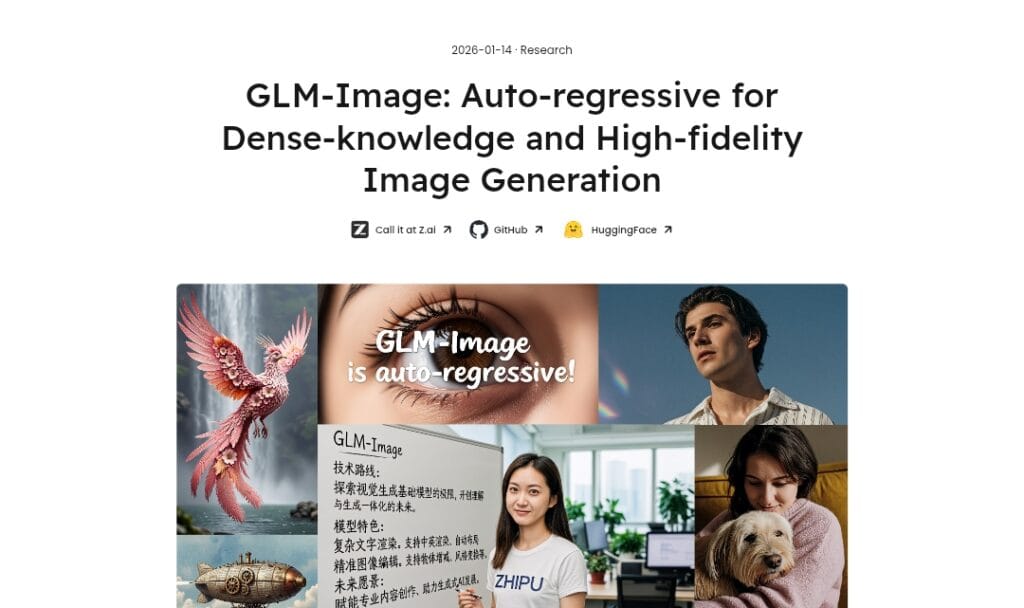
GLM Image is the first open-source, industrial-grade discrete auto-regressive image generation model from Zhipu AI, released on January 14, 2026.
It employs a hybrid architecture combining a 9B-parameter autoregressive generator (initialized from GLM-4-9B-0414) with a 7B-parameter single-stream DiT diffusion decoder for high-fidelity latent-space decoding.
The model excels in text-to-image and image-to-image tasks, including editing, style transfer, identity-preserving generation, and multi-subject consistency.
It demonstrates strong advantages in text-rendering, knowledge-intensive scenarios, precise semantic understanding, complex information expression, and fine-grained detail generation.
GLM Image aligns with mainstream latent diffusion models in general quality but outperforms in tasks requiring dense knowledge and accurate alignment.
It uses semantic-VQ tokenization for better semantic correlation, progressive generation for controllable high-resolution outputs, and decoupled reinforcement learning (GRPO) with rewards for aesthetics, OCR accuracy, VLM semantics, perceptual similarity, and detail scoring.
Additional enhancements include lightweight Glyph-byT5 for Chinese text rendering and block-causal attention for efficient image editing.
Benchmarks show top performance among open-source models on CVTG-2k (NED 0.9557, Word Accuracy 0.9116), LongText-Bench, OneIG, DPG Bench, and TIFF Bench.
Fully open-source on Hugging Face with weights and code available, it integrates with Z.AI API for generation (pricing per image) and supports developers via open platform.
Ideal for creators needing precise text in images, knowledge-heavy visuals, editing tasks, and high-quality generation without proprietary restrictions.
Key Features
- Hybrid auto-regressive architecture: Combines 9B autoregressive generator with 7B diffusion decoder for high-fidelity outputs
- Text-to-image generation: Produces detailed images from textual descriptions with strong prompt adherence
- Image-to-image capabilities: Supports editing, style transfer, identity preservation, and multi-subject consistency
- Superior text rendering: Excels at accurate text integration in images, including complex Chinese characters via Glyph-byT5
- Knowledge-intensive performance: Handles dense information, semantic understanding, and precise expression better than many diffusion models
- Progressive high-resolution generation: Controllable scaling with semantic-VQ tokenization for better correlation
- Decoupled reinforcement learning: GRPO post-training with rewards for aesthetics, OCR, semantics, and detail quality
- Block-causal attention for editing: Efficient reference preservation in image modification tasks
- Open-source availability: Full weights, code, and inference support on Hugging Face
- API integration: Accessible via Z.AI platform for programmatic generation
Price Plans
- Free ($0): Open-source model weights and code available for local/self-hosted use under permissive license; no cost for downloading/running personally
- Z.AI API (Pay-per-use): Approximately $0.015 per generated image (standard resolution); no subscription required, billed per usage
- Enterprise/Custom: Higher volume or dedicated access options available through Zhipu AI platform (details on request)
Pros
- Leading open-source text rendering: Tops benchmarks for text accuracy and knowledge-intensive tasks
- Strong semantic alignment: Precise understanding and expression of complex prompts
- Fully open weights: Apache/MIT-like access for free use, fine-tuning, and deployment
- Competitive with diffusion models: Matches or exceeds in specialized areas while being autoregressive
- Industrial-grade quality: Designed for real-world high-fidelity applications
- Chinese text excellence: Native advantages in multilingual scenarios including dense Chinese content
- API affordability: Low per-image cost via Z.AI platform for scalable use
Cons
- API pay-per-image: No unlimited free tier; costs accumulate for high volume
- Requires API or local setup: No simple hosted web playground mentioned
- Recent release: Limited independent benchmarks and community integrations yet
- Hardware needs for local: Large model size demands significant GPU resources for inference
- Focus on text/knowledge: May not lead in pure artistic/aesthetic generation vs some diffusion leaders
- No native mobile/desktop app: Primarily API and code-based access
- Potential latency: Autoregressive nature may be slower than optimized diffusion for some tasks
Use Cases
- Infographic and diagram creation: Generate images with accurate embedded text, charts, or data visualizations
- Product mockups and design: Create high-fidelity visuals with precise labels, branding, or instructions
- Multilingual content: Strong Chinese/English text rendering for educational or marketing materials
- Image editing tasks: Style transfer, object addition/removal, or identity-preserving modifications
- Knowledge visualization: Illustrate complex concepts, scientific explanations, or technical documentation
- Creative prototyping: Rapid iteration on ideas requiring accurate semantic and textual elements
- Developer integrations: Embed in apps or workflows via API for automated image needs
Target Audience
- Graphic designers and creators: Needing precise text integration in visuals
- Developers and researchers: Working with open-source models for custom generation
- Content marketers: Producing educational or promotional images with accurate information
- Educators and technical writers: Visualizing complex knowledge with reliable text rendering
- Chinese AI users: Benefiting from strong native multilingual support
- API integrators: Building scalable image generation features affordably
How To Use
- Local use: Download model weights from Hugging Face (zai-org/GLM-Image), set up environment, and run inference scripts per repo instructions
- API access: Sign up at open.bigmodel.cn or z.ai, get API key, and send requests to GLM-Image endpoint
- Prompt crafting: Provide detailed text descriptions; include specifics for style, composition, or reference images in image-to-image mode
- Image editing: Upload reference image and describe changes (e.g., 'change background to sunset while keeping subject')
- Monitor usage: Track per-image costs in Z.AI dashboard for API; local use is free
- Test and iterate: Generate variations, refine prompts for better text accuracy or detail
- Integrate: Use SDKs or HTTP calls in apps for automated generation
How we rated GLM Image
- Performance: 4.6/5
- Accuracy: 4.8/5
- Features: 4.7/5
- Cost-Efficiency: 4.9/5
- Ease of Use: 4.4/5
- Customization: 4.8/5
- Data Privacy: 4.7/5
- Support: 4.5/5
- Integration: 4.6/5
- Overall Score: 4.7/5
GLM Image integration with other tools
- Hugging Face: Model weights and inference code hosted for easy download, testing, and community fine-tuning
- Z.AI API Platform: Direct programmatic access for text-to-image and image-to-image generation with usage tracking
- ChatGLM Ecosystem: Potential integration with GLM language models for multimodal workflows (vision + text)
- Developer Tools: Compatible with standard Python environments, Gradio demos, or custom apps via API
- Open-Source Frameworks: Works with Diffusers library or similar for extended pipelines and experimentation
Best prompts optimised for GLM Image
- A detailed infographic explaining quantum computing principles with accurate technical terms and diagrams rendered in clean vector style, high-resolution, precise text labels
- Photorealistic product mockup of a smartphone on marble surface with overlaid Chinese and English specs text, professional lighting, identity preservation
- Fantasy book cover illustration featuring a dragon and wizard, intricate title text in elegant fantasy font embedded naturally, cinematic composition
- Scientific illustration of human anatomy with labeled organs in English and Chinese, medical accuracy, high detail, educational poster style
- Modern minimalist poster with motivational quote in bold typography, subtle background elements, perfect text alignment and rendering
FAQs
Newly Added Tools





About Author