



Zelili AI

LingBot-World

Open-Source Real-Time Interactive AI World Model – Persistent Virtual Worlds with Physics, Long Memory, and Autonomous Agents
Tool Users
N/A
0.0
๐Ÿ‘ 81

About This AI

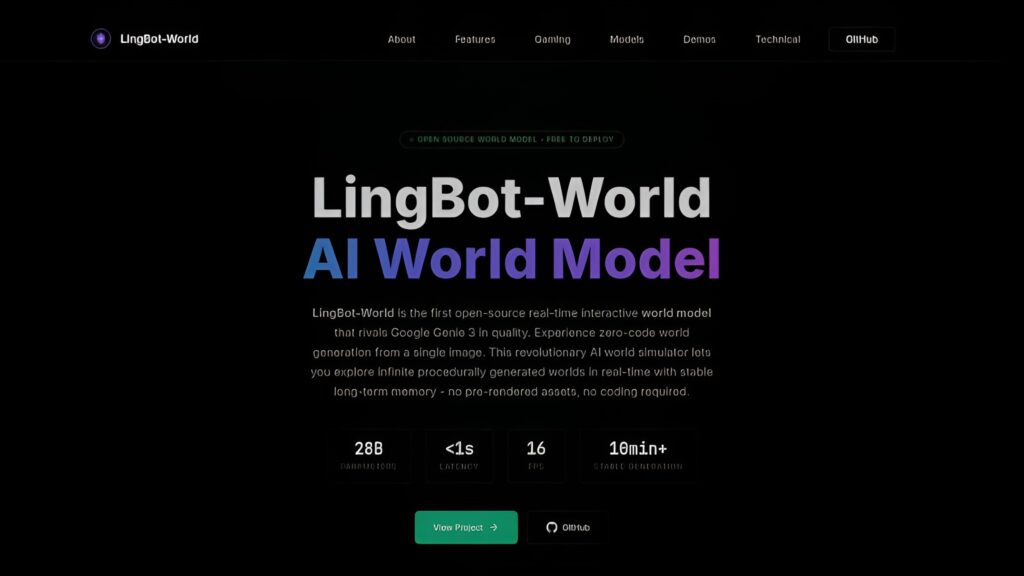
LingBot-World is an advanced open-source world model developed by Robbyant (Ant Group), designed to generate interactive, persistent, and physics-compliant virtual environments in real-time from video generation principles.

It creates explorable 3D-like worlds from a single image, text prompt, or game screenshot, supporting user navigation via keyboard (WASD for movement, camera controls) with immediate visual feedback.

The model maintains stable long-term memory (10 plus minutes without collapse), object permanence (unobserved elements remain consistent), realistic occlusion, collision dynamics, and spatial scaling.

It excels in extreme style generalization across photorealistic, anime, cartoon, game-quality, fantasy, sci-fi, and scientific visualizations through multi-domain training on real videos, game recordings, and Unreal Engine synthetic data.

Features include a VLM-powered intelligent action agent for autonomous navigation and interaction, dynamic off-screen behavior (world progresses even when unobserved), and text-based modifications (e.g., add rain, change season, place objects).

With approximately 28B parameters (14B inference size), it achieves 16 FPS generation, sub-1 second latency, 720P output, and high throughput for interactive applications.

Released under Apache 2.0 license in late January 2026 with full code, weights on Hugging Face, and deployment guide, it positions as the first top-tier fully open-source alternative to closed models like Google Genie 3.

Variants include LingBot-World-Base (Camera Poses) available now, Actions variant soon, and Fast low-latency edition upcoming.

Ideal for game development (zero-code worlds, prototyping, NPC training), embodied AI/robot learning, autonomous driving simulation, film/VFX pre-vis, and interactive content creation.

Key Features

  1. Real-time interactive generation: 16 FPS output with sub-1s latency for keyboard-controlled exploration
  2. Long-term stable memory: Sustains 10 plus minute coherent worlds without collapse or forgetting
  3. Object permanence and physics: Maintains consistency for unobserved elements with realistic collisions and occlusion
  4. Extreme style generalization: Handles photorealistic, anime, cartoon, game, fantasy, sci-fi, and scientific visuals
  5. VLM-powered autonomous agent: Intelligent navigation and interaction using vision-language understanding
  6. Dynamic off-screen progression: World continues evolving naturally even outside view
  7. Text-based world modification: Alter weather, objects, seasons, or structures via natural language prompts
  8. Zero-shot generalization: Generates from single real image or game screenshot without extra training
  9. High-resolution output: 720P standard with options for 480P/720P in base model
  10. Open-source deployment: Full Apache 2.0 code, weights, and guide for local running via Hugging Face/GitHub

Price Plans

  1. Free ($0): Completely open-source under Apache 2.0 with full model weights, code, and deployment guide available on GitHub and Hugging Face; no usage fees or subscriptions
  2. Cloud/Enterprise (Custom): Potential future hosted options or premium support via Ant Group/Robbyant (not specified yet)

Pros

  1. Fully open-source leadership: First SOTA deployable world model rivaling closed systems like Genie 3
  2. Persistent and consistent worlds: Breakthrough in long-horizon memory and object permanence without 3D engine
  3. Real-time interactivity: Sub-second latency enables true playable simulation
  4. Versatile styles and domains: Cross-genre generalization from diverse training data
  5. Autonomous agent capabilities: Emergent behaviors and navigation for embodied AI applications
  6. Cost-effective for developers: Reduces asset creation needs in gaming and simulation
  7. Community accessible: Apache 2.0 license with easy Hugging Face integration

Cons

  1. Requires powerful hardware: 28B model needs high-end GPU for real-time inference
  2. Early-stage variants: Actions and Fast versions still upcoming; base limited to camera control
  3. Setup complexity: Local deployment involves GitHub repo, dependencies, and model weights download
  4. No hosted web interface: Primarily for developers/researchers; no simple online demo mentioned
  5. Latency trade-offs: Full 720P may vary on consumer hardware
  6. Limited user metrics: Very recent release with no widespread adoption numbers yet
  7. Potential artifacts: Complex long interactions may still show inconsistencies in edge cases

Use Cases

  1. Game development prototyping: Generate infinite procedural worlds, test levels, train NPCs without manual assets
  2. Embodied AI and robotics: Simulate environments for robot training, trial-and-error learning, and navigation
  3. Autonomous driving simulation: Create dynamic traffic scenes for safe testing and scenario generation
  4. Film and VFX pre-visualization: Build explorable digital sets for storyboarding and camera paths
  5. Interactive content creation: Develop playable AI-driven experiences or virtual tours
  6. Research in world models: Extend or fine-tune for new domains like scientific visualization
  7. Educational simulations: Create consistent virtual labs or historical environments

Target Audience

  1. Game developers and studios: Reducing art/asset costs and enabling rapid prototyping
  2. AI researchers in embodied intelligence: Experimenting with interactive world models
  3. Robotics and autonomous systems teams: Needing high-fidelity simulation sandboxes
  4. Autonomous driving engineers: Generating diverse driving scenarios
  5. VFX and film creators: Pre-vis digital environments with camera control
  6. Open-source AI enthusiasts: Building upon or deploying the model locally

How To Use

  1. Visit GitHub: Go to github.com/Robbyant/lingbot-world for code, docs, and deployment guide
  2. Download model: Get weights from Hugging Face (e.g., robbyant/lingbot-world-base-cam)
  3. Install dependencies: Set up environment with required libraries (PyTorch, etc.) per repo instructions
  4. Run inference: Use provided scripts for camera-pose control or agent navigation
  5. Input starting frame: Provide single image or prompt to initialize world
  6. Interact live: Use WASD keys for movement, mouse/JKLI for camera; observe real-time generation
  7. Modify world: Add text prompts like 'make it rain' or 'add castle' during runtime

How we rated LingBot-World

  • Performance: 4.7/5
  • Accuracy: 4.6/5
  • Features: 4.8/5
  • Cost-Efficiency: 5.0/5
  • Ease of Use: 4.2/5
  • Customization: 4.9/5
  • Data Privacy: 5.0/5
  • Support: 4.3/5
  • Integration: 4.5/5
  • Overall Score: 4.7/5

LingBot-World integration with other tools

  1. Hugging Face: Model weights and inference pipelines hosted for easy download and testing
  2. GitHub Repository: Full open-source code, deployment scripts, and community contributions
  3. Game Engines (Potential): Designed for integration with Unity/Unreal via custom plugins or API wrappers for procedural world generation
  4. Robotics Frameworks: Compatible with simulation environments like MuJoCo or Isaac Sim for embodied AI training
  5. Local Hardware: Runs on consumer GPUs with CUDA; no cloud dependency for core use

Best prompts optimised for LingBot-World

  1. A bustling futuristic cyberpunk city street at night with neon signs and flying cars, start from this reference image [upload urban photo], enable WASD navigation and realistic physics
  2. Fantasy medieval kingdom with castles and dragons flying overhead, generate in anime style, maintain object permanence and dynamic weather changes
  3. Realistic autonomous driving simulation on a busy highway during sunset, include traffic, pedestrians, and lane changes with collision avoidance
  4. Sci-fi spaceship interior exploring corridors, zero-gravity effects, holographic displays, allow agent to walk and interact with objects
  5. Photorealistic forest trail in autumn with falling leaves, wildlife, and changing lighting as time progresses, support long-term consistency over 10 minutes
LingBot-World is a groundbreaking open-source world model delivering real-time interactive simulations with persistent memory, physics, and style versatility that rivals closed systems. Fully free and deployable, it excels for game prototyping, robotics training, and research. Setup requires technical know-how, but its innovations in long-horizon consistency make it a top choice for embodied AI and procedural content creation.

FAQs

  • What is LingBot-World?

    LingBot-World is an open-source real-time interactive world model that generates persistent, physics-compliant virtual environments from images or prompts, supporting user navigation and autonomous agents.

  • Who developed LingBot-World?

    It was developed by Robbyant, an embodied AI company within Ant Group (Alibaba-affiliated), and released open-source in late January 2026.

  • Is LingBot-World free to use?

    Yes, it is completely free and open-source under Apache 2.0 license with full code and model weights available on GitHub and Hugging Face.

  • What are the main features of LingBot-World?

    Key features include real-time 16 FPS generation, 10 plus minute stable memory, object permanence, style generalization (real/anime/cartoon), autonomous agents, and text-based world modifications.

  • What hardware is needed to run LingBot-World?

    It requires a powerful GPU (high-end consumer or better) for real-time inference due to its 28B parameters (14B active); local deployment via the GitHub repo.

  • How does LingBot-World compare to Google Genie 3?

    It is positioned as the leading open-source rival, matching or exceeding in long-term consistency, interactivity, and physics while being fully deployable unlike closed models.

  • When was LingBot-World released?

    The base model (Camera Poses) was open-sourced on January 28, 2026, with action and fast variants planned soon after.

  • What applications is LingBot-World suited for?

    Best for game development (procedural worlds), embodied AI/robot training, autonomous driving simulation, VFX pre-vis, and interactive content/research.


Newly Added Toolsโ€‹

Qodo AI

$0/Month

Codiga

$10/Month

Tabnine

$59/Month

CodeRabbit

$0/Month
LingBot-World Alternatives

Seedance 2.0

$0/Month

VideoGen

$12/Month

WUI.AI

$10/Month

LingBot-World Reviews

0.0
0.0 out of 5 stars (based on 0 reviews)
Excellent0%
Very good0%
Average0%
Poor0%
Terrible0%

There are no reviews yet. Be the first one to write one.