
What is LongCat-Video-Avatar?
LongCat-Video-Avatar is an open-source unified model from Meituan’s LongCat team for expressive audio-driven character animation, supporting AT2V, ATI2V, and video continuation with natural lip-sync and dynamics.
When was LongCat-Video-Avatar released?
It was released on December 16, 2025, with model weights, code, and technical report made public on Hugging Face and GitHub.
Is LongCat-Video-Avatar free to use?
Yes, it’s completely free and open-source under MIT license, with full model weights and inference code available for download and modification.
What tasks does LongCat-Video-Avatar support?
It natively handles Audio-Text-to-Video (AT2V), Audio-Text-Image-to-Video (ATI2V), and Video Continuation for single or multi-person scenarios.
What hardware is needed for LongCat-Video-Avatar?
It requires powerful multi-GPU setup (e.g., A100/H100) with PyTorch 2.6+, FlashAttention, and high VRAM for efficient inference, especially long videos.
Does LongCat-Video-Avatar support multi-person generation?
Yes, it handles both single-person and multi-character/avatar scenarios with consistent identity and natural interactions.
Where can I download LongCat-Video-Avatar?
Model weights are on Hugging Face at meituan-longcat/LongCat-Video-Avatar; code and report on GitHub meituan-longcat/LongCat-Video.
What license does LongCat-Video-Avatar use?
It is released under the MIT License, allowing free use, modification, and commercial applications (with trademark/patent caveats).

LongCat-Video-Avatar

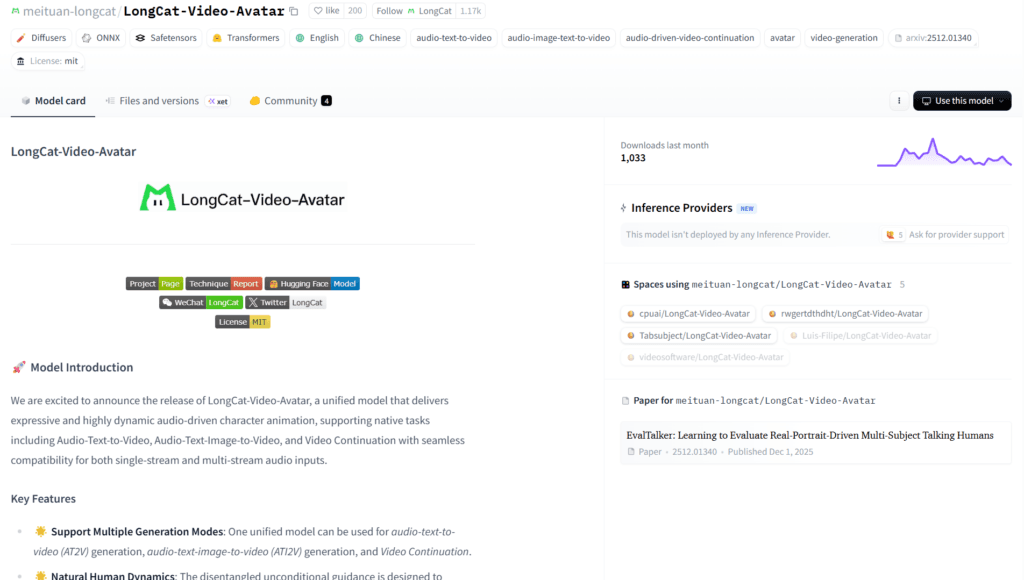
About This AI
LongCat-Video-Avatar is an advanced open-source model from Meituan’s LongCat team, released in December 2025, designed for highly expressive and dynamic audio-driven character animation.
Built upon the LongCat-Video foundation, it uses a unified Diffusion Transformer (DiT) architecture to support multiple native tasks: Audio-Text-to-Video (AT2V), Audio-Text-Image-to-Video (ATI2V), and Video Continuation.
The model excels at generating realistic talking-head videos with accurate lip-sync, natural facial expressions, body movements, and consistent identity preservation across long sequences.
Key innovations include Cross-Chunk Latent Stitching to prevent pixel degradation and error accumulation in extended generations, Reference Skip Attention to maintain character identity without excessive leakage, and disentangled unconditional guidance for decoupling speech from motion.
It handles single-stream and multi-stream audio inputs, supports single- and multi-person scenarios, and produces high-quality outputs at 480p or 720p resolutions.
Fully MIT-licensed with model weights, inference code, and technical report available on Hugging Face, it requires significant GPU resources (e.g., multi-GPU setup with PyTorch 2.6+, FlashAttention) for efficient inference.
Best suited for researchers, developers, and creators building lifelike virtual avatars, talking heads, or long-form animated content with audio synchronization.
The model has gained attention in the open-source community with hundreds of downloads and positive feedback for its realism in human dynamics and lip synchronization.
Key Features
- Unified multi-task architecture: Supports AT2V, ATI2V, and Video Continuation in a single model
- Audio-driven animation: Generates expressive facial expressions, lip-sync, and natural body dynamics from audio input
- Long-sequence consistency: Cross-Chunk Latent Stitching prevents degradation and error accumulation in extended videos
- Identity preservation: Reference Skip Attention maintains character consistency without excessive image leakage
- Disentangled guidance: Decouples speech-driven motion from unconditional priors for better control
- Single and multi-person support: Handles scenarios with one or multiple characters
- Multi-stream audio compatibility: Processes single or multiple audio inputs seamlessly
- High-resolution output: Generates 480p or 720p videos with configurable quality
- Efficient inference options: Supports FlashAttention-2/3, context parallel processing for multi-GPU
- Open-source ecosystem: MIT license with full code, weights, and technical report on Hugging Face
Price Plans
- Free ($0): Completely open-source model weights, code, and inference tools under MIT license with no usage fees
- Cloud/Hosted (Custom): Potential costs for running on cloud GPUs (e.g., RunPod, Vast.ai) or enterprise deployment
Pros
- Highly expressive and realistic: Delivers natural human dynamics, lip-sync, and facial expressions in audio-driven videos
- Strong long-video handling: Maintains quality and consistency in extended generations via innovative stitching
- Fully open-source: MIT license allows free use, modification, and commercial applications
- Multi-task versatility: One model covers AT2V, ATI2V, and continuation without separate fine-tunes
- Community traction: Positive reception in open-source AI circles with growing downloads and integrations
- Technical sophistication: Addresses key issues like identity drift and stiff motion effectively
- Research-friendly: Accompanied by detailed technical report and eval benchmarks
Cons
- High hardware requirements: Needs powerful multi-GPU setup (e.g., A100/H100) for reasonable inference speed
- Complex setup: Requires specific PyTorch version, FlashAttention, and dependencies like librosa/ffmpeg
- Resource-intensive: Large model size (likely billions of parameters) demands significant VRAM
- No hosted demo: Primarily local/offline use; no easy web interface or Spaces demo mentioned
- Limited accessibility: Steep learning curve for non-experts; best for developers/researchers
- Potential artifacts: Long generations or complex audio may still show minor inconsistencies
- Recent release: Community tools, fine-tunes, and integrations still emerging
Use Cases
- Talking head generation: Create lifelike virtual avatars from audio for presentations or videos
- Multi-character animation: Animate scenes with multiple people synced to dialogue
- Video continuation: Extend existing avatar clips while preserving identity and motion
- Research in audio-visual synthesis: Experiment with expressive long-form human animation
- Content creation tools: Build custom AI avatars for apps, games, or virtual assistants
- Accessibility and education: Generate sign-language or dubbed avatar videos from audio
- Entertainment prototypes: Prototype animated characters for films, ads, or social media
Target Audience
- AI researchers and developers: Experimenting with advanced audio-driven video models
- Content creators and animators: Building realistic talking avatars or extensions
- Virtual human application builders: For chatbots, virtual assistants, or metaverse projects
- Open-source enthusiasts: Using MIT-licensed models for custom projects
- Academic teams: Studying expressive animation, lip-sync, and long-sequence generation
- Tech companies: Integrating avatar tech into products or prototypes
How To Use
- Clone repository: git clone --single-branch --branch main https://github.com/meituan-longcat/LongCat-Video
- Set up environment: Create conda env with Python 3.10, install PyTorch 2.6+cu124, FlashAttention-2, and requirements.txt
- Download model: Use huggingface-cli download meituan-longcat/LongCat-Video-Avatar --local-dir ./weights/LongCat-Video-Avatar
- Prepare input: Create JSON config with audio path, text prompt, optional reference image
- Run inference: Use torchrun with multi-GPU for AT2V/ATI2V, e.g., run_demo_avatar_single_audio_to_video.py
- Adjust parameters: Set resolution (480/720), context_parallel_size, and other flags for quality/speed
- View output: Generated video saved to output directory; iterate with different configs
How we rated LongCat-Video-Avatar
- Performance: 4.6/5
- Accuracy: 4.7/5
- Features: 4.8/5
- Cost-Efficiency: 5.0/5
- Ease of Use: 4.0/5
- Customization: 4.5/5
- Data Privacy: 4.9/5
- Support: 4.2/5
- Integration: 4.4/5
- Overall Score: 4.6/5
LongCat-Video-Avatar integration with other tools
- Hugging Face Diffusers: Native support for loading and inference with Diffusers library
- ComfyUI: Community quantized GGUF versions available for ComfyUI + WanVideoWrapper workflows
- PyTorch Ecosystem: Direct integration with torchrun for multi-GPU parallel processing
- Local Development Tools: Works with VS Code, Jupyter, or custom scripts for experimentation
- Video Editing Software: Export MP4 outputs for import into Premiere Pro, DaVinci Resolve, or CapCut
Best prompts optimised for LongCat-Video-Avatar
- A professional news anchor in a studio delivering breaking news with serious expression, natural head movements, lip-sync to the provided audio script, high detail, realistic lighting
- Young woman with long hair smiling and explaining a recipe enthusiastically, casual kitchen background, fluid gestures, accurate lip synchronization, warm indoor lighting
- Animated cartoon character dancing excitedly while singing along to upbeat music, vibrant colors, smooth body motion, expressive facial reactions
- Elderly professor in glasses lecturing on physics, whiteboard in background, thoughtful pauses, precise lip movements matching technical terms
- Group of friends laughing and chatting at a cafe table, multi-person scene with natural interactions, casual outfits, outdoor daylight
FAQs
Newly Added Tools







About Author