
What is MiMo V2 Flash?
MiMo V2 Flash is Xiaomi’s open-source Mixture-of-Experts model with 309B total and 15B active parameters, optimized for fast reasoning, agentic tasks, coding, and long-context processing.
When was MiMo V2 Flash released?
It was officially released and open-sourced on December 16, 2025, with the technical report published shortly after.
Is MiMo V2 Flash free to use?
Yes, it’s fully open-source under MIT license with weights and code available on Hugging Face; no usage fees for local deployment.
What are the key strengths of MiMo V2 Flash?
It excels in high-speed inference (150 tokens/s), strong benchmarks (e.g., 84.9 MMLU-Pro, 94.1 AIME 2025), 256k context, agentic/tool use, and efficiency with fewer active parameters.
What hardware is required for MiMo V2 Flash?
Full real-time performance needs multi-GPU setup (e.g., 8+ high-end GPUs); quantized versions (4-bit, GGUF) run on consumer hardware with trade-offs.
How does MiMo V2 Flash compare to other models?
It matches or exceeds DeepSeek-V3.2 and Kimi-K2 on many benchmarks while using fewer parameters and offering faster inference via MTP speculative decoding.
Does MiMo V2 Flash support tool use?
Yes, it features strong agentic capabilities with tool calling, multi-step reasoning, and outputs including reasoning_content and tool_calls for complex workflows.
Where can I run MiMo V2 Flash?
Locally via SGLang (recommended), Hugging Face Spaces, MLX (Apple silicon), or cloud API through Xiaomi’s platform with token pricing.

MiMo V2 Flash

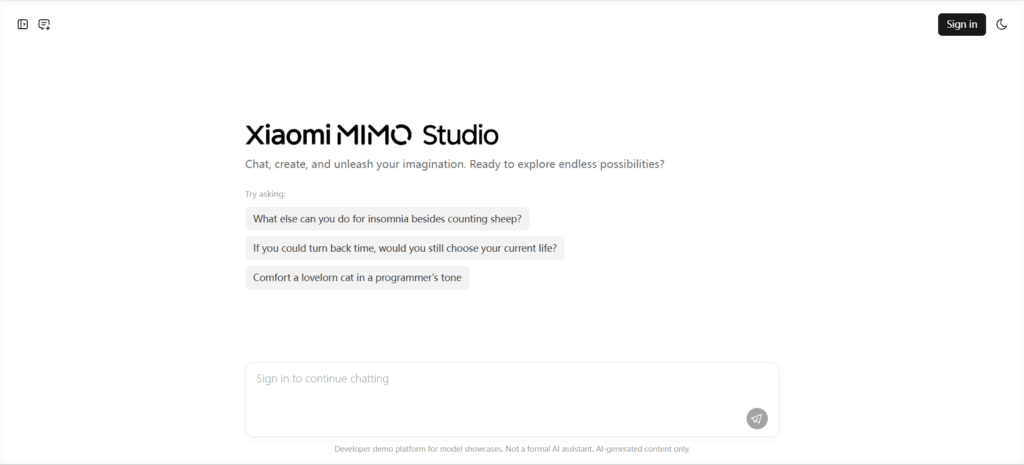
About This AI
MiMo V2 Flash is Xiaomi’s flagship open-source Mixture-of-Experts (MoE) language model from the MiMo V2 series, featuring 309 billion total parameters with only 15 billion active per inference for exceptional efficiency.
It combines a hybrid attention architecture (interleaving Sliding Window Attention and global attention in a 5:1 ratio) with Multi-Token Prediction (MTP) for native speculative decoding, achieving up to 150 tokens/second inference speed and 2.6x speedup via repurposed MTP as draft model.
The model supports a native 32k context extended to 256k tokens with attention sink bias for stable long-context performance.
Pre-trained on 27 trillion tokens using FP8 mixed precision, it employs Multi-Teacher On-Policy Distillation (MOPD) and large-scale agentic RL (100k+ GitHub tasks) for strong reasoning, tool use, coding, math, and agentic workflows.
It rivals or exceeds top open models like DeepSeek-V3.2 and Kimi-K2 (despite fewer total parameters) on benchmarks including MMLU-Pro (84.9), GPQA-Diamond (83.7), AIME 2025 (94.1), SWE-Bench Verified (73.4), and LongBench V2.
Released under MIT license on December 16, 2025, with full weights on Hugging Face and optimized SGLang inference support.
Ideal for developers needing fast, high-performance LLMs for reasoning, coding, agentic applications, long-context tasks, and cost-effective deployment without sacrificing capability.
Key Features
- Mixture-of-Experts Architecture: 309B total / 15B active parameters for efficient high-performance inference
- Hybrid Attention Mechanism: 5:1 ratio of Sliding Window (128-token) and global attention across blocks
- Multi-Token Prediction (MTP): Native speculative decoding with up to 3.6 acceptance length and 2.6x speedup
- Extended Context Length: Native 32k extended to 256k with attention sink bias for long-document handling
- Agentic and Tool-Use Optimization: Strong multi-step planning, tool calling, and reasoning via large-scale RL
- Multi-Teacher On-Policy Distillation (MOPD): Token-level distillation from domain-specialized teachers
- FP8 Mixed Precision Training: Enables efficient scaling on 27 trillion tokens
- High Inference Speed: Up to 150 tokens/second with optimized SGLang backend
- Strong Benchmark Performance: SOTA-level results on MMLU-Pro, GPQA, AIME, SWE-Bench, and more
- Open-Source Full Stack: MIT license, weights, MTP layers, and inference code available
Price Plans
- Free ($0): Full open-source model under MIT license with weights and code on Hugging Face; no usage fees for local/self-hosted deployment
- Cloud API (Paid via Xiaomi Platform): Hosted inference with token-based pricing (e.g., $0.1/M input, $0.3/M output tokens)
- Enterprise (Custom): Premium support, scaled deployment, or fine-tuning services through Xiaomi MiMo
Pros
- Exceptional efficiency: Matches or beats larger models with 1/2 to 1/3 parameters
- Blazing-fast inference: 150 tokens/s and speculative decoding make it ideal for real-time apps
- Competitive reasoning: Tops open models in math, coding, agentic tasks, and long context
- Fully open-source: MIT license with complete weights and code for unrestricted use
- Long-context mastery: Stable 256k support with minimal degradation
- Agentic strength: Built-in tool use and multi-step planning for complex workflows
- Cost-effective deployment: Lower active parameters reduce hardware requirements
Cons
- Requires multi-GPU setup: 309B model needs significant VRAM (e.g., 8+ high-end GPUs) for full speed
- Complex inference setup: Optimal performance via SGLang with specific flags and backends
- Knowledge cutoff: Pre-training ends around December 2024; no built-in web search
- Early ecosystem: Community quantizations and integrations still emerging post-release
- Potential quantization trade-offs: FP8 and 4-bit versions may slightly reduce accuracy
- No hosted API free tier: Local or self-hosted; API platform pricing applies for cloud use
- Specialized optimization: Best with SGLang; other backends may be slower
Use Cases
- High-speed chat and agents: Real-time conversational AI with tool calling and reasoning
- Coding and software development: Code generation, debugging, and agentic programming tasks
- Mathematical and scientific reasoning: Solving complex problems with step-by-step logic
- Long-document analysis: Summarizing or querying large texts up to 256k tokens
- Research and prototyping: Building custom agents or experimenting with MoE architectures
- Cost-sensitive production: Deploying powerful LLM capabilities on limited hardware
- Multi-turn workflows: Maintaining context in extended interactions or simulations
Target Audience
- AI developers and researchers: Experimenting with open MoE models and agentic systems
- Software engineers: Needing fast local coding assistants and tool-use LLMs
- Data scientists: Long-context analysis and mathematical reasoning at scale
- Startups and indie devs: Cost-effective high-performance AI without massive infra
- Enterprise teams: Self-hosting powerful models for privacy and speed
- Open-source community: Fine-tuning or extending the MiMo V2 series
How To Use
- Download model: Get weights from Hugging Face (XiaomiMiMo/MiMo-V2-Flash)
- Install SGLang: pip install sglang for optimized inference backend
- Launch server: Run python -m sglang.launch_server with model path, tp/dp/pp sizes, context length 262144, enable-mtp, and other flags
- Interact via API: Send JSON requests with messages array, max_tokens, temperature, top_p, and enable_thinking for reasoning mode
- Use system prompt: Include role and date in system message (e.g., 'You are MiMo, knowledge cutoff December 2024')
- Enable tool use: Parse tool_calls and reasoning_content in responses for agentic flows
- Quantize if needed: Use community GGUF or 4-bit versions for lower VRAM
How we rated MiMo V2 Flash
- Performance: 4.8/5
- Accuracy: 4.7/5
- Features: 4.8/5
- Cost-Efficiency: 4.9/5
- Ease of Use: 4.4/5
- Customization: 4.7/5
- Data Privacy: 5.0/5
- Support: 4.5/5
- Integration: 4.6/5
- Overall Score: 4.8/5
MiMo V2 Flash integration with other tools
- Hugging Face: Model weights, inference examples, and community quantizations hosted for easy access
- SGLang Backend: Optimized launch server and API for high-speed inference with speculative decoding
- Xiaomi MiMo Platform: Cloud API and AI Studio for hosted usage with token pricing
- Local Frameworks: Compatible with vLLM, LM Studio, Ollama (via community GGUF), and MLX for Apple silicon
- Agent Frameworks: Tool-calling support integrates with LangChain, LlamaIndex, or custom agent loops
Best prompts optimised for MiMo V2 Flash
- You are MiMo, an expert AI assistant. Solve this AIME 2025-level math problem step by step with clear reasoning: [insert problem]
- As an advanced coding agent, write a complete Python script for [task description] using best practices, handle edge cases, and include comments
- Analyze this long document (up to 256k tokens) and provide a concise summary with key insights, action items, and potential risks: [paste text]
- You are a multi-step reasoning agent. Plan and execute the following task using tools if needed: research [topic], summarize findings, and propose next actions
- Translate and explain this technical Chinese research abstract to fluent English, preserving all scientific accuracy and terminology: [insert abstract]
FAQs
Newly Added Tools







About Author