What is MiniMax M2.1?
MiniMax M2.1 is an efficient open-source large language model optimized for multi-language coding, agentic workflows, office automation, and real-world complex tasks with low active parameters and high performance.
When was MiniMax M2.1 released?
MiniMax M2.1 was officially released on December 23, 2025, with open-source weights and API availability shortly after.
Is MiniMax M2.1 free to use?
Model weights are open-source for local use (free); API is pay-as-you-go starting at $0.30 per million input tokens, with limited-time free access to MiniMax Agent chat.
What are the key strengths of MiniMax M2.1?
It excels in multilingual programming (Rust, Java, etc.), agentic tool use, mobile/web development, 3D simulations, and office automation, with strong benchmarks like VIBE 88.6%.
How does MiniMax M2.1 pricing compare?
API costs $0.30 per million input tokens and $1.20 per million output tokens, significantly cheaper than many competitors like Claude models while offering similar or better performance in coding/agentic tasks.
Where can I access MiniMax M2.1?
Open-source weights on Hugging Face, API via platform.minimax.io, and chat interface at agent.minimax.io (limited free period).
What context window does MiniMax M2.1 have?
It supports a 196,608-token context window, enabling handling of large codebases, documents, or long conversations.
Is MiniMax M2.1 good for local deployment?
Yes, fully open-source with support for vLLM, Transformers, SGLang, and Ktransformers; runs efficiently on suitable GPUs due to sparse MoE design.
MiniMax M2.1

About This AI
MiniMax M2.1 is an enhanced large language model from MiniMax, released on December 23, 2025, optimized for multi-language programming, agentic workflows, and office automation.
With a sparse MoE architecture (230B total parameters, 10B active per token), it delivers high performance with low latency, reduced token usage, and exceptional cost-efficiency.
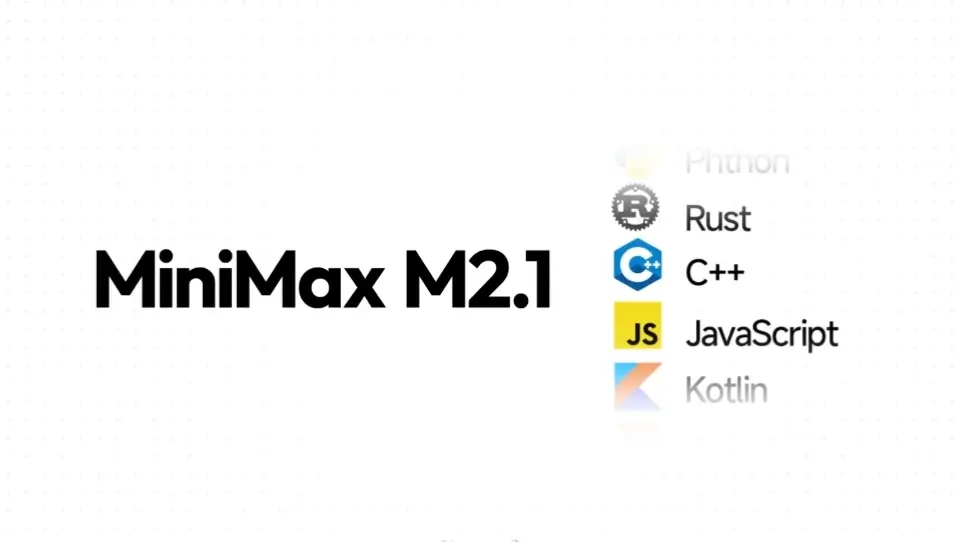
It excels in Rust, Java, Golang, C++, Kotlin, Objective-C, TypeScript, JavaScript, and more, supporting native Android/iOS development, Web/App design, 3D rendering, interactive simulations, and full-stack scenarios.
The model features improved composite instruction following, concise responses, faster speed, and strong generalization across agent frameworks like Claude Code, Droid, Cline, Kilo Code, Roo Code, and BlackBox.
It demonstrates outstanding results on SWE-bench Verified (multilingual), VIBE benchmark (88.6 aggregate, with high Web/Android scores), and long-horizon tool use.
MiniMax M2.1 supports text, speech, video, and music multimodal integration, enabling digital employee capabilities for end-to-end office tasks (admin, data science, finance, HR, software dev).
Available open-source on Hugging Face for local deployment (via SGLang, vLLM, Transformers), with API access on MiniMax platform and free/limited-time access to MiniMax Agent chat interface.
Pricing is highly competitive at $0.30 per million input tokens and $1.20 per million output tokens, making it accessible for developers and enterprises building autonomous applications.
Key Features
- Sparse MoE efficiency: 230B total parameters with only 10B active per token for fast, low-cost inference
- Multi-language programming mastery: Top performance in Rust, Java, Golang, C++, Kotlin, Objective-C, TypeScript, JavaScript, and more
- Native mobile development: Strong Android/iOS app generation and interaction handling
- Web/App full-stack excellence: Enhanced design comprehension, aesthetic UI, and complex interactions
- Agentic tool use generalization: Robust across frameworks like Claude Code, Droid, Cline, Kilo Code, Roo Code, BlackBox
- Interleaved Thinking: Systematic problem-solving with code execution correctness and composite constraints
- Multimodal capabilities: Text, speech, video, music integration for 3D rendering, animations, and simulations
- Digital employee automation: Controls mouse/keyboard via text for office tasks in admin, finance, HR, dev
- Concise and fast responses: Reduced token consumption and higher speed compared to prior versions
- Open-source deployment: Weights on Hugging Face, supported by SGLang, vLLM, Transformers for local use
Price Plans
- Free ($0): Open-source weights for local use (no cost); limited-time free access to MiniMax Agent chat; potential free API credits or trials
- API Pay-as-you-go ($0.30 input / $1.20 output per million tokens): Standard usage-based pricing on MiniMax platform; lightning variant for faster speed at higher output cost
- Enterprise/Custom (Contact-based): Volume discounts, dedicated support, or Coding Plan subscriptions for heavy dev/agent use
Pros
- Outstanding coding benchmarks: Leads multilingual SWE-bench and approaches Claude Opus in real-world tasks
- Highly cost-effective: $0.30 input/$1.20 output per million tokens, far below many competitors
- Efficient and scalable: Low active parameters enable fast latency and high throughput
- Strong agentic generalization: Reliable tool use and long-horizon planning across diverse frameworks
- Open-source accessibility: Full weights available for local deployment and customization
- Multimodal versatility: Handles code, UI design, 3D, audio, and office automation
- Rapid real-world performance: Excels in VIBE benchmark for full-stack execution
Cons
- API-focused pricing: Token-based costs can add up for heavy usage without flat plans
- Local deployment demanding: Requires significant GPU resources for full-speed inference
- Limited free access: MiniMax Agent free for limited time; full features via paid API
- Recent release: Community fine-tunes and integrations still emerging
- Multimodal depth varies: Strongest in coding/agentic; some multimodal features preview-stage
- No massive user stats: Adoption growing but no public billion-scale metrics yet
- Potential framework quirks: Occasional inconsistencies in niche tools or modern frameworks
Use Cases
- Multi-language software development: Generate, debug, and optimize code in Rust, Java, C++, etc.
- Agentic workflows: Build autonomous agents for complex multi-step tasks and tool integration
- Mobile app prototyping: Native Android/iOS development with UI and interaction logic
- Web/App full-stack creation: Design aesthetic UIs, handle frontend/backend, and simulate interactions
- Office automation: Digital employee for admin, data analysis, finance, HR tasks via text commands
- 3D and interactive simulations: Render scenes, animations, and Web Audio projects
- Technical documentation and writing: Produce high-quality docs, reports, and explanations
Target Audience
- Software developers: Working in multiple languages or full-stack/mobile projects
- AI agent builders: Creating autonomous systems with tool calling and long-horizon planning
- Product teams: Prototyping apps, UIs, and interactive features quickly
- Office professionals: Automating repetitive tasks in admin, finance, HR
- Researchers and startups: Leveraging open-source for cost-effective high-performance LLMs
- Enterprises: Scaling agentic AI with affordable API access
How To Use
- Access API: Sign up at platform.minimax.io, get API key for text generation
- Use MiniMax Agent: Visit agent.minimax.io for chat interface (free limited time)
- Local deployment: Download weights from huggingface.co/MiniMaxAI/MiniMax-M2.1
- Run inference: Use SGLang, vLLM, or Transformers with recommended params (temp=1.0, top_p=0.95)
- Prompt for coding: Provide detailed instructions, codebase context, or task specs
- Agent mode: Enable tool calling for multi-step execution or external integrations
- Optimize: Use lightning variant for faster speed on supported platforms
How we rated MiniMax M2.1
- Performance: 4.8/5
- Accuracy: 4.7/5
- Features: 4.9/5
- Cost-Efficiency: 4.9/5
- Ease of Use: 4.5/5
- Customization: 4.6/5
- Data Privacy: 4.5/5
- Support: 4.4/5
- Integration: 4.7/5
- Overall Score: 4.7/5
MiniMax M2.1 integration with other tools
- MiniMax API Platform: Official endpoint for text generation, agentic tasks, and multimodal features
- Hugging Face: Model weights and inference support for local deployment and experimentation
- Coding Agent Frameworks: Native compatibility with Claude Code, Droid, Cline, Kilo Code, Roo Code, BlackBox for seamless tool use
- Development Environments: Works in VS Code extensions, Cursor, or any LLM-compatible IDE via API
- Office Tools: Potential for Excel, browser automation, and file handling in agentic workflows
Best prompts optimised for MiniMax M2.1
- Write a complete Rust CLI tool for parsing and analyzing large log files, including error handling, parallel processing, and output to JSON. Use best practices and add tests.
- Generate a full-stack React + Node.js web app for a task manager with user auth, real-time updates via WebSockets, and clean UI design. Include backend API routes.
- Create native Android Kotlin code for a fitness tracker app that integrates camera for pose detection, tracks steps, and shows progress charts. Use Jetpack Compose.
- Automate an office workflow: Read an Excel sheet of sales data, analyze trends using Python pandas, generate summary report, and draft email to team in professional tone.
- Build an interactive 3D scene in Three.js: A solar system simulation with orbiting planets, realistic lighting, and camera controls. Provide complete HTML/JS code.
FAQs
Newly Added Tools



About Author