
What is Mistral AI?
Mistral AI is a French AI company offering high-performance, open-weight and frontier large language models like Mistral Large 2, Pixtral, and Codestral, known for efficiency, multilingual strength, and developer tools.
When was Mistral AI founded?
Mistral AI was founded in April 2023 by former researchers from Meta and Google DeepMind.
Are Mistral models free to use?
Many models are fully open-source under Apache 2.0 for self-hosting; Le Chat offers free access with limits, while API usage is pay-per-token starting at low rates.
What are Mistral AI’s flagship models?
Current highlights include Mistral Large 2 (123B), Mistral Small 3, Pixtral 12B (vision), Codestral (coding), and Mistral Nemo (efficient 12B).
Does Mistral AI support multimodal inputs?
Yes, Pixtral 12B handles image + text for vision tasks like document understanding, chart analysis, and visual reasoning.
How does Mistral compare to OpenAI models?
Mistral models often match or beat GPT-4 class performance in reasoning and multilingual tasks while being more efficient and open, though ecosystem support is smaller.
Can I self-host Mistral models?
Yes, open-weight models like Mistral Nemo, Codestral, and others can be downloaded from Hugging Face and run locally or on your infrastructure.
What is Le Chat by Mistral?
Le Chat is Mistral’s free conversational web interface (chat.mistral.ai) where users can try models, switch between them, and build custom assistants.

Mistral AI

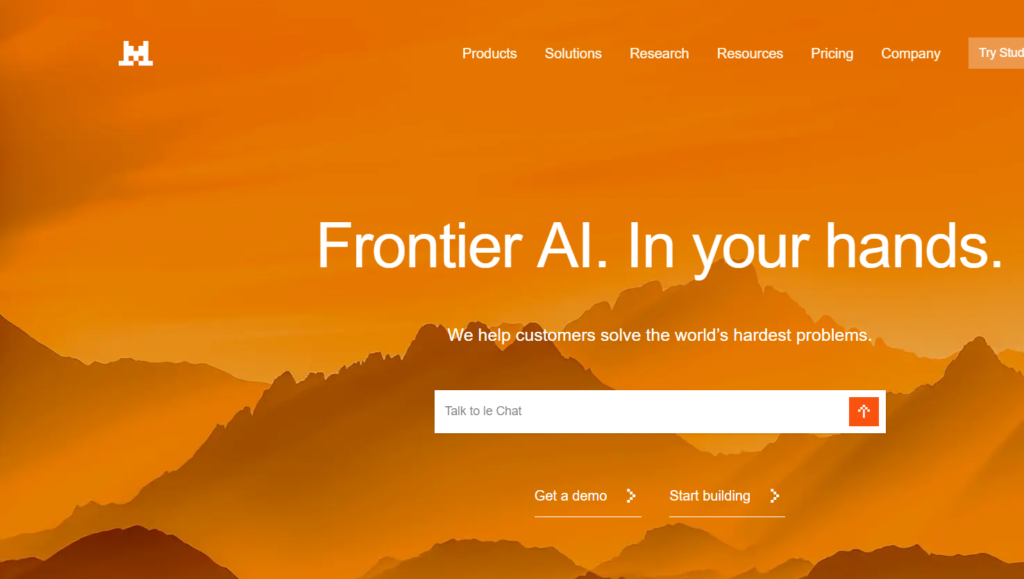
About This AI
Mistral AI is a French AI company founded in 2023, specializing in efficient, open-weight and frontier large language models that rival or outperform larger closed models.
It offers a family of models including Mistral Large 2 (123B parameters, 128K context), Mistral Nemo (12B), Pixtral 12B (multimodal vision), Codestral (code-focused), and Mistral Small 3 (latest efficient frontier model).
Key strengths include top-tier reasoning, multilingual performance (especially European languages), long-context handling, function calling, JSON mode, reduced hallucinations, and fast inference via optimized architecture.
Models are available via Le Chat (conversational interface), API (pay-per-token), self-hosting (open weights under Apache 2.0 for many), and integrations with major platforms.
Mistral emphasizes openness (multiple models fully open), European data sovereignty, cost-efficiency (lower inference costs than competitors), and developer tools like Agents API, fine-tuning, and enterprise-grade security.
As of early 2026, Mistral powers applications in finance, legal, healthcare, coding, research, and multilingual enterprise workflows.
It has grown rapidly with billions in valuation, partnerships (e.g., Microsoft Azure, Snowflake, IBM), and a focus on responsible, transparent AI.
Le Chat offers free access with limits, while paid plans provide higher rate limits, priority, and advanced features.
Ideal for developers needing powerful, affordable, open LLMs and enterprises prioritizing privacy and performance.
Key Features
- High-performance frontier models: Mistral Large 2 and Small 3 deliver top reasoning and multilingual results with efficiency
- Long context windows: Up to 128K tokens for processing large documents or codebases
- Multimodal capabilities: Pixtral 12B handles vision + text for image understanding and generation tasks
- Strong coding support: Codestral excels at code completion, debugging, and generation in 80+ languages
- Function calling and JSON mode: Reliable structured outputs and tool use for agentic applications
- Fast inference: Optimized for low latency and high throughput on consumer and cloud hardware
- Open weights availability: Many models fully open under Apache 2.0 for self-hosting and fine-tuning
- Le Chat interface: Free conversational access with model switching and custom assistants
- Enterprise features: SOC 2 compliance, private deployments, fine-tuning, and usage monitoring
- Multilingual excellence: Native strength in French, German, Spanish, Italian, and many others
Price Plans
- Free ($0): Le Chat access with rate limits, basic model usage, and community open weights for self-hosting
- Pay-as-you-go API (Token-based): Starts at low per-million token rates (e.g., $0.10-$0.40 input depending on model), no subscription minimum
- Enterprise (Custom): Dedicated deployments, fine-tuning, higher limits, SLAs, and volume discounts for businesses
Pros
- Outstanding efficiency: Delivers near or better performance than larger models at lower cost and latency
- Open and transparent: Multiple fully open models enable self-hosting and community innovation
- Strong European focus: Excellent multilingual support and data sovereignty compliance
- Developer-friendly: Robust APIs, fine-tuning, agents, and integrations with major platforms
- Competitive pricing: Often cheaper per token than US closed models for similar quality
- Rapid innovation: Frequent releases (Large 2, Small 3, Pixtral, Nemo) keep it cutting-edge
- Enterprise trust: Partnerships with Microsoft, Snowflake, IBM, and strong security certifications
Cons
- Free tier limits: Le Chat has rate limits; full API access requires paid credits
- Smaller ecosystem: Fewer third-party tools and plugins compared to OpenAI/ChatGPT
- Model size trade-offs: Smaller open models may lag in some niche reasoning tasks vs largest closed ones
- Multimodal still maturing: Pixtral strong but not yet at GPT-4o level in complex vision
- European regulatory focus: Some features shaped by GDPR may limit certain use cases
- Community support growing: Less mature than older players for troubleshooting open deployments
- API pricing variable: Costs can add up for very high-volume usage
Use Cases
- Multilingual enterprise apps: Chatbots, translation, and content generation in European languages
- Coding and software development: Code completion, debugging, refactoring with Codestral
- Document analysis: Long-context summarization, legal/financial review with large windows
- Multimodal tasks: Image captioning, visual QA, and document understanding with Pixtral
- Agentic workflows: Building reliable agents with function calling and JSON outputs
- Self-hosted solutions: Private deployments for data-sensitive industries
- Research and prototyping: Fine-tuning open models for custom domains
Target Audience
- European enterprises: Needing GDPR-compliant, multilingual AI solutions
- Developers and startups: Seeking cost-effective, high-performance open models
- Coding teams: Using Codestral for faster development cycles
- Research institutions: Fine-tuning and experimenting with open weights
- Multilingual businesses: Global teams requiring strong non-English support
- AI enthusiasts: Running frontier models locally or via Le Chat
How To Use
- Access Le Chat: Visit chat.mistral.ai and start chatting for free (select model from dropdown)
- Use API: Sign up at console.mistral.ai, get API key, and integrate via SDKs (Python, JS, etc.)
- Self-host open models: Download weights from Hugging Face (e.g., Mistral-Nemo, Codestral) and run with vLLM or Ollama
- Prompt effectively: Use clear instructions, system prompts for role-playing, and JSON mode for structured output
- Enable tools: Add function calling for agents or external APIs in paid plans
- Fine-tune: Use Mistral platform or open tools like Axolotl for custom datasets
- Monitor usage: Track tokens and costs in the console dashboard
How we rated Mistral AI
- Performance: 4.8/5
- Accuracy: 4.7/5
- Features: 4.6/5
- Cost-Efficiency: 4.9/5
- Ease of Use: 4.5/5
- Customization: 4.8/5
- Data Privacy: 4.9/5
- Support: 4.4/5
- Integration: 4.7/5
- Overall Score: 4.7/5
Mistral AI integration with other tools
- Microsoft Azure: Official deployment and scaling on Azure AI platform with enterprise features
- Snowflake: Native integration for secure, governed AI workloads in data cloud
- Hugging Face: Open model weights hosted for easy download, inference, and community fine-tuning
- LangChain / LlamaIndex: First-class support for building agents and RAG applications
- Ollama / LM Studio: Simple local running of Mistral models on personal hardware
Best prompts optimised for Mistral AI
- You are a senior Python developer. Write clean, efficient code to solve this LeetCode-style problem: [paste problem]. Include comments and edge cases.
- Translate this legal contract clause from French to English with precise terminology, then explain any ambiguities in simple terms.
- Analyze this uploaded financial report image: summarize key metrics, trends, and potential risks in a professional executive summary.
- Act as a strategic consultant. Given this business scenario [describe], generate a 5-step action plan with risks and KPIs.
- Write a detailed sci-fi short story in the style of Isaac Asimov, 800 words, incorporating themes of AI ethics and human-machine coexistence.
FAQs
Newly Added Tools







About Author