


Zelili AI

NitroGen

Open Foundation Model for Generalist Gaming Agents – Vision-to-Action AI Trained on 40,000 Hours of Gameplay Across 1000+ Titles
Tool Release Date

19 Dec 2025

Tool Users
N/A
0.0
πŸ‘ 58

About This AI

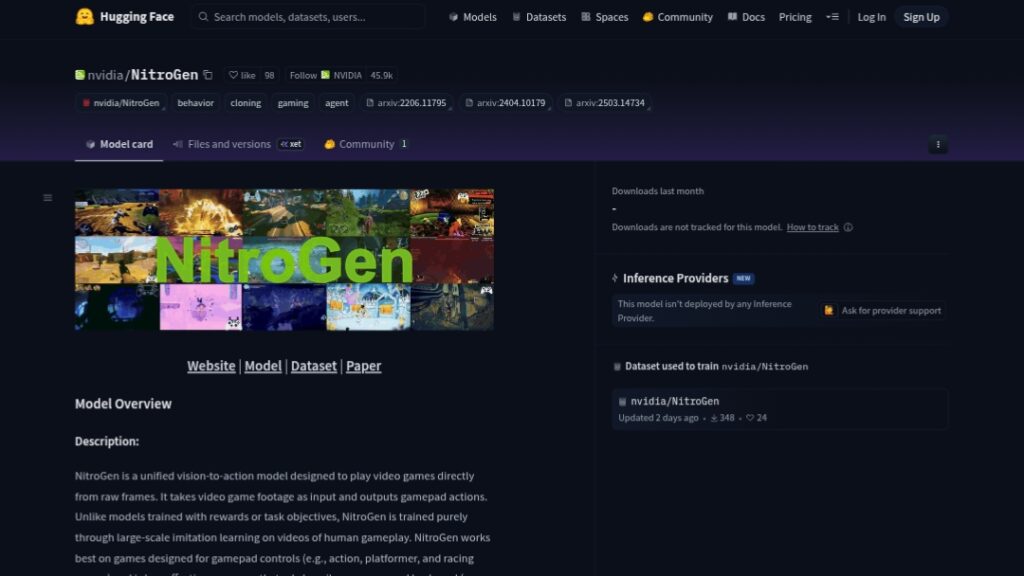
NitroGen is an open-source unified vision-to-action foundation model developed by NVIDIA researchers in collaboration with Stanford, Caltech, UChicago, UT Austin, and others.

It enables generalist gaming agents to play a wide variety of commercial video games directly from raw RGB video frames by predicting gamepad actions through large-scale behavior cloning.

Trained on 40,000 hours of internet-scale gameplay videos spanning more than 1,000 diverse titles, it learns to handle action, platformer, racing, RPG, battle royale, 2D/3D games, and more without game-specific APIs or reward signals.

The model takes 256×256 RGB inputs and outputs a 21×16 action tensor (two continuous 2D joystick vectors plus 17 binary buttons).

Architecture combines a SigLip2 Vision Transformer backbone with a Diffusion Matching Transformer (DiT) for action prediction.

It demonstrates strong zero-shot competence in complex tasks like combat, navigation, high-precision platforming, and exploration, with up to 52 percent relative improvement in task success rates when fine-tuned on unseen games compared to scratch-trained models.

Released in December 2025 with full weights on Hugging Face, dataset, universal Gymnasium API simulator for commercial games, evaluation suite, and code on GitHub under NVIDIA’s non-commercial license (backbone Apache 2.0).

Ideal for advancing embodied AI research, game testing automation, NPC behavior training, and transferring skills to robotics or real-world simulation.

As an open model, it promotes progress in generalist agents beyond narrow RL-trained bots.

Key Features

  1. Vision-to-action prediction: Maps raw 256x256 RGB game frames directly to gamepad actions (joysticks and buttons)
  2. Large-scale imitation learning: Trained purely via behavior cloning on 40,000 hours of unlabeled internet gameplay videos
  3. Multi-game generalization: Zero-shot competence across 1000+ titles in diverse genres (action, platformer, racing, RPG, etc.)
  4. High-precision control: Handles fine movements in 2D platformers and complex decision-making in 3D games
  5. Strong transfer learning: Up to 52 percent relative success rate improvement when fine-tuned on unseen games
  6. Universal simulator API: Gymnasium wrapper to run commercial games with agent control for evaluation
  7. Open dataset and eval suite: 40k-hour action-annotated videos plus multi-task benchmark across 10+ games
  8. Efficient architecture: SigLip2 ViT backbone + Diffusion Matching Transformer for scalable inference
  9. Research-focused release: Full weights, code, dataset, and paper available for community advancement

Price Plans

  1. Free ($0): Fully open-source model weights, code, dataset, and tools available on Hugging Face and GitHub under NVIDIA non-commercial license; no usage fees for research purposes
  2. Commercial (Not Available): License restricts commercial use; contact NVIDIA for potential enterprise licensing

Pros

  1. Groundbreaking generalization: First open model to play 1000+ diverse games from pixels alone
  2. Internet-scale training: Leverages massive public gameplay data without expensive human demos
  3. Strong transfer performance: Significant gains when fine-tuned on new titles compared to scratch baselines
  4. Fully open ecosystem: Weights, dataset, code, simulator, and eval suite released for research
  5. Embodied AI potential: Skills transferable to robotics and real-world simulation domains
  6. Non-commercial license clarity: Enables broad academic and open-source experimentation

Cons

  1. Non-commercial license: Restricted to research/non-commercial use per NVIDIA terms
  2. Gamepad focus limitation: Best on controller games; weaker on mouse/keyboard-heavy titles (RTS/MOBA)
  3. Hardware demands: Inference requires capable GPU for real-time or large-scale use
  4. Setup complexity: Local deployment needs Git clone, pip install, checkpoint download, and game wrappers
  5. No hosted demo: No simple web interface; requires technical setup to run
  6. Early-stage maturity: Released December 2025; community integrations and fine-tuning examples emerging
  7. Potential noise in data: Trained on unfiltered internet videos which may include suboptimal play

Use Cases

  1. Game AI research: Benchmarking generalist agents across diverse titles and tasks
  2. Game development testing: Automate playtesting, bug hunting, or NPC behavior prototyping
  3. Embodied AI transfer: Adapt gaming skills to robotics simulation or real-world control
  4. Autonomous agent training: Fine-tune on specific games for stronger performance
  5. Educational simulations: Create interactive game-based learning environments
  6. Procedural content evaluation: Test AI in generated or varied game worlds

Target Audience

  1. AI researchers in embodied intelligence: Studying generalist agents and imitation learning
  2. Game developers and studios: Exploring AI for testing, NPCs, or procedural generation
  3. Robotics and simulation engineers: Transferring pixel-to-action skills to physical domains
  4. Academic institutions: Using open dataset and model for courses/projects
  5. Open-source AI community: Fine-tuning or extending the foundation model

How To Use

  1. Clone repository: git clone https://github.com/MineDojo/NitroGen.git and cd NitroGen
  2. Install dependencies: pip install -e . to set up environment
  3. Download checkpoint: hf download nvidia/NitroGen ng.pt (or from Hugging Face)
  4. Start inference server: python scripts/serve.py path/to/ng.pt
  5. Run agent on game: python scripts/play.py --process 'game.exe' for Windows titles
  6. Prepare game: Ensure game runs and exposes window for frame capture
  7. Monitor output: Observe agent actions and performance in real-time

How we rated NitroGen

  • Performance: 4.6/5
  • Accuracy: 4.5/5
  • Features: 4.7/5
  • Cost-Efficiency: 5.0/5
  • Ease of Use: 4.0/5
  • Customization: 4.8/5
  • Data Privacy: 5.0/5
  • Support: 4.2/5
  • Integration: 4.4/5
  • Overall Score: 4.6/5

NitroGen integration with other tools

  1. Hugging Face: Model weights and dataset hosted for easy download and experimentation
  2. GitHub Repository: Full code, inference scripts, and deployment instructions available
  3. Gymnasium API: Universal simulator wrapper to run commercial games with agent control
  4. MineDojo Ecosystem: Ties into broader MineDojo framework for embodied AI research
  5. Local GPU Setup: Runs natively on NVIDIA hardware with PyTorch/CUDA

Best prompts optimised for NitroGen

  1. Not applicable - NitroGen is a vision-to-action gaming agent model that takes raw RGB frames as input and predicts gamepad actions; it does not use text prompts for generation.
NitroGen marks a major step in open embodied AI by training a single vision-to-action model on massive internet gameplay data to play over 1000 diverse games. Its strong zero-shot and transfer performance, combined with full open-source release of weights, dataset, and simulator, makes it invaluable for gaming AI research. Setup is technical, but the potential for generalist agents in games and beyond is exciting.

FAQs

  • What is NitroGen?

    NitroGen is an open-source vision-to-action foundation model from NVIDIA that plays over 1000 diverse video games directly from raw pixel frames by predicting gamepad actions.

  • When was NitroGen released?

    NitroGen was released on December 19, 2025, with model weights, dataset, code, and paper made publicly available.

  • Is NitroGen free to use?

    Yes, it is completely free and open-source with weights and code on Hugging Face/GitHub under NVIDIA’s non-commercial license for research purposes.

  • How was NitroGen trained?

    It uses large-scale behavior cloning on 40,000 hours of internet gameplay videos across 1000+ games, without rewards or game-specific APIs.

  • What games does NitroGen play best?

    It excels at gamepad-controlled titles like action, platformers, racing, RPGs, and battle royales; weaker on heavy mouse/keyboard games like RTS or MOBAs.

  • How can I run NitroGen?

    Clone the GitHub repo, install dependencies, download checkpoint from Hugging Face, start inference server, and run on Windows game executables.

  • What license does NitroGen use?

    Governed by NVIDIA One-Way Noncommercial License; backbone (SigLip2) is Apache 2.0; intended strictly for research/non-commercial use.

  • What are NitroGen’s implications beyond gaming?

    Skills learned from games can transfer to embodied AI, robotics simulation, autonomous systems training, and real-world control tasks.


Newly Added Tools​

CodeRabbit

$0/Month

Code Genius

$0/Month

AskCodi

$20/Month

PearAI

$0/Month
NitroGen Alternatives

CodeRabbit

$0/Month

Code Genius

$0/Month

AskCodi

$20/Month

NitroGen Reviews

0.0
0.0 out of 5 stars (based on 0 reviews)
Excellent0%
Very good0%
Average0%
Poor0%
Terrible0%

There are no reviews yet. Be the first one to write one.