



Zelili AI

OpenFOAM

Leading Open-Source CFD Software – Advanced Fluid Dynamics Simulation for Engineering and Research
Tool Release Date

10 Dec 2004

Tool Users
N/A
0.0
๐Ÿ‘ 53

About This AI

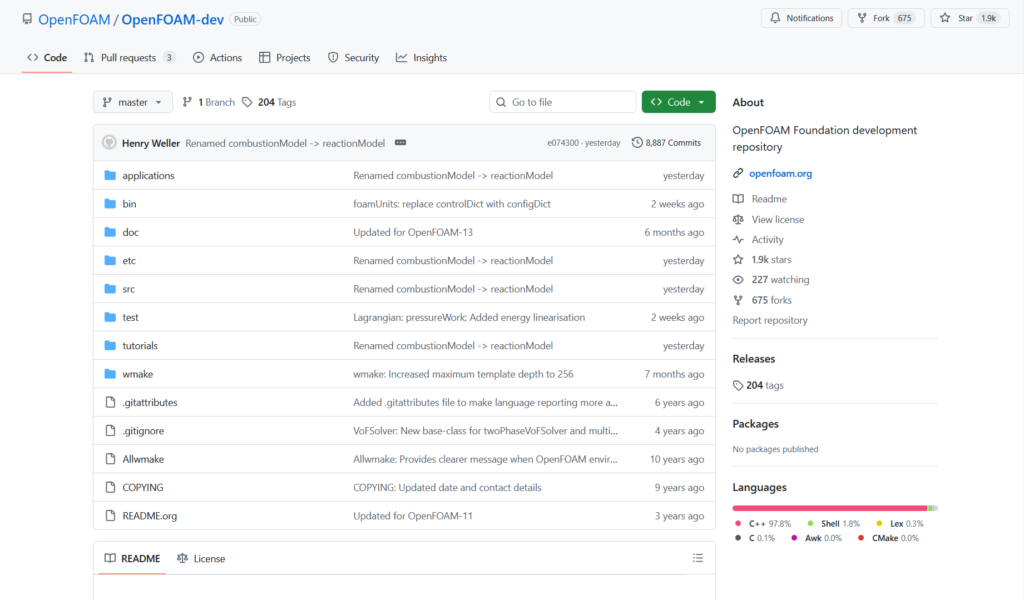
OpenFOAM is the most widely used free and open-source computational fluid dynamics (CFD) toolbox in the world.

It provides extensive capabilities for solving complex fluid flows involving turbulence, multiphase phenomena, heat transfer, chemical reactions, solid mechanics, electromagnetics, and more.

The software supports a wide range of discretization methods (finite volume primarily), unstructured meshes, polyhedral support, dynamic mesh motion, and overset grids.

Users can perform steady-state, transient, incompressible, compressible, laminar, turbulent (RANS, LES, DES), reacting flows, conjugate heat transfer, particle tracking, and fluid-structure interaction simulations.

Key strengths include high customizability through C++ programming, ability to add new physics/models via solvers/utilities, parallel computing with excellent scalability, and integration with pre/post-processing tools like ParaView.

Maintained by the OpenFOAM Foundation and ESI-OpenCFD (OpenFOAM.com edition), it has two main variants: OpenFOAM.org (community-driven) and OpenFOAM.com (ESI-maintained with additional features and commercial support).

Released under GPL license since 2004, it powers academic research, industrial design (aerospace, automotive, energy, marine, HVAC), and product development worldwide.

With a massive user community, thousands of solvers/utilities, and active development, OpenFOAM remains the gold standard for accessible high-fidelity CFD without licensing costs.

Key Features

  1. Finite Volume Method Solver: Core discretization for incompressible and compressible flows with second-order accuracy
  2. Turbulence Modeling: Extensive RANS (k-epsilon, k-omega SST), LES, DES, hybrid models, and wall functions
  3. Multiphase Flows: VOF, Eulerian-Eulerian, Lagrangian particle tracking, and interface capturing
  4. Dynamic Mesh Capabilities: Moving meshes, AMI, overset grids, mesh morphing, and sixDoFR solvers
  5. Heat Transfer and Conjugate: Conjugate heat transfer, radiation models, porous media, and buoyancy effects
  6. Chemical Reactions: Combustion, species transport, reactingFoam, XiFoam, and detailed chemistry support
  7. Parallel Computing: Domain decomposition, excellent scalability on HPC clusters (MPI-based)
  8. Custom Solvers and Utilities: Full C++ source access to add new physics, boundary conditions, or post-processing
  9. Pre- and Post-Processing: Integration with blockMesh, snappyHexMesh, cfMesh, ParaView, and Salome
  10. Free Surface and Immersed Boundary: Advanced free-surface tracking and immersed boundary methods

Price Plans

  1. Free ($0): Full open-source version (both OpenFOAM.org and OpenFOAM.com editions) with all solvers, utilities, and source code; no usage limits
  2. Commercial Support (Custom): ESI Group provides paid training, consulting, priority support, and extended features (pricing on request)
  3. Cloud/HPC (Variable): Run on cloud platforms (AWS, Azure) or HPC clusters; costs depend on compute usage

Pros

  1. Completely free and open-source: No licensing fees, full source code access under GPL
  2. Highly customizable: Modify or extend any solver/model with C++ programming
  3. Industry-proven accuracy: Used in aerospace, automotive, energy, and research worldwide
  4. Strong community support: Active forums, wikis, thousands of tutorials, and annual workshops
  5. Excellent scalability: Runs efficiently on thousands of cores for large-scale simulations
  6. Continuous development: Regular major releases with new physics and performance improvements
  7. Wide physics coverage: Handles almost any fluid flow problem from laminar to hypersonic

Cons

  1. Steep learning curve: Requires CFD knowledge, Linux familiarity, and programming for advanced use
  2. Command-line heavy: Text-based case setup (no native GUI for all tasks)
  3. Mesh generation complex: snappyHexMesh powerful but challenging for beginners
  4. Windows/macOS support limited: Best on Linux; WSL/Docker needed for other OS
  5. Commercial support separate: ESI-OpenCFD offers paid training/support; community version free
  6. Post-processing requires ParaView: External tool needed for visualization
  7. Long setup time: Case preparation and debugging can be time-consuming

Use Cases

  1. Aerodynamics optimization: External flow around vehicles, aircraft, wind turbines
  2. Internal flows: HVAC systems, pumps, turbines, combustors
  3. Multiphase processes: Oil/gas separation, bubble columns, free-surface waves
  4. Heat transfer analysis: Electronics cooling, heat exchangers, conjugate problems
  5. Combustion simulation: Engines, burners, fire safety, explosions
  6. Marine hydrodynamics: Ship resistance, propellers, slamming, seakeeping
  7. Research and academia: Developing new turbulence models, validation studies

Target Audience

  1. CFD engineers and researchers: Performing high-fidelity fluid simulations
  2. Aerospace and automotive industries: Aerodynamics, thermal management
  3. Energy sector: Turbomachinery, renewable energy, oil/gas
  4. Academic institutions: Teaching CFD, conducting research
  5. Marine and offshore engineering: Hydrodynamics and wave simulations
  6. Manufacturing and HVAC: Product design and optimization

How To Use

  1. Install OpenFOAM: Download from openfoam.com or openfoam.org; use package managers on Linux or Docker/WSL on Windows
  2. Create case directory: Set up folder with 0/, constant/, system/ subfolders
  3. Define geometry and mesh: Use blockMesh for simple cases or snappyHexMesh for complex CAD
  4. Set boundary/initial conditions: Edit files in 0/ directory (velocity, pressure, temperature, etc.)
  5. Choose solver: Select appropriate solver (e.g., simpleFoam, pimpleFoam, reactingParcelFoam) in system/controlDict
  6. Run simulation: Execute solver command (e.g., simpleFoam -parallel) in terminal
  7. Post-process: Open results in ParaView for visualization and analysis

How we rated OpenFOAM

  • Performance: 4.8/5
  • Accuracy: 4.9/5
  • Features: 4.9/5
  • Cost-Efficiency: 5.0/5
  • Ease of Use: 3.8/5
  • Customization: 5.0/5
  • Data Privacy: 5.0/5
  • Support: 4.4/5
  • Integration: 4.6/5
  • Overall Score: 4.7/5

OpenFOAM integration with other tools

  1. ParaView: Native post-processing and visualization tool bundled with OpenFOAM
  2. Salome Platform: Pre-processing for geometry and meshing integration
  3. HELYX-OS: Open-source GUI for case setup and running OpenFOAM simulations
  4. cfMesh and snappyHexMesh: Built-in advanced meshing utilities
  5. HPC Clusters: MPI parallelization for large-scale runs on supercomputers

Best prompts optimised for OpenFOAM

  1. Not applicable - OpenFOAM is a computational fluid dynamics simulation toolbox, not a generative AI tool. It uses case setup files, dictionaries, and C++ code rather than text prompts for simulations.
  2. N/A - This tool runs physics-based solvers on user-defined meshes and conditions; no natural language prompting interface exists.
  3. N/A - Focus is on numerical simulation setup via configuration files and command-line execution, not AI prompt-based generation.
OpenFOAM remains the premier open-source CFD toolbox, offering unmatched flexibility, physics coverage, and scalability at zero cost. Its customizability and community make it ideal for research and industry, though the steep learning curve and lack of GUI suit experienced users best. Essential for serious fluid dynamics work.

FAQs

  • What is OpenFOAM?

    OpenFOAM is the leading free and open-source computational fluid dynamics (CFD) toolbox for simulating complex fluid flows, heat transfer, turbulence, multiphase, and reacting flows.

  • Is OpenFOAM free to use?

    Yes, it is completely free and open-source under GPL license with full source code available; no licensing fees for any use.

  • Who maintains OpenFOAM?

    Two main editions exist: OpenFOAM Foundation (openfoam.org – community-driven) and ESI-OpenCFD (openfoam.com – commercial support and extensions).

  • What operating systems support OpenFOAM?

    Primarily Linux (native best performance); Windows via WSL/Docker, macOS via Docker or compilation; Linux recommended for production use.

  • Does OpenFOAM require programming knowledge?

    Basic use needs case setup via dictionaries; advanced customization, new models, or debugging require C++ programming skills.

  • What are the main applications of OpenFOAM?

    Aerodynamics, turbomachinery, combustion, multiphase flows, heat transfer, marine hydrodynamics, and research in fluid mechanics.

  • How large is the OpenFOAM community?

    One of the largest in CFD with thousands of active users, extensive forums, wikis, tutorials, and annual conferences/workshops.

  • Can OpenFOAM handle large-scale simulations?

    Yes, excellent parallel scalability (MPI) allows runs on thousands of cores for industrial and research-scale problems.


Newly Added Toolsโ€‹

Qwen-Image-2.0

$0/Month

Qodo AI

$0/Month

Codiga

$10/Month

Tabnine

$59/Month
OpenFOAM Alternatives

Qodo AI

$0/Month

Codiga

$10/Month

Tabnine

$59/Month

OpenFOAM Reviews

0.0
0.0 out of 5 stars (based on 0 reviews)
Excellent0%
Very good0%
Average0%
Poor0%
Terrible0%

There are no reviews yet. Be the first one to write one.