



Zelili AI

Qwen3-Coder-Next

Ultra-Efficient Open-Weight Coding Agent Model – 3B Active Parameters with 80B Total for Frontier Agentic Coding Performance
Tool Users
N/A
0.0
๐Ÿ‘ 41

About This AI

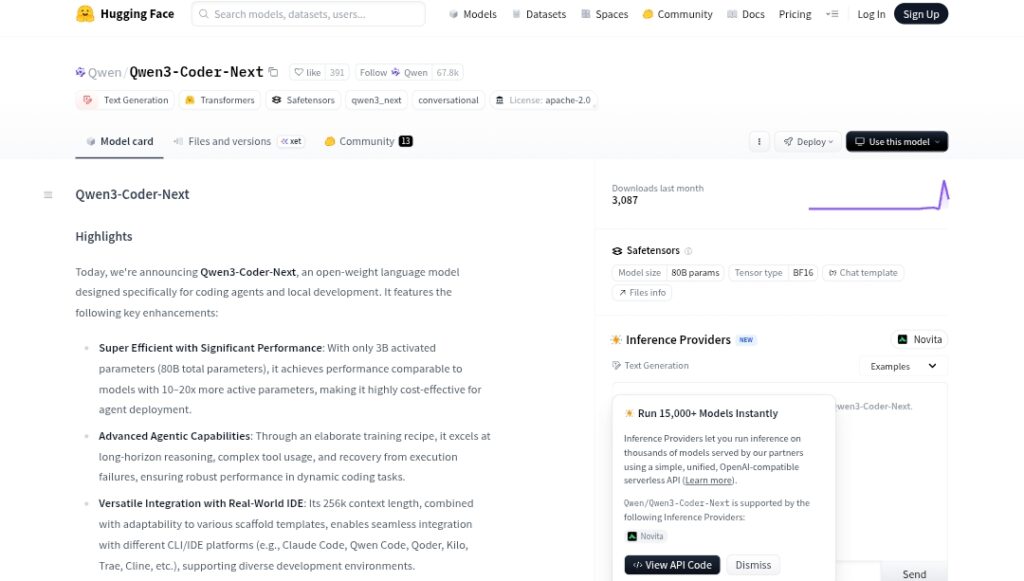
Qwen3-Coder-Next is an open-weight language model from Alibaba’s Qwen team, released on February 2, 2026, specifically designed for coding agents and local development.

Built on the Qwen3-Next-80B-A3B-Base with hybrid attention and Mixture-of-Experts (MoE) architecture, it activates only 3B parameters per token while maintaining 80B total parameters for exceptional efficiency.

It excels in long-horizon reasoning, complex tool usage, recovery from execution failures, and multi-turn agentic tasks through large-scale agentic training on verifiable coding tasks, executable environments, reinforcement learning, continued pretraining on code/agent data, supervised fine-tuning on high-quality trajectories, domain-specialized expert training, and expert distillation.

The model supports seamless integration with real-world IDEs and scaffolds (e.g., OpenClaw, Qwen Code, Claude Code, Cline), with 256K context length for handling large codebases.

It achieves over 70% on SWE-Bench Verified using SWE-Agent, strong results on SWE-Bench Pro, TerminalBench 2.0, Aider, and multilingual settings, often matching or exceeding models with 10xโ€“20x more active parameters in agent-centric evaluations.

Available on Hugging Face (https://huggingface.co/Qwen/Qwen3-Coder-Next), ModelScope, and GitHub under Apache 2.0 license, with demos for chat interfaces, web development, games, and more via Qwen Chat or local deployment.

Ideal for developers building coding agents, local IDE integrations, or cost-effective deployment where high performance meets low inference costs in agentic coding workflows.

Key Features

  1. Ultra-sparse MoE architecture: 80B total parameters with only 3B activated per token for high efficiency and low inference cost
  2. Advanced agentic capabilities: Long-horizon reasoning, multi-step planning, tool calling, and automatic recovery from execution errors
  3. 256K context length: Handles large codebases and repositories without truncation
  4. Strong tool usage: Reliable interaction with external environments and scaffolds for dynamic coding tasks
  5. Reinforcement learning from execution feedback: Trained on verifiable tasks with environment interaction for robust performance
  6. Seamless IDE/CLI integration: Compatible with OpenClaw, Qwen Code, Claude Code, Cline, and other scaffolds
  7. Multilingual coding support: Competitive on multilingual SWE-Bench and other diverse benchmarks
  8. High throughput: Enables fast local or server deployment for real-time agentic workflows
  9. Open-weight availability: Full weights on Hugging Face and ModelScope under Apache 2.0 for commercial use
  10. Continued pretraining and expert distillation: Combines code-focused data, agent trajectories, and specialized domains for balanced expertise

Price Plans

  1. Free ($0): Fully open-weight model with weights, code, and inference support available at no cost under Apache 2.0
  2. Cloud API (Paid via DashScope or similar): Optional hosted access through Alibaba Cloud or third-party providers with token-based pricing for convenience
  3. Enterprise (Custom): Potential premium support or scaled deployment through Alibaba Cloud services

Pros

  1. Exceptional efficiency: Matches 10xโ€“20x larger models in agentic benchmarks with far lower active parameters and cost
  2. Strong SWE-Bench performance: Over 70% on Verified using SWE-Agent, competitive on Pro and other agent-centric evals
  3. Robust agentic behavior: Excels at recovery, long tasks, and tool interaction for real-world coding agents
  4. Local development friendly: Low resource needs make it ideal for on-device or edge deployment
  5. Fully open and permissive: Apache 2.0 license enables unrestricted commercial and research use
  6. Fast inference potential: Sparse design delivers high throughput compared to dense equivalents
  7. Versatile scaffolds: Works well with popular agent frameworks and IDE integrations

Cons

  1. Recent release: Limited independent verifications and community quantizations/GGUF versions emerging slowly
  2. Requires strong hardware for full speed: While efficient, 80B total needs sufficient GPU memory (quantized versions help)
  3. No built-in thinking mode in base: Some variants need specific enable_thinking flags or configurations
  4. Focused on agentic coding: Less general-purpose than full Qwen3 series for non-coding tasks
  5. Setup for advanced inference: Optimal performance needs SGLang v0.5.8+ or compatible frameworks
  6. Limited official user stats: Adoption data not widely published yet as a very new release
  7. Potential scaffold dependency: Best results with specific agent harnesses like SWE-Agent

Use Cases

  1. Coding agent development: Build autonomous agents for code generation, debugging, and multi-turn fixes
  2. Local IDE enhancement: Integrate into VS Code, Cursor, or custom CLIs for real-time code assistance
  3. Repository-scale tasks: Analyze and refactor large codebases with long context
  4. Automated software engineering: Handle SWE-Bench style issues with tool use and error recovery
  5. Research in agentic AI: Experiment with reinforcement learning and executable feedback loops
  6. Cost-effective deployment: Run high-performance agents on consumer hardware
  7. Multilingual code support: Work on diverse programming languages and regional codebases

Target Audience

  1. AI developers and agent builders: Creating coding assistants or autonomous dev tools
  2. Software engineers: Using local/offline coding help with strong agentic features
  3. Open-source researchers: Studying efficient MoE and agentic training methods
  4. Indie developers: Needing powerful coding AI without high cloud costs
  5. Enterprises: Deploying secure, local coding agents at scale
  6. Students and educators: Learning advanced coding and AI agent concepts

How To Use

  1. Install dependencies: Use pip install transformers>=4.45 or sglang>=0.5.8 for fast serving
  2. Load model: from transformers import AutoModelForCausalLM; model = AutoModelForCausalLM.from_pretrained('Qwen/Qwen3-Coder-Next', device_map='auto')
  3. Generate code: Use model.generate() with prompts; enable thinking mode if needed via flags
  4. Run with SGLang: python -m sglang.launch_server --model Qwen/Qwen3-Coder-Next --port 30000 --tp-size 2 --tool-call-parser qwen3_coder
  5. Try demos: Visit coder.qwen.ai or Hugging Face Spaces for no-code testing
  6. Agent scaffolds: Integrate with SWE-Agent, OpenClaw, or Cline for full agentic workflows
  7. Quantize if needed: Use GGUF versions (e.g., from unsloth) for lower VRAM requirements

How we rated Qwen3-Coder-Next

  • Performance: 4.8/5
  • Accuracy: 4.7/5
  • Features: 4.9/5
  • Cost-Efficiency: 5.0/5
  • Ease of Use: 4.5/5
  • Customization: 4.6/5
  • Data Privacy: 4.9/5
  • Support: 4.4/5
  • Integration: 4.7/5
  • Overall Score: 4.8/5

Qwen3-Coder-Next integration with other tools

  1. Hugging Face Transformers: Direct loading and inference with standard library for easy local deployment
  2. SGLang Serving Framework: Fast OpenAI-compatible API server with tool-call parsing for agentic use
  3. SWE-Agent and OpenClaw: Seamless compatibility with popular coding agent scaffolds for automated tasks
  4. Qwen Chat and coder.qwen.ai: Web-based demo interfaces for quick testing without setup
  5. GitHub and ModelScope: Full code, weights, and community resources for fine-tuning or extensions

Best prompts optimised for Qwen3-Coder-Next

  1. You are an expert software engineer. Fix this bug in the following Python code: [paste buggy code]. Use step-by-step reasoning, test cases, and execute fixes in a loop until it works. Output the final corrected code.
  2. Implement a complete React component for a responsive todo list app with add, edit, delete, and drag-to-reorder features. Use TypeScript, Tailwind CSS, and include state management with Zustand. Provide full code with explanations.
  3. Analyze this large codebase repository [describe structure or paste key files]. Suggest a major refactor to improve modularity and testability. Output a plan, then implement changes for the main module.
  4. Write a secure REST API in FastAPI for user authentication with JWT, password hashing, rate limiting, and PostgreSQL integration. Include endpoints for register, login, refresh token, and protected routes.
  5. Debug and optimize this slow SQL query: [paste query]. Rewrite it for better performance, add indexes if needed, and explain the improvements step by step.
Qwen3-Coder-Next delivers impressive agentic coding performance with just 3B active parameters from an 80B MoE base, hitting over 70% on SWE-Bench Verified and rivaling much larger models in efficiency. Its focus on tool use, error recovery, and long-horizon tasks makes it ideal for local agents and IDE integrations. Fully open under Apache 2.0, it’s a top choice for cost-effective, high-capability coding AI.

FAQs

  • What is Qwen3-Coder-Next?

    Qwen3-Coder-Next is an open-weight coding agent model from Alibaba’s Qwen team, released February 2, 2026, with 80B total parameters but only 3B activated via MoE for efficient agentic performance.

  • When was Qwen3-Coder-Next released?

    It was announced and released on February 2, 2026, as per the official Qwen blog post.

  • What are the key features of Qwen3-Coder-Next?

    It excels at agentic coding with long-horizon reasoning, tool use, error recovery, 256K context, and integration with scaffolds like SWE-Agent, achieving over 70% on SWE-Bench Verified.

  • Is Qwen3-Coder-Next free and open-source?

    Yes, it’s fully open-weight under Apache 2.0 license, with weights on Hugging Face and ModelScope at no cost for local or commercial use.

  • How efficient is Qwen3-Coder-Next?

    With only 3B active parameters, it matches models with 10-20x more active params in agentic benchmarks, enabling high throughput and low-cost deployment.

  • What benchmarks does Qwen3-Coder-Next excel on?

    It scores over 70% on SWE-Bench Verified (SWE-Agent), strong on SWE-Bench Pro, TerminalBench 2.0, Aider, and multilingual agent tasks.

  • How can I run Qwen3-Coder-Next locally?

    Load via Transformers or SGLang (recommended for fast serving); quantized GGUF versions available for lower VRAM; try demos on coder.qwen.ai.

  • What is the context length of Qwen3-Coder-Next?

    It supports a 256K token context window, ideal for large codebases and long agent interactions.

Newly Added Toolsโ€‹

Qodo AI

$0/Month

Codiga

$10/Month

Tabnine

$59/Month

CodeRabbit

$0/Month
Qwen3-Coder-Next Alternatives

Qodo AI

$0/Month

Codiga

$10/Month

Tabnine

$59/Month

Qwen3-Coder-Next Reviews

0.0
0.0 out of 5 stars (based on 0 reviews)
Excellent0%
Very good0%
Average0%
Poor0%
Terrible0%

There are no reviews yet. Be the first one to write one.