
What is SpotEdit?
SpotEdit is a training-free framework for selective region editing in Diffusion Transformer models, allowing precise local changes without regenerating the entire image.
When was SpotEdit released?
SpotEdit was published on arXiv on December 26, 2025 (paper 2512.22323), with code available on GitHub shortly after.
Is SpotEdit free to use?
Yes, it’s completely open-source and free with code on GitHub under standard academic licensing (no costs involved).
How does SpotEdit work?
It uses SpotSelector to identify and skip stable regions via perceptual similarity, and SpotFusion to blend edited tokens seamlessly, boosting speed by ~2× while preserving fidelity.
What models does SpotEdit support?
SpotEdit is designed specifically for Diffusion Transformer (DiT) models; it’s plug-and-play with existing DiT-based editing pipelines.
Does SpotEdit require training?
No, it’s completely training-free and works directly on pre-trained DiT models without any additional fine-tuning.
Where can I find SpotEdit code?
The official GitHub repo is at https://github.com/Biangbiang0321/SpotEdit, including implementation details and examples.
What are SpotEdit’s main advantages?
It provides efficient local editing, nearly doubles inference speed for small changes, and perfectly preserves unmodified areas without manual masks.

SpotEdit

About This AI
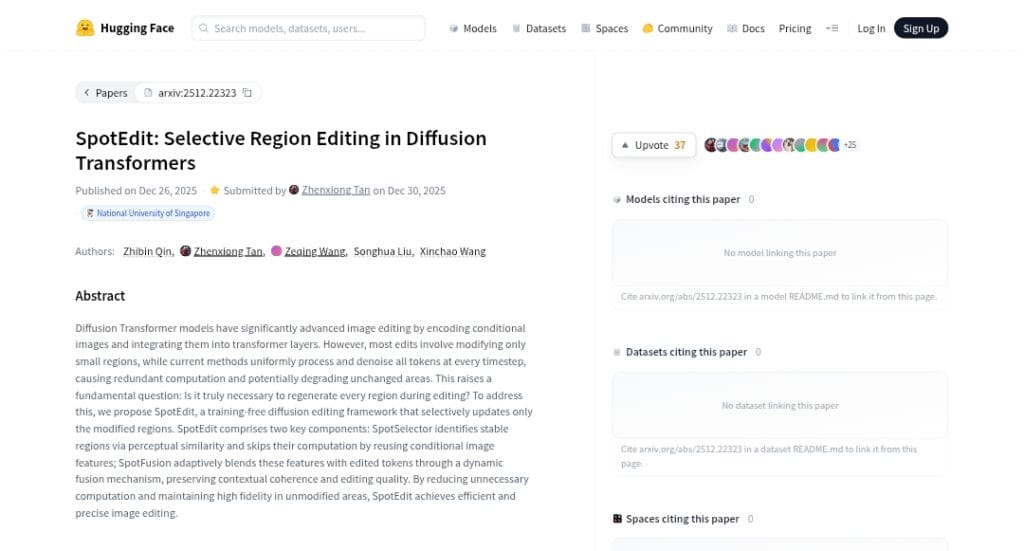
SpotEdit is a training-free, plug-and-play framework for precise local image editing using Diffusion Transformer (DiT) models.
It addresses the inefficiency of traditional diffusion-based editors that regenerate the entire image even for small changes, leading to redundant computation and potential degradation in unchanged areas.
SpotEdit consists of two main components: SpotSelector, which automatically identifies stable (non-edited) regions via perceptual similarity and reuses their original conditional image features to skip unnecessary denoising steps, and SpotFusion, which adaptively blends the reused features with newly edited tokens through a dynamic fusion mechanism to ensure contextual coherence and high editing quality.
This approach enables true local editing, preserving every detail in unmodified regions (e.g., backgrounds) while only processing the targeted area.
It boosts inference speed by nearly 2× by avoiding background computation and maintains fidelity without manual masks or retraining.
Released as an open-source project on December 26, 2025 (arXiv:2512.22323), SpotEdit is designed for DiT-based models and includes code on GitHub for easy integration.
Ideal for scenarios requiring small, targeted modifications like adding objects to photos without altering surroundings, it represents an efficient enhancement for existing diffusion editing pipelines in research and creative applications.
Key Features
- Training-free framework: Plug-and-play enhancement for existing Diffusion Transformer models without retraining
- SpotSelector mechanism: Automatically detects stable regions using perceptual similarity to reuse original features and skip computation
- SpotFusion blending: Dynamic adaptive fusion of reused original features with edited tokens for seamless coherence
- Selective region processing: Only updates modified areas, preserving unmodified regions perfectly
- Massive speed boost: Nearly 2× faster inference by eliminating redundant background denoising
- Mask-free local editing: No manual masks required; edits based on instruction prompts
- High fidelity preservation: Maintains every detail in unchanged areas without distortion or artifacts
- Compatible with DiT models: Works universally with Diffusion Transformers for instruction-based editing
- Open-source implementation: Full code available on GitHub for research and custom use
Price Plans
- Free ($0): Fully open-source framework with code, weights (if available), and usage rights under standard academic license (no costs, no restrictions beyond code terms)
Pros
- Highly efficient: Cuts computation significantly for small edits, enabling faster workflows
- Preserves original quality: Achieves true local editing with perfect background fidelity
- Training-free: Easy to apply to existing models without data or compute for fine-tuning
- Mask-free operation: Automatic region detection simplifies user experience
- Strong coherence: Adaptive fusion ensures edited parts blend naturally with originals
- Open-source accessibility: Free code on GitHub for experimentation and integration
- Research-grade innovation: Addresses real pain points in diffusion editing pipelines
Cons
- Academic/research focus: Requires technical setup (DiT model, code integration) for use
- No hosted demo/app: No user-friendly web interface or pre-built tool; GitHub code only
- Limited to DiT models: Designed specifically for Diffusion Transformers; not plug-and-play for other architectures
- Recent release: Limited community testing and integrations as of early 2026
- Potential accuracy variability: Region detection relies on perceptual similarity; complex prompts may need tuning
- No commercial support: Academic project without enterprise features or dedicated support
- Setup complexity: Users need familiarity with diffusion models and Python environments
Use Cases
- Targeted photo editing: Add small objects (e.g., scarf on dog) without regenerating background
- Creative refinement: Modify specific elements in images while keeping surroundings identical
- Research experimentation: Test efficient editing in DiT-based pipelines
- Content creation: Precise local changes for social media, marketing visuals, or art
- Product visualization: Alter details in product shots without full re-rendering
- Batch small edits: Efficiently process multiple minor modifications at scale
Target Audience
- AI researchers: Studying diffusion models and efficient editing techniques
- Computer vision developers: Integrating advanced local editing into tools or apps
- Digital artists: Needing precise control in generative workflows
- Content creators: Wanting fast targeted edits without artifacts
- Academic teams: Experimenting with training-free enhancements for DiTs
How To Use
- Clone repo: Git clone https://github.com/Biangbiang0321/SpotEdit
- Install dependencies: Follow README to set up environment (PyTorch, DiT model requirements)
- Load DiT model: Prepare base Diffusion Transformer model for editing
- Run inference: Use provided scripts with input image and edit instruction prompt
- Apply SpotEdit: Enable selective processing during denoising steps
- Generate output: Run to produce edited image with preserved unchanged regions
- Customize: Adjust perceptual thresholds or fusion params if needed for specific cases
How we rated SpotEdit
- Performance: 4.7/5
- Accuracy: 4.6/5
- Features: 4.5/5
- Cost-Efficiency: 5.0/5
- Ease of Use: 4.0/5
- Customization: 4.4/5
- Data Privacy: 5.0/5
- Support: 4.0/5
- Integration: 4.3/5
- Overall Score: 4.6/5
SpotEdit integration with other tools
- Diffusion Transformer Models: Plug-and-play compatibility with existing DiT-based image editing pipelines
- GitHub Codebase: Direct integration into custom Python scripts or research frameworks via provided implementation
- Hugging Face Ecosystem: Potential use with DiT models hosted on Hugging Face (e.g., via transformers library)
- Local Development Tools: Works with PyTorch environments, Jupyter notebooks, and custom inference setups
- Research Benchmarks: Compatible with evaluation suites for diffusion editing tasks
Best prompts optimised for SpotEdit
- Add a red scarf around the dog's neck while keeping the background and rest of the dog unchanged
- Change the shirt color to blue on the person in the photo, preserve all other details exactly
- Replace the sky with a sunset view but keep the foreground landscape and subjects identical
- Remove the watermark in the corner without affecting any other part of the image
- Add sunglasses to the subject's face, maintaining natural lighting and background fidelity
FAQs
Newly Added Tools






About Author