



Zelili AI

StereoSpace

Depth-Free Monocular-to-Stereo Synthesis – End-to-End Diffusion for Realistic Stereo Images Without Explicit Geometry
Tool Release Date

11 Dec 2025

Tool Users
N/A
0.0
๐Ÿ‘ 104

About This AI

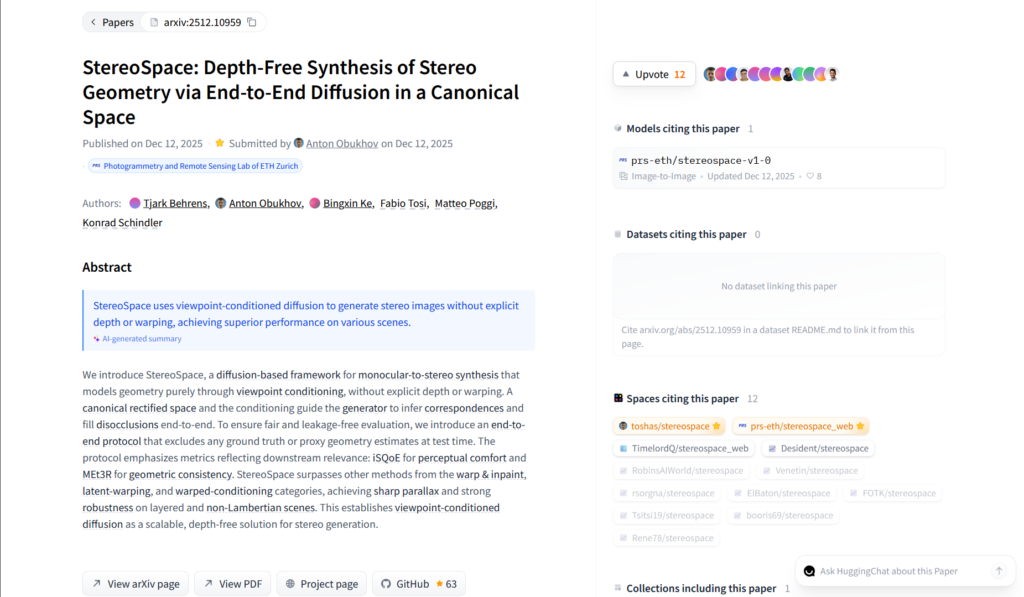
StereoSpace is a cutting-edge diffusion-based framework for converting monocular (single-view) images into high-quality stereo pairs, modeling geometry purely through viewpoint conditioning in a canonical rectified space.

It eliminates the need for explicit depth estimation, warping, or ground-truth geometry during inference, achieving end-to-end synthesis of correspondences and disocclusion filling.

The model excels in challenging scenarios like thin structures, transparencies, layered scenes, and non-Lambertian surfaces, producing sharp parallax and natural stereo effects with superior perceptual comfort and geometric consistency.

Developed by researchers from ETH Zurich’s Photogrammetry and Remote Sensing Lab (authors: Tjark Behrens, Anton Obukhov, Bingxin Ke, Fabio Tosi, Matteo Poggi, Konrad Schindler), the paper was published on December 11, 2025 (arXiv:2512.10959).

It outperforms traditional warp-and-inpaint, latent-warping, and warped-conditioning methods on benchmarks like iSQoE (perceptual stereo quality) and MEt3R (geometric accuracy).

A public interactive demo is available on Hugging Face Spaces, allowing users to upload a single image and generate stereo views instantly.

Code is open-sourced on GitHub (prs-eth/stereospace), and the project page provides additional details and results.

While not a full world model, StereoSpace advances depth-free stereo generation, making it highly relevant for VR/AR content creation, 3D photography, and immersive media from 2D sources.

As a recent research release, it has no widespread user numbers yet but is gaining attention in computer vision and AI communities for its scalable, geometry-free approach.

Key Features

  1. Depth-free stereo synthesis: Generates stereo pairs from monocular images without explicit depth maps or warping
  2. Viewpoint-conditioned diffusion: Models geometry via conditioning in a canonical rectified space for end-to-end inference
  3. Robust handling of challenges: Excels on thin structures, transparencies, layered scenes, and non-Lambertian surfaces
  4. Sharp parallax and natural effects: Produces realistic stereo with strong disocclusion filling and correspondence inference
  5. Perceptual and geometric benchmarks: Superior iSQoE (comfort) and MEt3R (consistency) scores over warp-based methods
  6. Interactive demo: Upload any image on Hugging Face Spaces for instant stereo pair generation
  7. Open-source code: Full implementation available on GitHub for local running and extension
  8. Scalable approach: Establishes viewpoint-conditioned diffusion as a viable depth-free alternative for stereo generation

Price Plans

  1. Free ($0): Completely free research demo on Hugging Face Spaces and open-source code on GitHub; no paid tiers or subscriptions mentioned
  2. Potential Future (N/A): No commercial or premium plans indicated in paper or project page

Pros

  1. Eliminates depth dependency: No need for explicit geometry or proxy depth, simplifying pipeline and improving robustness
  2. High robustness: Handles difficult cases (transparencies, thin objects) better than traditional methods
  3. Superior quality metrics: Outperforms warp-and-inpaint and latent-warping baselines on perceptual and geometric benchmarks
  4. Easy demo access: Free interactive web demo on Hugging Face for quick testing
  5. Open-source availability: Code released on GitHub for research, extension, and local deployment
  6. Potential VR/AR applications: Enables quick stereo conversion for immersive content from 2D photos

Cons

  1. Research-focused: Primarily a paper/demo; no production-ready hosted service or API yet
  2. Limited to stereo pairs: Generates static stereo images, not full 3D models or videos
  3. Recent release: No widespread adoption or user metrics; still early-stage with potential undiscovered edge cases
  4. Compute requirements: Diffusion-based inference may be slow on consumer hardware without optimization
  5. No explicit 3D output: Focuses on stereo views rather than explicit depth maps or meshes
  6. Demo limitations: Web demo may have queue times or resolution caps during high usage

Use Cases

  1. 3D photography conversion: Turn 2D photos into stereo pairs for VR/AR viewing or 3D displays
  2. VR content creation: Quickly generate stereo images from monocular shots for immersive experiences
  3. Research in stereo vision: Baseline for depth-free geometry synthesis and viewpoint-conditioned diffusion
  4. Augmented reality prototyping: Create stereo visuals from single images for AR previews
  5. Creative media: Generate 3D-like effects from 2D artwork or photos for artistic projects
  6. Film pre-visualization: Test stereo camera setups or depth perception in shots without real stereo capture

Target Audience

  1. Computer vision researchers: Studying depth-free stereo synthesis and diffusion models
  2. VR/AR developers: Needing quick stereo conversion for content prototyping
  3. 3D content creators: Converting 2D images to stereo for immersive media
  4. Photogrammetry experts: Exploring geometry-free alternatives to traditional stereo matching
  5. AI enthusiasts: Testing cutting-edge Hugging Face demos for fun or experimentation
  6. Academic labs: Reproducing or extending the ETH Zurich research

How To Use

  1. Access demo: Visit huggingface.co/spaces/prs-eth/stereospace_web
  2. Upload image: Drag and drop or browse a single monocular photo
  3. Generate stereo: Click process; AI creates left/right views or SBS pair
  4. View result: Download stereo image or view in 3D/VR mode if supported
  5. Run locally: Clone GitHub repo (github.com/prs-eth/stereospace), install deps, load model
  6. Input custom: Use provided scripts for batch or advanced inference
  7. Experiment: Test on challenging images (transparencies, thin objects) to see robustness

How we rated StereoSpace

  • Performance: 4.6/5
  • Accuracy: 4.7/5
  • Features: 4.5/5
  • Cost-Efficiency: 5.0/5
  • Ease of Use: 4.4/5
  • Customization: 4.3/5
  • Data Privacy: 4.8/5
  • Support: 4.2/5
  • Integration: 4.4/5
  • Overall Score: 4.6/5

StereoSpace integration with other tools

  1. Hugging Face Spaces: Hosted interactive demo for quick online testing without installation
  2. GitHub Repository: Full open-source code and implementation for local running and modification
  3. Potential VR/AR Tools: Stereo outputs compatible with viewers like Side-by-Side formats in VR headsets or apps
  4. Diffusion Frameworks: Built on standard diffusion pipelines; integrable with ComfyUI or Automatic1111 extensions
  5. Research Pipelines: Easily extendable in PyTorch-based computer vision workflows

Best prompts optimised for StereoSpace

  1. N/A - StereoSpace is an image-to-stereo synthesis tool that takes a single uploaded monocular image as input and automatically generates stereo pairs via viewpoint-conditioned diffusion; no text prompts are required or used for generation.
  2. N/A - The model operates end-to-end from a single photo without additional prompting; simply provide the input image in the demo or code.
StereoSpace delivers impressive depth-free stereo synthesis from single images, excelling in robust parallax and handling tricky scenes like transparencies without explicit geometry. The free Hugging Face demo and open-source code make it highly accessible for VR prototyping and research. As a recent paper release, it’s a promising advancement in viewpoint-conditioned diffusion for 3D-from-2D conversion.

FAQs

  • What is StereoSpace?

    StereoSpace is a diffusion-based research framework that converts single monocular images into high-quality stereo pairs without using explicit depth maps or warping, relying on viewpoint-conditioned diffusion in a canonical space.

  • When was StereoSpace released?

    The paper was published on arXiv on December 11, 2025, with a Hugging Face demo and GitHub code released around December 16, 2025.

  • Is StereoSpace free to use?

    Yes, it is completely free with an interactive demo on Hugging Face Spaces and open-source code on GitHub; no paid tiers or subscriptions.

  • How does StereoSpace work?

    It uses viewpoint-conditioned diffusion to generate stereo geometry end-to-end from a single image, inferring correspondences and filling disocclusions without depth estimation.

  • Where can I try StereoSpace?

    Use the free public demo at huggingface.co/spaces/prs-eth/stereospace_web; upload any photo to generate stereo views instantly.

  • Who created StereoSpace?

    Developed by researchers at ETH Zurich’s Photogrammetry and Remote Sensing Lab: Tjark Behrens, Anton Obukhov, Bingxin Ke, Fabio Tosi, Matteo Poggi, Konrad Schindler.

  • What makes StereoSpace better than other methods?

    It outperforms warp-and-inpaint, latent-warping, and warped-conditioning approaches on perceptual comfort (iSQoE) and geometric consistency (MEt3R), especially for thin/translucent objects.

  • Is StereoSpace open-source?

    Yes, the code is available on GitHub (prs-eth/stereospace), and the model/demo is hosted on Hugging Face for free use and experimentation.


Newly Added Toolsโ€‹

CodeRabbit

$0/Month

Code Genius

$0/Month

AskCodi

$20/Month

PearAI

$0/Month
StereoSpace Alternatives

GLM-OCR

$0/Month

Lummi AI

$10/Month

Bing Image Creator

$0/Month

StereoSpace Reviews

0.0
0.0 out of 5 stars (based on 0 reviews)
Excellent0%
Very good0%
Average0%
Poor0%
Terrible0%

There are no reviews yet. Be the first one to write one.