
What is Stream Diff-VSR?
Stream Diff-VSR is a causal diffusion framework for low-latency online Video Super-Resolution, processing only past frames for real-time streaming upscaling with fast inference.
When was Stream Diff-VSR released?
The model checkpoint and paper were published on December 29, 2025, with code and details on Hugging Face and GitHub.
Is Stream Diff-VSR free to use?
Yes, it is fully open-source with weights, code, and inference scripts available for free on Hugging Face under standard terms.
What hardware does Stream Diff-VSR require?
It runs best on powerful NVIDIA GPUs like RTX 4090; TensorRT acceleration is supported for maximum speed on compatible hardware.
How fast is Stream Diff-VSR?
It processes 720p frames in 0.328 seconds on RTX 4090 with 4-step denoising, achieving the lowest reported latency for diffusion VSR.
Is Stream Diff-VSR production-ready?
No, the provided checkpoint is a toy/proof-of-concept trained on limited data; expect artifacts and inconsistent quality on real-world videos.
What makes Stream Diff-VSR different?
It uses causal conditioning, distilled denoiser, ARTG temporal guidance, and TPM decoder to enable streaming/low-latency diffusion VSR unlike prior methods.
Where can I try Stream Diff-VSR?
Clone the GitHub repo, set up the conda environment, and run inference.py with your frame sequences; no live demo is mentioned.

Stream Diff-VSR

About This AI
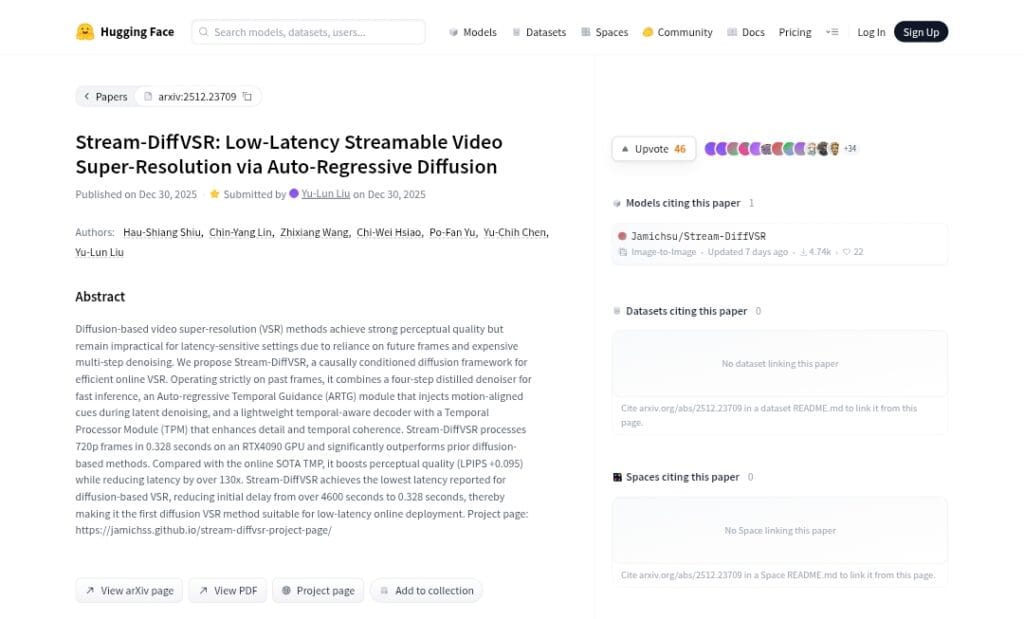
Stream Diff-VSR is an advanced causal diffusion framework for efficient online Video Super-Resolution (VSR), enabling low-latency streaming processing.
It strictly operates on past frames only (causal conditioning) to support real-time deployment, eliminating reliance on future frames common in prior diffusion VSR methods.
Key innovations include a four-step distilled denoiser for fast inference (only 4 steps needed), Auto-regressive Temporal Guidance (ARTG) that injects motion-aligned cues during latent denoising, and a lightweight temporal-aware decoder with Temporal Processor Module (TPM) for enhanced detail and coherence.
The model achieves remarkable latency reduction: processes 720p frames in 0.328 seconds on an RTX 4090 GPU, dropping initial delay from over 4600 seconds in previous methods to just 0.328 seconds.
Compared to online SOTA like TMP, it improves perceptual quality (LPIPS +0.095) while slashing latency by over 130x, making it the first diffusion-based VSR suitable for low-latency online use.
This is a proof-of-concept/toy checkpoint trained on limited data, demonstrating the pipeline’s feasibility rather than production-level quality.
Released December 29, 2025, with full code on GitHub, inference scripts supporting TensorRT acceleration, and a project page.
Ideal for researchers, developers, and applications requiring real-time video upscaling, streaming enhancement, or low-latency VSR in rendering pipelines, though real-world diversity coverage is limited in this checkpoint.
Key Features
- Causal conditioning: Processes video strictly using past frames only for true online/streaming inference without future-frame dependency
- Four-step distilled denoiser: Enables very fast diffusion inference with just 4 denoising steps for low latency
- Auto-regressive Temporal Guidance (ARTG): Injects motion-aligned temporal cues during latent denoising to maintain coherence
- Lightweight temporal decoder with TPM: Enhances fine details and temporal consistency via Temporal Processor Module
- Real-time performance: Upscales 720p frames in 0.328 seconds on RTX 4090 GPU
- Streaming support: Designed for continuous low-latency online video super-resolution deployment
- TensorRT acceleration: Optional high-speed inference pipeline for NVIDIA GPUs
- Input sequence handling: Takes directories of past frame PNGs and outputs super-resolved frames
- Open-source pipeline: Full GitHub repo with installation, inference scripts, and conda environment setup
Price Plans
- Free ($0): Completely open-source model weights, code, and inference pipeline under standard Hugging Face/GitHub terms; no usage fees
Pros
- Breakthrough low latency: Reduces diffusion VSR delay dramatically, enabling real-time use cases
- First streamable diffusion VSR: Achieves online deployment feasibility where previous methods failed
- Strong perceptual gains: Outperforms online SOTA TMP in LPIPS by 0.095 while cutting latency 130x+
- Fast inference: Only 4 steps needed thanks to distillation and optimizations
- High hardware efficiency: Runs on consumer RTX 4090 at practical speeds for 720p
- Full open-source access: Code, weights, and acceleration options freely available on Hugging Face/GitHub
- Proof-of-concept value: Demonstrates promising direction for future real-world diffusion VSR
Cons
- Proof-of-concept only: Toy model trained on limited data; does not cover full real-world video diversity
- Visual quality limitations: Expected artifacts and inconsistent results due to limited training
- Not production-ready: Intended for demonstration of pipeline/low-latency feasibility, not high-quality upscaling
- Requires powerful GPU: Optimal speed on RTX 4090; slower on lesser hardware
- Setup complexity: Needs conda env, GitHub clone, and potential TensorRT config for best performance
- No pre-built demo/app: Command-line inference only; no Gradio or easy web UI mentioned
- Recent release: Limited community testing and fine-tuning examples available
Use Cases
- Real-time video enhancement: Upscale low-res live streams or webcam feeds with minimal delay
- Streaming platforms: Improve quality in online broadcasting or video conferencing without buffering
- Research prototyping: Test causal diffusion VSR ideas or build on the pipeline for further work
- Low-latency rendering: Integrate into time-sensitive pipelines like gaming or AR/VR upscaling
- Video post-processing experiments: Run offline on short clips to evaluate temporal consistency gains
- Hardware-accelerated demos: Showcase TensorRT speed on NVIDIA GPUs for presentations or benchmarks
Target Audience
- AI researchers in computer vision: Studying diffusion-based VSR or low-latency video processing
- Developers building streaming apps: Needing real-time super-resolution for live video
- Video tech enthusiasts: Experimenting with open-source upscaling models on powerful GPUs
- Academic groups: Reproducing or extending the Stream-DiffVSR paper results
- Hardware optimization testers: Evaluating TensorRT acceleration for diffusion models
- Proof-of-concept explorers: Interested in causal diffusion frameworks for temporal tasks
How To Use
- Clone repo: git clone https://github.com/jamichss/Stream-DiffVSR.git and cd into directory
- Setup environment: conda env create -f requirements.yml then conda activate stream-diffvsr
- Run basic inference: python inference.py --model_id 'Jamichsu/Stream-DiffVSR' --out_path 'output/' --in_path 'input_frames/' --num_inference_steps 4
- Enable TensorRT: Add --enable_tensorrt --image_height 720 --image_width 1280 for acceleration (specify target resolution)
- Prepare input: Place sequential PNG frames in input directory (e.g., seq1/frame_0001.png)
- Monitor output: Super-resolved frames save to specified out_path; review for quality/latency
- Customize: Adjust steps, model path, or add flags for different resolutions/hardware
How we rated Stream Diff-VSR
- Performance: 4.7/5
- Accuracy: 4.2/5
- Features: 4.5/5
- Cost-Efficiency: 5.0/5
- Ease of Use: 3.8/5
- Customization: 4.4/5
- Data Privacy: 5.0/5
- Support: 4.0/5
- Integration: 4.3/5
- Overall Score: 4.4/5
Stream Diff-VSR integration with other tools
- GitHub Repo: Full source code, inference scripts, and requirements for local setup and extension
- Hugging Face Hub: Model weights hosted for easy download via transformers or diffusers library
- TensorRT Acceleration: Native support for NVIDIA TensorRT to maximize speed on compatible GPUs
- Python Ecosystem: Built on PyTorch/Diffusers; integrable into custom pipelines or ComfyUI-like workflows
- Video Processing Tools: Output frames can be fed into FFmpeg, OpenCV, or DaVinci Resolve for further editing/compression
Best prompts optimised for Stream Diff-VSR
- Not applicable - Stream Diff-VSR is a specialized video super-resolution model that processes existing low-res video frames automatically, not a text-to-video or prompt-based generative tool. No user prompts are required; it works on input frame sequences directly.
FAQs
Newly Added Tools







About Author