
What is V-RGBX?
V-RGBX is the first end-to-end framework for intrinsic-aware video editing, decomposing videos into albedo, normals, materials, irradiance, and enabling precise keyframe-based edits with temporal consistency.
When was V-RGBX released?
The paper was published December 12, 2025; model weights and inference code were released on January 15, 2026.
Is V-RGBX free and open-source?
Yes, fully open-source with model weights and code available on GitHub (Aleafy/V-RGBX) under permissive license; no usage fees.
What are the main capabilities of V-RGBX?
It supports video inverse rendering, photorealistic synthesis, and keyframe editing conditioned on intrinsic channels for object appearance changes and scene relighting.
Who developed V-RGBX?
Developed by researchers including Ye Fang, Tong Wu, and others from Adobe Research and collaborators.
What hardware is needed for V-RGBX?
Requires powerful GPU for inference due to complex rendering/synthesis pipelines; local deployment via GitHub repo.
Is there a demo or hosted version of V-RGBX?
No hosted web demo mentioned; users must set up and run locally using the released code and weights.
What applications is V-RGBX best for?
Ideal for VFX, film post-production, precise relighting, object editing in videos, and research in intrinsic-aware AI editing.

V-RGBX

About This AI
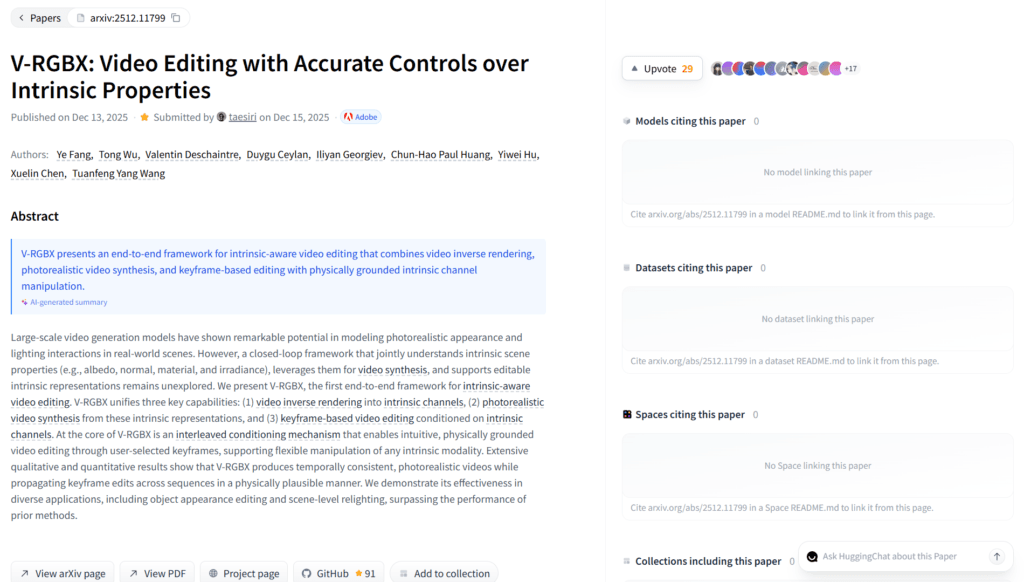
V-RGBX is the first end-to-end framework for intrinsic-aware video editing, presented in an arXiv paper published December 12, 2025.
It unifies video inverse rendering into intrinsic channels (albedo, normal, material, irradiance), photorealistic video synthesis from these representations, and keyframe-based editing conditioned on intrinsic properties.
The core innovation is an interleaved conditioning mechanism that allows intuitive, physically grounded manipulation through user-selected keyframes, supporting flexible editing of any intrinsic modality while propagating changes temporally consistently across the video sequence.
This enables accurate object appearance editing, scene-level relighting, material changes, and other intrinsic modifications in a photorealistic, temporally coherent manner.
Extensive qualitative and quantitative results demonstrate superior performance over prior methods in producing stable, high-fidelity outputs with plausible physics-based propagation.
Developed by researchers from Adobe Research and collaborators, the framework was released with model weights, inference code (including inverse rendering, forward rendering, and editing pipelines), and a project page on January 15, 2026.
Code and weights are available on GitHub (Aleafy/V-RGBX), making it accessible for researchers and developers to experiment with or extend intrinsic-aware video editing.
As a recent research release, it targets advanced applications in VFX, film post-production, creative content editing, and AI-driven video manipulation where precise physical control is essential.
Key Features
- Video inverse rendering: Decomposes input video into intrinsic channels like albedo, normals, materials, and irradiance
- Photorealistic synthesis: Generates high-fidelity RGB video from intrinsic representations
- Keyframe-based editing: Users edit keyframes in intrinsic space; changes propagate plausibly over time
- Interleaved conditioning: Core mechanism for flexible manipulation of any intrinsic modality
- Temporal consistency: Ensures edits remain coherent across entire sequence without flickering
- Physically grounded controls: Edits respect real-world properties like lighting and material interactions
- Object and scene editing: Supports appearance changes, relighting, material swaps, and more
- Inference pipeline: Includes separate modules for inverse rendering, synthesis, and editing propagation
Price Plans
- Free ($0): Fully open-source with model weights and inference code available on GitHub; no usage fees or subscriptions
- Cloud/Enterprise (Custom): Potential future hosted options or premium support (not available yet)
Pros
- Physically accurate editing: First framework to enable intrinsic-level precise control in video
- Temporal coherence: Strong propagation of keyframe edits without artifacts
- Photorealistic quality: High-fidelity outputs surpassing many prior methods
- Open-source release: Model weights and inference code available on GitHub for experimentation
- Versatile applications: Ideal for VFX, relighting, object modification in videos
- Research impact: Addresses key gap in intrinsic-aware video manipulation
Cons
- Research-oriented: Requires technical setup and GPU for running locally
- Early release: Limited community adoption and integrations so far
- No hosted demo: No simple web interface; users must deploy code
- Compute intensive: Inverse rendering and synthesis demand powerful hardware
- Scope limited to editing: Focuses on intrinsic manipulation, not from-scratch generation
- Potential artifacts: Complex scenes or extreme edits may still show inconsistencies
Use Cases
- Video post-production: Precise relighting or material changes in film footage
- VFX workflows: Object appearance editing while preserving lighting consistency
- Creative experimentation: Test intrinsic modifications on existing videos
- Research extension: Fine-tune or build upon for advanced video AI tasks
- Scene-level editing: Uniform relighting or property tweaks across entire clips
- Prototyping visual effects: Simulate physical edits before full production
Target Audience
- VFX artists and filmmakers: Needing accurate intrinsic controls in editing
- AI researchers in video generation: Studying or extending intrinsic-aware models
- Computer vision developers: Experimenting with decomposition and synthesis pipelines
- Content creators: Advanced users wanting physically grounded video tweaks
- Academic teams: Reproducing or building on the framework for papers/projects
How To Use
- Visit GitHub: Go to github.com/Aleafy/V-RGBX for code, weights, and docs
- Download model: Get weights from linked sources in repo
- Setup environment: Install dependencies (PyTorch etc.) per instructions
- Run inverse rendering: Process input video to extract intrinsic channels
- Edit keyframes: Modify intrinsic properties on selected frames
- Propagate edits: Use synthesis pipeline to generate edited full video
- Experiment locally: Test on sample videos or own footage
How we rated V-RGBX
- Performance: 4.5/5
- Accuracy: 4.7/5
- Features: 4.6/5
- Cost-Efficiency: 5.0/5
- Ease of Use: 3.8/5
- Customization: 4.8/5
- Data Privacy: 5.0/5
- Support: 4.0/5
- Integration: 4.2/5
- Overall Score: 4.5/5
V-RGBX integration with other tools
- GitHub Repository: Full open-source code and model weights for local deployment
- Hugging Face (Potential): Paper linked, possible future model hosting
- Video Editing Software: Outputs compatible with tools like After Effects, DaVinci Resolve for further refinement
- Research Frameworks: Built with PyTorch; integrable with diffusion or rendering pipelines
- Local Hardware: Runs on GPUs with CUDA support for inference
Best prompts optimised for V-RGBX
- Not applicable - V-RGBX is a research framework for intrinsic-aware video editing using keyframes and decomposition, not text-prompt generation. It operates on existing videos rather than text-to-video creation; no manual prompts are used for core functionality.
- N/A - This model focuses on inverse rendering and keyframe editing in intrinsic space; best 'use' is providing input video and editing intrinsic channels directly.
- N/A - No generative prompting required; workflow involves uploading video, decomposing, keyframe edits, and synthesis.
FAQs
Newly Added Tools







About Author