
What is Chatterbox Turbo?
Chatterbox Turbo is an open-source text-to-speech model by Resemble AI, optimized for ultra-low latency with one-step generation, zero-shot voice cloning, paralinguistic tags, and built-in watermarking.
When was Chatterbox Turbo released?
It was officially released and announced on December 15, 2025, as per the Hugging Face model card and Resemble AI announcements.
Is Chatterbox Turbo free?
Yes, it’s completely free and open-source under MIT license; run locally with no fees. Resemble AI offers paid production hosting optionally.
What languages does Chatterbox Turbo support?
English only (optimized for speed and quality); multilingual support is in the separate Chatterbox-Multilingual model.
How fast is Chatterbox Turbo?
It achieves sub-200ms end-to-end latency (under 150ms time-to-first-sound reported), making it suitable for real-time voice agents.
Does Chatterbox Turbo support voice cloning?
Yes, zero-shot cloning from just 5-10 seconds of reference audio, with high quality in tests against proprietary models.
What are paralinguistic tags in Chatterbox Turbo?
Tags like [laugh], [chuckle], [cough], [sigh] add natural non-speech sounds and expressiveness to generated audio.
How do I run Chatterbox Turbo locally?
Install via pip install chatterbox-tts, load on GPU with Python code, provide text and optional reference audio, then generate and save WAV.

Chatterbox Turbo

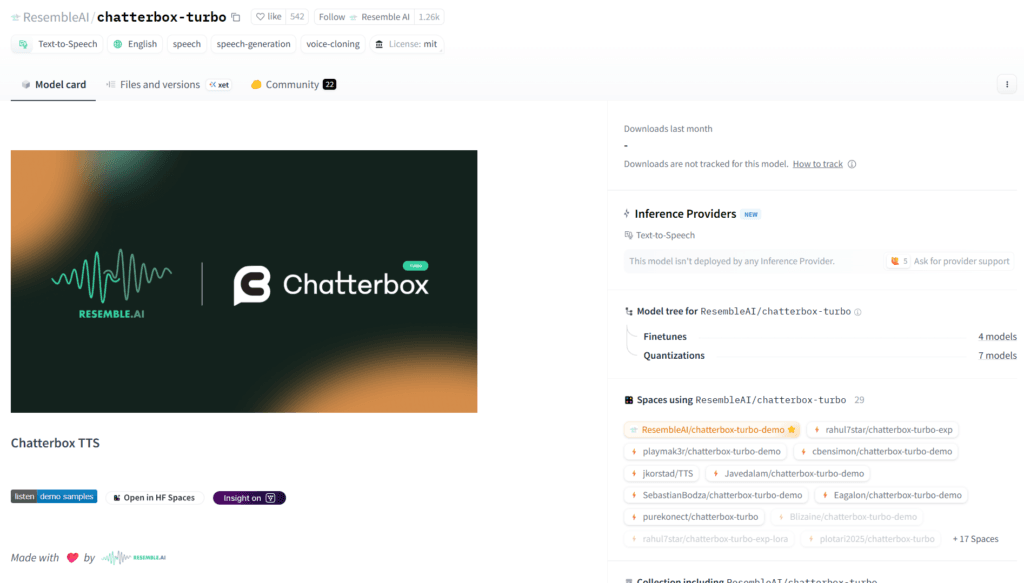
About This AI
Chatterbox Turbo is an efficient, open-source text-to-speech (TTS) model developed by Resemble AI, released on December 15, 2025, as the fastest member of the Chatterbox family.
With a streamlined 350 million parameter architecture, it delivers high-fidelity speech generation with significantly reduced compute and VRAM requirements compared to prior models.
The key innovation is a distilled speech-token-to-mel decoder that reduces generation from 10 steps to just 1, enabling ultra-low latency (sub-200ms in production, under 150ms time-to-first-sound reported in tests) while maintaining quality suitable for real-time voice agents, narration, and creative applications.
It supports native paralinguistic tags like [laugh], [chuckle], [cough], [sigh] to add natural expressiveness and non-speech sounds.
Zero-shot voice cloning requires only a short 5-10 second reference audio clip to synthesize speech in the target voice, outperforming many proprietary models in blind tests.
Every output includes built-in Perth perceptual watermarks (imperceptible neural markers) for traceability, surviving compression and editing with high detection accuracy.
English-only focus optimizes speed and quality for that language, making it ideal for low-latency English voice AI.
Fully MIT-licensed and open-source, it runs locally on GPU (CUDA recommended) with easy pip installation and Python inference.
Demos are available on Hugging Face Spaces and Resemble AI’s site, with production-grade hosting via Resemble AI’s paid service for scale.
Popular for voice agents, gaming, accessibility, content creation, and real-time applications where speed, expressiveness, and ethical watermarking matter.
Key Features
- One-step generation: Distilled decoder reduces synthesis from 10 steps to 1 for ultra-fast output
- Zero-shot voice cloning: Clone any voice with just 5-10 seconds of reference audio
- Paralinguistic tags: Native support for [laugh], [chuckle], [cough], [sigh] and similar for natural expressiveness
- Low-latency performance: Sub-200ms end-to-end (under 150ms TTFS reported), ideal for real-time agents
- Perth watermarking: Built-in imperceptible neural watermarks on every audio for traceability and ethics
- High-fidelity English TTS: Optimized for English with reduced artifacts and strong prosody
- Lower resource usage: 350M parameters require less VRAM and compute than larger TTS models
- MIT open-source license: Full freedom to use, modify, and deploy commercially
- Easy Python integration: pip install chatterbox-tts with simple generate() calls
- Production-ready optimizations: Suitable for voice agents, narration, and creative workflows
Price Plans
- Free ($0): Fully open-source model with MIT license, no usage fees; run locally or on your infrastructure
- Resemble AI Paid Service (Custom): Production hosting, API access, scaling, and premium support via Resemble platform (pricing not public; contact for enterprise)
Pros
- Blazing fast inference: 6x faster than real-time on GPU, sub-200ms latency for real-time use
- Impressive voice cloning: High-quality zero-shot from short clips, competitive with paid services
- Expressive control: Paralinguistic tags add realism and emotion unavailable in many open TTS
- Ethical watermarking: Built-in Perth markers help prevent misuse and ensure traceability
- Resource efficient: Runs well on consumer GPUs with low VRAM footprint
- Fully open-source: MIT license allows unrestricted use, modification, and deployment
- Strong community demos: Hugging Face Spaces and GitHub examples for quick testing
- Production viability: Used in real-time agents and outperforms some closed models in speed/quality
Cons
- English-only support: Lacks multilingual capabilities (unlike Chatterbox-Multilingual variant)
- Requires GPU for best speed: CPU inference slower; optimal on CUDA-enabled hardware
- Reference audio needed for cloning: Zero-shot still requires 5-10s clean clip for best results
- No built-in multilingual expansion: Focused on English; separate model needed for other languages
- Early adoption stage: Released late 2025, community fine-tunes and integrations still growing
- Watermark detection separate: Requires Perth library to verify/extract markers
- Limited official benchmarks: Relies on user tests and demos rather than standardized leaderboards
Use Cases
- Real-time voice agents: Low-latency conversational AI for chatbots, virtual assistants, customer support
- Voice cloning applications: Personalized narration, dubbing, or character voices from short samples
- Expressive audio content: Podcasts, audiobooks, games, or videos with natural laughs/coughs/sighs
- Accessibility tools: Screen readers or text-to-speech with emotional tone for better engagement
- Creative prototyping: Quick voiceovers for animations, ads, or social media content
- Local/offline TTS: Privacy-focused speech synthesis without cloud dependency
- Developer experiments: Build custom voice AI apps with open-source freedom
Target Audience
- AI developers and voice engineers: Building real-time agents or TTS integrations
- Content creators: Needing fast, expressive voiceovers or cloned voices
- Game developers: Adding dynamic character speech with emotions
- Accessibility advocates: Creating engaging TTS for visually impaired users
- Researchers in speech AI: Experimenting with open-source TTS advancements
- Startups and indie devs: Low-cost, high-performance voice features without vendor lock-in
How To Use
- Install package: pip install chatterbox-tts (or from source via GitHub)
- Load model: from chatterbox.tts_turbo import ChatterboxTurboTTS; model = ChatterboxTurboTTS.from_pretrained(device='cuda')
- Prepare reference: Provide 5-10s clean WAV clip for voice cloning (optional for default voice)
- Generate speech: wav = model.generate('Your text here [chuckle] with tags', audio_prompt_path='ref.wav')
- Save output: import torchaudio as ta; ta.save('output.wav', wav, model.sr)
- Test demos: Try Hugging Face Space or Resemble demo page for no-code preview
- Optimize: Use GPU for speed; experiment with tags like [laugh], [sigh] for expression
How we rated Chatterbox Turbo
- Performance: 4.9/5
- Accuracy: 4.7/5
- Features: 4.8/5
- Cost-Efficiency: 5.0/5
- Ease of Use: 4.6/5
- Customization: 4.7/5
- Data Privacy: 4.9/5
- Support: 4.5/5
- Integration: 4.6/5
- Overall Score: 4.8/5
Chatterbox Turbo integration with other tools
- Hugging Face Ecosystem: Direct model loading from HF hub with Spaces demos for testing
- Python Frameworks: Easy integration with torchaudio, PyTorch, and local apps for custom TTS pipelines
- Voice Agent Platforms: Compatible with real-time frameworks like LiveKit, Pipecat, or custom WebSocket agents
- Resemble AI Platform: Seamless upgrade to hosted API for production scaling and monitoring
- ONNX Export: Quantized ONNX versions available for broader deployment on edge devices or servers
Best prompts optimised for Chatterbox Turbo
- Hi there, this is Alex from support calling back [chuckle]. Just checking if you received the updated invoice?
- The quick brown fox jumps over the lazy dog [sigh], what a classic sentence to test pronunciation.
- Welcome to the future [excited laugh], where AI voices sound almost human! Let's explore together.
- I'm really sorry for the delay [soft sigh], but we're working hard to fix it right now.
- And the winner is... [dramatic pause] you! Congratulations on your achievement [cheerful clap sound implied]
FAQs
Newly Added Tools







About Author