


Zelili AI

Chroma 1.0

World’s First Open-Source Real-Time End-to-End Spoken Dialogue Model with Personalized Voice Cloning
Tool Release Date

16 Jan 2026

Tool Users
N/A
0.0
๐Ÿ‘ 77

About This AI

Chroma 1.0 is the pioneering open-source real-time end-to-end spoken dialogue model developed by FlashLabs, enabling natural speech-to-speech interactions with high-fidelity personalized voice cloning.

It processes audio inputs directly through speech tokenizers and neural audio codecs, allowing LLMs to operate on discrete speech representations for sub-second latency streaming generation.

The model achieves an interleaved text-audio token schedule (1:2) for low-latency multi-turn conversations while preserving speaker identity across responses.

Key strengths include exceptional speaker similarity (10.96 percent relative improvement over human baseline), Real-Time Factor (RTF) of 0.43 for fast inference, and strong reasoning/dialogue capabilities without sacrificing voice quality.

Released in January 2026 with full code and models publicly available on GitHub and Hugging Face (Chroma-4B variant), it supports streaming speech-to-speech output, personalized cloning from reference audio, and natural conversational flow.

As an open-source breakthrough, Chroma 1.0 democratizes real-time voice AI, eliminating the need for separate ASR/TTS pipelines and enabling applications in virtual assistants, interactive agents, accessibility tools, gaming NPCs, and more.

With its focus on low-latency and high-fidelity cloning, it addresses major limitations in prior spoken dialogue systems, making personalized, responsive voice interactions feasible on open platforms.

Key Features

  1. Real-time end-to-end spoken dialogue: Direct speech-to-speech processing with sub-second latency
  2. Personalized voice cloning: High-fidelity speaker identity preservation across multi-turn conversations
  3. Interleaved text-audio token schedule: 1:2 ratio enables streaming generation without separate ASR/TTS
  4. Low-latency streaming: Achieves RTF of 0.43 for responsive real-time interaction
  5. Speaker similarity improvement: 10.96 percent relative gain over human baseline
  6. Strong reasoning and dialogue: Maintains LLM-level capabilities in text understanding and response generation
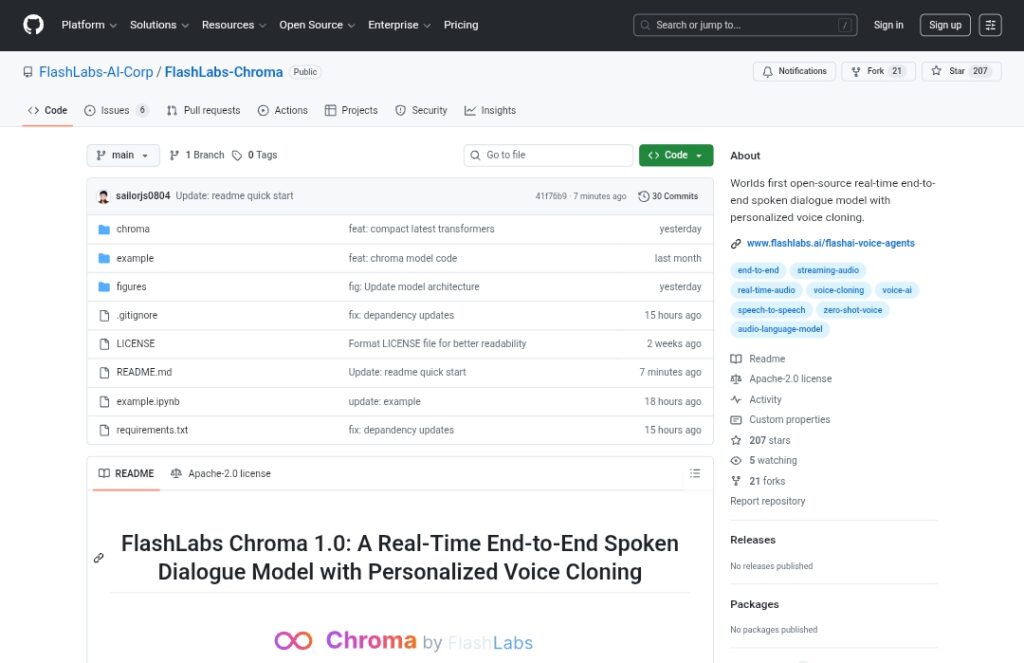
  7. Open-source availability: Full code, models, and benchmarks on GitHub and Hugging Face
  8. Multimodal audio handling: Processes auditory inputs for natural voice interactions
  9. High-quality synthesis: Preserves voice characteristics in dynamic conversations

Price Plans

  1. Free ($0): Fully open-source under permissive license with model weights, code, and inference scripts available on GitHub and Hugging Face; no usage fees
  2. Cloud/Hosted (Potential Custom): Future options via FlashLabs or third-party platforms (not specified yet)

Pros

  1. Breakthrough real-time performance: First open-source model with sub-second speech-to-speech latency
  2. Superior voice cloning: Exceptional speaker similarity and consistency in multi-turn dialogue
  3. Fully open-source: Code and 4B-parameter model publicly available for free use/modification
  4. Eliminates pipeline complexity: End-to-end design removes need for separate speech recognition/synthesis
  5. Strong dialogue quality: Retains advanced reasoning while adding voice capabilities
  6. Developer-friendly: Hugging Face integration for easy inference and experimentation
  7. Potential for broad applications: Virtual assistants, gaming, accessibility, interactive agents

Cons

  1. Requires powerful hardware: 4B model needs GPU for real-time inference
  2. Early release stage: Limited community benchmarks or widespread deployments yet
  3. Setup complexity: Local running involves dependencies and model loading
  4. No hosted demo: Primarily for developers; no simple web interface mentioned
  5. Potential audio quality variability: Depends on input clarity and reference voice
  6. Latency trade-offs: Streaming may vary on consumer hardware
  7. No official user metrics: Very recent release with no reported adoption numbers

Use Cases

  1. Virtual assistants and chatbots: Real-time voice conversations with personalized voices
  2. Gaming NPCs: Dynamic, responsive character dialogue with cloned voices
  3. Accessibility tools: Speech-to-speech for users with disabilities or language barriers
  4. Interactive education: Personalized tutoring or language practice with natural voice
  5. Customer support agents: Voice-based AI with brand-consistent cloning
  6. Content creation: Voiceovers or dialogue generation in videos/podcasts
  7. Research in spoken AI: Baseline for advancing real-time dialogue systems

Target Audience

  1. AI developers and researchers: Building or extending real-time voice models
  2. Game developers: Creating immersive NPCs with natural speech
  3. Accessibility and education creators: Personalized voice interfaces
  4. Enterprise teams: Voice AI for support or internal tools
  5. Open-source enthusiasts: Experimenting with cutting-edge speech models
  6. Voice tech startups: Prototyping personalized dialogue systems

How To Use

  1. Visit repository: Go to github.com/FlashLabs-AI-Corp/FlashLabs-Chroma for code and docs
  2. Download model: Get Chroma-4B weights from huggingface.co/FlashLabs/Chroma-4B
  3. Install dependencies: Set up environment with required libraries per repo instructions
  4. Run inference: Use provided scripts for speech input/output and dialogue loop
  5. Provide reference audio: Upload sample voice for cloning in personalized mode
  6. Interact live: Speak into microphone for real-time response with cloned voice
  7. Customize: Adjust parameters for latency, quality, or streaming behavior

How we rated Chroma 1.0

  • Performance: 4.6/5
  • Accuracy: 4.5/5
  • Features: 4.8/5
  • Cost-Efficiency: 5.0/5
  • Ease of Use: 4.1/5
  • Customization: 4.7/5
  • Data Privacy: 5.0/5
  • Support: 4.2/5
  • Integration: 4.4/5
  • Overall Score: 4.6/5

Chroma 1.0 integration with other tools

  1. Hugging Face: Model weights and inference pipelines for easy download and testing
  2. GitHub Repository: Full open-source code, demos, and community contributions
  3. Real-time Audio Frameworks: Compatible with PyAudio, WebRTC, or browser-based mic input for live demos
  4. Agent Frameworks: Potential integration with LangChain, LlamaIndex for voice-enabled agents
  5. Local Hardware: Runs on GPUs with CUDA; no cloud required for core deployment

Best prompts optimised for Chroma 1.0

  1. Not applicable - Chroma 1.0 is a real-time spoken dialogue model, not prompt-based text or image generation. It processes live speech input directly for end-to-end voice responses and cloning; no manual text prompts required for core functionality.
  2. N/A - Interaction occurs via spoken audio rather than written prompts; reference audio for cloning is provided by uploading voice samples.
  3. N/A - Focus is on speech-to-speech streaming; best 'use' is natural conversation with microphone input.
Chroma 1.0 marks a major open-source milestone as the first real-time end-to-end spoken dialogue model with strong personalized voice cloning. Its sub-second latency, high speaker similarity, and streaming capabilities make it ideal for voice AI apps. Fully free with GitHub/Hugging Face access, it suits developers pushing interactive speech tech, though hardware demands and setup apply.

FAQs

  • What is Chroma 1.0?

    Chroma 1.0 is the first open-source real-time end-to-end spoken dialogue model with personalized voice cloning, enabling sub-second speech-to-speech interactions.

  • Who developed Chroma 1.0?

    It was developed by FlashLabs, an AI research lab focused on real-time agentic systems.

  • When was Chroma 1.0 released?

    The model was announced and open-sourced in January 2026, with arXiv paper submitted on January 16, 2026.

  • Is Chroma 1.0 free to use?

    Yes, it is fully open-source with model weights and code available on Hugging Face and GitHub under a permissive license; no usage fees.

  • What are the key features of Chroma 1.0?

    Sub-second latency, high-fidelity personalized cloning, interleaved text-audio scheduling for streaming, 10.96 percent speaker similarity improvement, and strong dialogue reasoning.

  • How does Chroma 1.0 achieve real-time performance?

    Through an interleaved 1:2 text-audio token schedule supporting streaming generation and a Real-Time Factor (RTF) of 0.43.

  • Where can I access Chroma 1.0?

    Models at huggingface.co/FlashLabs/Chroma-4B and code at github.com/FlashLabs-AI-Corp/FlashLabs-Chroma.

  • What hardware is needed for Chroma 1.0?

    GPU acceleration (CUDA) recommended for real-time inference; the 4B model requires sufficient VRAM for low-latency performance.


Newly Added Toolsโ€‹

Qwen-Image-2.0

$0/Month

Qodo AI

$0/Month

Codiga

$10/Month

Tabnine

$59/Month
Chroma 1.0 Alternatives

Synthflow AI

$0/Month

Fireflies

$10/Month

Notta AI

$9/Month

Chroma 1.0 Reviews

0.0
0.0 out of 5 stars (based on 0 reviews)
Excellent0%
Very good0%
Average0%
Poor0%
Terrible0%

There are no reviews yet. Be the first one to write one.