
What is Fun-Audio-Chat?
Fun-Audio-Chat is an open-source Large Audio Language Model (8B parameters) from Alibaba’s Tongyi Fun Team, released December 23, 2025, for natural low-latency speech-to-speech and speech-to-text voice interactions.
Is Fun-Audio-Chat free to use?
Yes, it is completely open-source under Apache 2.0 license with model weights, code, and inference/demo scripts freely available on GitHub and Hugging Face.
When was Fun-Audio-Chat released?
The model was officially released on December 23, 2025, with technical report on arXiv and open-source code shortly after.
What are the key innovations in Fun-Audio-Chat?
It uses Dual-Resolution Speech Representations (5Hz backbone + 25Hz head) for ~50% compute reduction and Core-Cocktail training to preserve text LLM strength alongside audio capabilities.
What hardware is required for Fun-Audio-Chat?
Inference needs approximately 24GB GPU VRAM; training requires 4x80GB GPUs; supports vLLM for significant speedups.
Does Fun-Audio-Chat support voice empathy?
Yes, it detects emotional tone, pace, and energy in speech and responds appropriately for more natural conversations.
What benchmarks does Fun-Audio-Chat excel in?
It ranks top among similar-sized models on OpenAudioBench, VoiceBench, UltraEval-Audio, MMAU series, and speech function/instruction benchmarks.
How do I run Fun-Audio-Chat locally?
Clone the GitHub repo, install dependencies (Python 3.12, PyTorch 2.8.0, ffmpeg), download weights from Hugging Face, and run inference scripts like infer_s2t.py or infer_s2s.py.

Fun-Audio-Chat

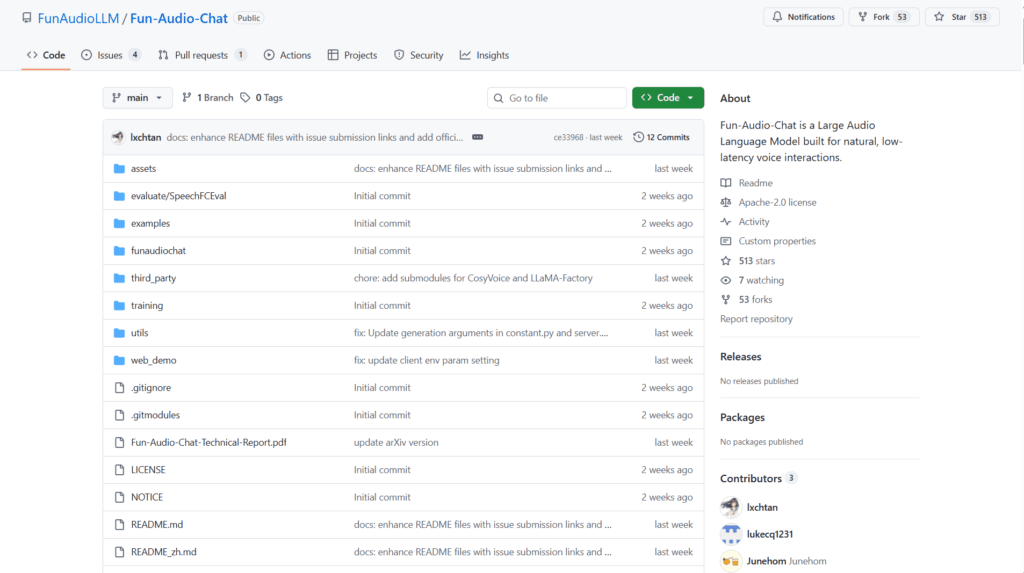
About This AI
Fun-Audio-Chat is an open-source Large Audio Language Model (LALM) developed by Alibaba’s Tongyi Fun Team, released on December 23, 2025.
The 8B-parameter model (with a 30B MoE variant Fun-Audio-Chat-30B-A3B) enables natural, low-latency voice conversations using innovative Dual-Resolution Speech Representations (5Hz efficient backbone + 25Hz refined head) to reduce compute by nearly 50% while preserving high speech quality.
It incorporates Core-Cocktail training to retain strong text LLM capabilities alongside audio understanding, reasoning, and generation.
Key strengths include state-of-the-art performance on spoken QA, audio understanding, speech function calling, speech instruction-following, and voice empathy benchmarks (top rankings among similar-sized models on OpenAudioBench, VoiceBench, UltraEval-Audio, MMAU, MMAU-Pro, MMSU, Speech-ACEBench, Speech-BFCL, Speech-SmartInteract, VStyle).
Supports speech-to-text (S2T), speech-to-speech (S2S), full-duplex two-way communication (Fun-Audio-Chat-Duplex variant), emotional tone detection/response, and tool/function calling via spoken prompts.
Fully open-source under Apache 2.0 with model weights on Hugging Face/ModelScope, training/inference code, web demo, and vLLM integration for up to 50x speedup on long audio.
Requires Python 3.12, PyTorch 2.8.0, ~24GB GPU for inference; ideal for building real-time voice assistants, interactive agents, and multimodal speech applications.
Key Features
- Dual-Resolution Speech Representations: 5Hz backbone for efficiency plus 25Hz head for high-quality speech output
- Core-Cocktail Training: Preserves text LLM knowledge while gaining strong audio capabilities
- Low-Latency Voice Interaction: Natural real-time speech-to-speech conversations with minimal delay
- Voice Empathy: Detects and responds to emotional tone, pace, and energy in speech
- Spoken Function Calling: Executes tools and instructions via voice prompts
- Full-Duplex Support: Simultaneous two-way communication in Duplex variant
- Multimodal Audio Understanding: Excels at spoken QA, audio analysis, and instruction-following
- vLLM Inference Acceleration: Up to 20x speedup for short audios and 50x for long ones
- Open-Source Ecosystem: Full code, weights, web demo, and evaluation scripts available
- High Benchmark Performance: Tops leaderboards for 8B-scale models across audio tasks
Price Plans
- Free ($0): Fully open-source under Apache 2.0; model weights, code, demo, and inference scripts available at no cost for local use and modification
Pros
- State-of-the-art efficiency: 50% less compute with dual-resolution design without quality loss
- Top benchmark rankings: Leads in spoken QA, audio understanding, function calling, and empathy
- Fully open-source: Apache 2.0 license with complete training/inference code and weights
- Real-time low-latency: Enables natural voice conversations suitable for interactive agents
- Emotional intelligence: Unique voice empathy for more human-like responses
- Acceleration support: vLLM integration dramatically speeds up inference
- Community resources: Hugging Face/ModelScope hosting, interactive demo, and paper
Cons
- High hardware requirements: Needs ~24GB GPU VRAM for inference
- Setup complexity: Requires specific Python/PyTorch versions and dependencies
- Limited languages: Primarily English and Chinese (based on LLM backbone)
- No hosted service: Local deployment only; no cloud API mentioned
- Recent release: Adoption and community integrations still growing
- Potential latency variance: Depends on hardware and audio length
- Evaluation focused: Strong on benchmarks but real-world edge cases may vary
Use Cases
- Voice assistants and chatbots: Build natural spoken dialogue systems with emotion awareness
- Interactive AI agents: Real-time voice interaction for gaming, virtual companions, or customer service
- Spoken question answering: Handle audio-based queries with high accuracy
- Speech instruction-following: Execute complex voice commands and function calls
- Audio understanding tasks: Analyze spoken content for insights or summarization
- Research in LALMs: Fine-tune or extend for new audio-language applications
- Accessibility tools: Voice interfaces for hands-free computing
Target Audience
- AI researchers and developers: Experimenting with audio LLMs and voice AI
- Voice application builders: Creating real-time speech-to-speech systems
- Open-source enthusiasts: Deploying and extending large audio models
- Game and virtual agent creators: Adding natural voice interactions
- Multimodal AI teams: Integrating speech with LLM reasoning
- Alibaba/Tongyi ecosystem users: Leveraging related models like CosyVoice
How To Use
- Clone repo: git clone --recurse-submodules https://github.com/FunAudioLLM/Fun-Audio-Chat
- Install dependencies: Use Python 3.12, PyTorch 2.8.0 (CUDA), ffmpeg, and pip install -r requirements.txt
- Download models: From Hugging Face (FunAudioLLM/Fun-Audio-Chat-8B) or ModelScope
- Run inference: python examples/infer_s2t.py for speech-to-text or infer_s2s.py for speech-to-speech
- Launch web demo: Run server (python -m web_demo.server.server) and client (npm run dev)
- Evaluate: Use provided scripts for benchmarks like VoiceBench or OpenAudioBench
- Customize: Modify configs or fine-tune with LLaMA-Factory on your data
How we rated Fun-Audio-Chat
- Performance: 4.8/5
- Accuracy: 4.7/5
- Features: 4.6/5
- Cost-Efficiency: 5.0/5
- Ease of Use: 4.3/5
- Customization: 4.7/5
- Data Privacy: 5.0/5
- Support: 4.4/5
- Integration: 4.5/5
- Overall Score: 4.7/5
Fun-Audio-Chat integration with other tools
- Hugging Face: Model weights and pipelines for easy download and inference
- ModelScope: Alternative hosting for weights and community access
- vLLM: Inference acceleration backend for significant speedups
- LLaMA-Factory: Training/fine-tuning framework used in development
- CosyVoice: Integrated speech synthesis component for output generation
Best prompts optimised for Fun-Audio-Chat
- N/A - Fun-Audio-Chat is a speech-to-speech / audio language model that processes spoken input directly; no text prompts required for core voice interaction (automatic transcription and response generation).
- N/A - Use spoken questions or commands in real-time voice mode via demo or inference scripts.
- N/A - For evaluation or custom use, provide audio files or live microphone input instead of text prompts.
FAQs
Newly Added Tools







About Author