
What is HeartMuLa?
HeartMuLa is an open-source family of music foundation models for generating high-quality songs from lyrics and style tags, supporting multiple languages and controllable sections.
Is HeartMuLa free to use?
Yes, it’s completely free and open-source under Apache 2.0 with model weights, code, and local inference available on GitHub and Hugging Face.
When was HeartMuLa released?
The initial open-source release (HeartMuLa-oss-3B) was on January 14-15, 2026, with updates like RL-refined versions in late January.
What languages does HeartMuLa support?
It generates music with lyrics in English, Chinese, Japanese, Korean, Spanish, and potentially more, with strong multilingual conditioning.
How do I run HeartMuLa locally?
Clone the heartlib repo, install via pip, download weights from Hugging Face, and run examples/run_music_generation.py with lyrics and tags.
Does HeartMuLa have a web interface?
No official hosted UI, but community tools like HeartMuLa-Studio and ComfyUI nodes provide graphical interfaces for easier use.
How does HeartMuLa compare to Suno?
It offers similar quality in many cases but with open-source freedom, no limits, offline use, and multilingual strengths, though Suno has easier UI.
What hardware is required for HeartMuLa?
A good GPU (8GB+ VRAM recommended) for smooth inference; supports multi-GPU and lazy loading to optimize memory.

HeartMuLa

About This AI
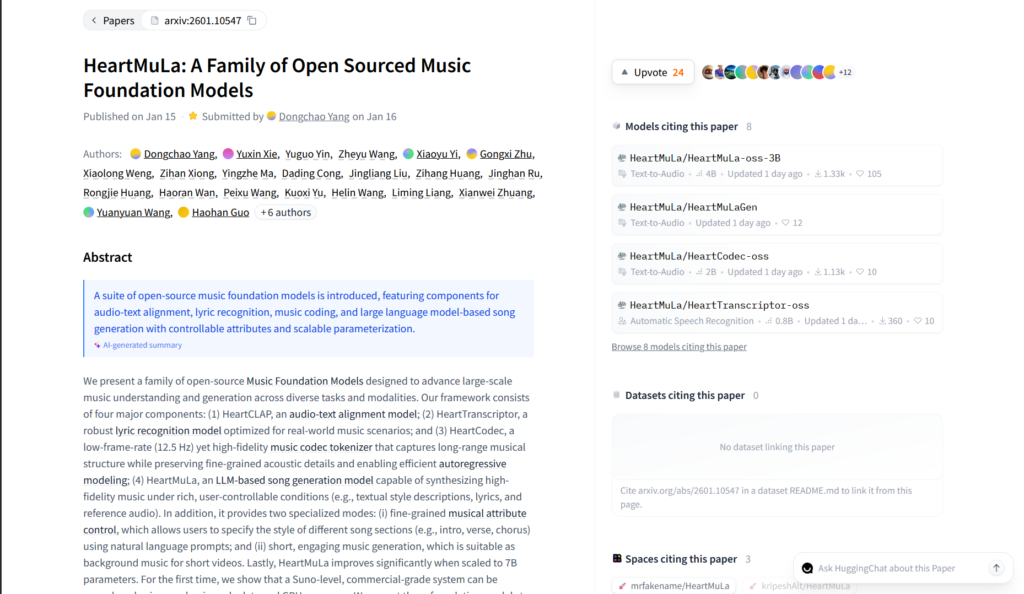
HeartMuLa is a family of open-source music foundation models released in January 2026, designed for high-quality music generation and understanding tasks.
The flagship HeartMuLa-oss-3B is a music language model that generates studio-quality songs conditioned on lyrics and tags (style, mood, genre), supporting multilingual lyrics in English, Chinese, Japanese, Korean, Spanish, and more.
It uses a cascaded decoding architecture with global and local transformers for coherent long-form music, a 12.5 Hz high-fidelity codec (HeartCodec) for efficient tokenization, a fine-tuned Whisper-based lyrics transcriber (HeartTranscriptor), and an audio-text alignment model (HeartCLAP) for retrieval.
Key strengths include section-level style control (intro, verse, chorus), reference audio conditioning in advanced versions, and competitive quality against commercial tools like Suno while being fully open-source under Apache 2.0.
Inference runs locally with multi-GPU support, lazy loading for memory efficiency, and classifier-free guidance for better control.
Community integrations include ComfyUI nodes, HeartMuLa-Studio UI, and rapid adoption (2.7k GitHub stars shortly after release).
Available via GitHub repo with pretrained weights on Hugging Face/ModelScope, it enables developers, musicians, and creators to generate unlimited music offline without licensing restrictions.
Future plans include 7B scaling, streaming inference, and enhanced fine-grained control, making it a leading open alternative in AI music synthesis.
Key Features
- Multilingual lyrics-to-music generation: Creates songs in English, Chinese, Japanese, Korean, Spanish and more from text lyrics and tags
- Section-level style control: Specify different styles/moods for intro, verse, chorus, etc. via prompts
- High-fidelity audio codec: HeartCodec at 12.5 Hz with excellent reconstruction for long-range structure
- Lyrics transcription: HeartTranscriptor (Whisper-tuned) extracts accurate lyrics from audio
- Audio-text alignment: HeartCLAP for cross-modal retrieval and similarity tasks
- Classifier-free guidance: Adjustable CFG scale for controlled generation quality
- Multi-GPU and lazy loading: Optimizes VRAM usage for larger models and inference
- Local offline deployment: Full inference without internet or API keys
- Community UIs and nodes: ComfyUI integration, HeartMuLa-Studio for browser-like experience
Price Plans
- Free ($0): Full open-source access to models, code, weights, and inference under Apache 2.0; unlimited local generations with no fees
- Cloud/Hosted (Custom): Potential future paid hosted options via community or third-parties (not official yet)
Pros
- Completely open-source: Apache 2.0 with weights, code, and no usage limits or costs
- Multilingual excellence: Strong support for non-English lyrics and global music styles
- Controllable generation: Section styles, tags, and CFG for tailored outputs
- High audio quality: Competitive with commercial tools like Suno in fidelity
- Community momentum: Rapid integrations (ComfyUI nodes, studios) and 2.7k stars
- Offline unlimited use: Ideal for creators wanting privacy and no quotas
- Active development: RL-refined versions and 7B scaling planned
Cons
- Requires strong GPU: 3B model needs good VRAM (8GB+ recommended) for smooth inference
- Setup technical: Local install, dependencies, and model download needed
- No hosted demo for all: Official demo limited; full power is local-only
- Early-stage scaling: 3B is current; 7B not yet released
- Generation speed: RTF around 1.0; longer songs take time
- Occasional inconsistencies: Complex prompts may need prompt engineering
- No mobile/web native: Primarily for desktop/local use
Use Cases
- Music creation from lyrics: Turn written songs/poems into full tracks with style control
- Multilingual song generation: Produce music in Chinese, Japanese, Korean, etc. for global creators
- Background music for videos: Generate short engaging clips with specific moods
- Prototyping and ideation: Quickly test musical ideas offline without subscriptions
- Research and fine-tuning: Extend models for custom genres or voices
- ComfyUI workflows: Integrate into visual AI pipelines for multimedia projects
- Personal music projects: Unlimited experimentation for hobbyists and indie artists
Target Audience
- AI music enthusiasts and creators: Wanting Suno-like quality open-source and offline
- Multilingual songwriters: Working in non-English languages for authentic generation
- Indie musicians and producers: Prototyping tracks without commercial limits
- ComfyUI and Stable Diffusion users: Extending visual workflows to audio
- AI researchers in audio: Experimenting with music foundation models
- Content creators needing BGM: For videos, games, or social media
How To Use
- Clone repo: git clone https://github.com/HeartMuLa/heartlib.git and cd heartlib
- Install: pip install -e . (use python 3.10 recommended)
- Download models: Get weights from Hugging Face (HeartMuLa/HeartMuLa-oss-3B etc.)
- Run generation: python examples/run_music_generation.py --model_path ./ckpt --version 3B
- Provide inputs: Lyrics in .txt file and tags (e.g. piano,happy,romantic)
- Customize: Use --cfg_scale for guidance, --temperature for variety
- Output: Generated .mp3 saved; explore ComfyUI nodes for GUI
How we rated HeartMuLa
- Performance: 4.5/5
- Accuracy: 4.6/5
- Features: 4.7/5
- Cost-Efficiency: 5.0/5
- Ease of Use: 4.2/5
- Customization: 4.8/5
- Data Privacy: 5.0/5
- Support: 4.3/5
- Integration: 4.5/5
- Overall Score: 4.6/5
HeartMuLa integration with other tools
- ComfyUI: Custom nodes for seamless integration into visual AI workflows (HeartMuLa_ComfyUI repo)
- Hugging Face: Model weights and spaces for testing/inference pipelines
- GitHub: Full source code, examples, and community contributions
- Local Audio Tools: Outputs MP3/WAV for use in DAWs like Ableton, Logic, or Audacity
- Third-Party UIs: HeartMuLa-Studio and community frontends for browser-like experience
Best prompts optimised for HeartMuLa
- A heartfelt acoustic ballad about lost love in English, gentle piano and soft vocals, emotional verse-chorus structure, romantic melancholy mood
- Upbeat K-pop dance track in Korean, synth-heavy with catchy chorus, energetic female vocals, summer party vibe
- Traditional Chinese guzheng instrumental with modern electronic fusion, serene and meditative, flowing melody
- J-pop anime opening song in Japanese, fast-paced rock with powerful male vocals, heroic adventure theme
- Latin pop reggaeton beat in Spanish, rhythmic percussion and sensual lyrics, party club atmosphere
FAQs
Newly Added Tools







About Author