



Zelili AI

JavisGPT

Unified Multimodal LLM for Joint Audio-Video Comprehension and Sounding-Video Generation
Tool Release Date

26 Dec 2025

Tool Users
N/A
0.0
πŸ‘ 24

About This AI

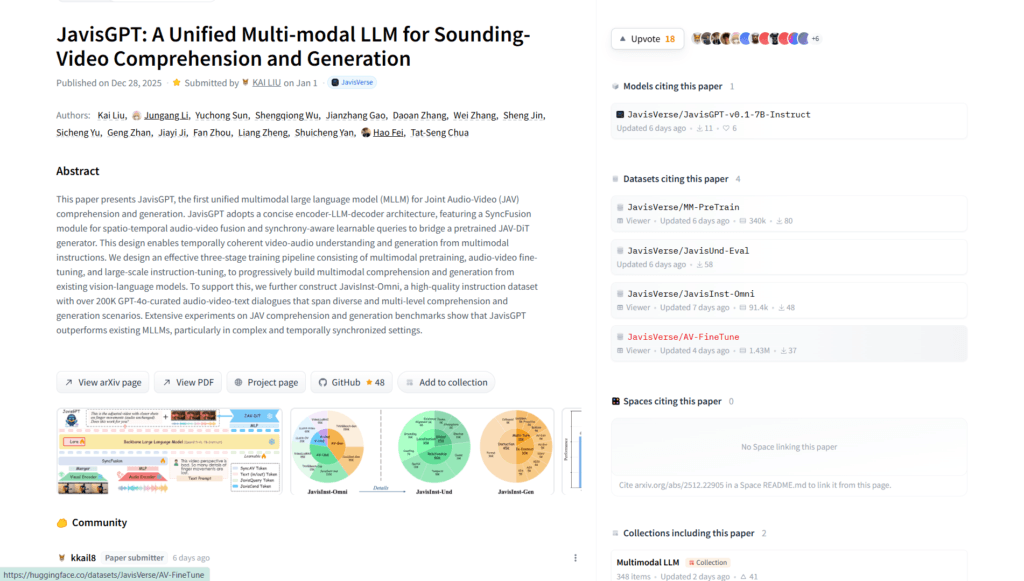
JavisGPT is the first unified multimodal large language model (MLLM) specifically designed for joint audio-video (JAV) comprehension and generation.

It enables temporally coherent understanding of audiovisual inputs and simultaneous generation of synchronized sounding videos from multimodal instructions.

The model features a concise encoder-LLM-decoder architecture with the innovative SyncFusion module for spatio-temporal audio-video fusion and synchrony-aware learnable queries that bridge a pretrained JAV-DiT generator.

Trained via a three-stage pipeline: multimodal pretraining, audio-video fine-tuning, and large-scale instruction-tuning on the JavisInst-Omni dataset (over 200K GPT-4o-curated audio-video-text dialogues).

It excels in complex, temporally synchronized tasks, outperforming existing MLLMs on JAV comprehension and generation benchmarks, including synchronized audio-video QA and high-quality text-to-audio-video generation.

Released as an open-source project in late December 2025 (NeurIPS 2025 Spotlight), with code, preview checkpoint (JavisGPT-v0.1-7B-Instruct), and dataset available on Hugging Face and GitHub.

Ideal for researchers, developers, and creators working on audiovisual AI, video understanding, sounding video synthesis, multimodal agents, and applications requiring aligned audio-visual intelligence.

As a research-oriented model, it requires technical setup (e.g., via GitHub code) and is not a ready-to-use consumer app but supports inference and fine-tuning for advanced users.

Key Features

  1. Joint Audio-Video Comprehension: Understands synchronized audiovisual inputs with temporal coherence
  2. Sounding-Video Generation: Generates videos with aligned audio from text or multimodal prompts
  3. SyncFusion Module: Spatio-temporal fusion for effective audio-video alignment
  4. Synchrony-Aware Queries: Learnable queries bridging LLM to JAV-DiT generator
  5. Multimodal Instruction Following: Handles complex instructions involving audio, video, and text
  6. Temporally Coherent Outputs: Ensures synchronization across time for realistic sounding videos
  7. Three-Stage Training: Multimodal pretraining, AV fine-tuning, large-scale instruction-tuning
  8. JavisInst-Omni Dataset: 200K+ GPT-4o-curated dialogues for diverse JAV tasks
  9. Benchmark Leadership: Superior performance on synchronized AV QA and generation tasks
  10. Open-Source Release: Code, model checkpoint, dataset on Hugging Face and GitHub

Price Plans

  1. Free ($0): Fully open-source model weights, code, and dataset under permissive license; no usage fees
  2. Local/Cloud Compute (Variable): Costs depend on hardware or cloud GPU rental for running inference/generation

Pros

  1. Pioneering unified JAV model: First to jointly handle comprehension and generation in one framework
  2. Strong temporal synchronization: Excels at aligned audio-video outputs and understanding
  3. Open-source accessibility: Full code, weights (preview 7B-Instruct), and dataset freely available
  4. Research-grade performance: Outperforms prior MLLMs on specialized JAV benchmarks
  5. Innovative architecture: SyncFusion and synchrony-aware queries enable high-quality fusion
  6. Extensive dataset: JavisInst-Omni provides rich, curated multimodal instruction data
  7. NeurIPS Spotlight recognition: Accepted as high-impact work in top AI conference

Cons

  1. Research-focused: Requires technical setup (no simple web app; needs code execution)
  2. Preview stage: v0.1 release means potential instability or limited capabilities
  3. Compute-intensive: Large multimodal model demands significant GPU resources for inference/generation
  4. No consumer interface: Lacks polished UI; users must run locally or via HF Spaces if available
  5. Limited public stats: New release with no widespread user numbers or broad adoption yet
  6. Specialized scope: Focused on sounding-video tasks; less general-purpose than text LLMs
  7. Setup complexity: Requires following GitHub instructions for installation and use

Use Cases

  1. Sounding-video generation: Create videos with synchronized audio from text or multimodal prompts
  2. Audiovisual understanding: Analyze and answer questions about videos with sound
  3. Multimodal research: Experiment with joint audio-video models and fine-tuning
  4. Video captioning/QA: Generate descriptions or answers for sounding videos
  5. Creative AI applications: Build tools for synchronized media synthesis
  6. Academic benchmarking: Test and compare JAV comprehension/generation performance
  7. Agent development: Integrate into multimodal agents handling audio-visual inputs

Target Audience

  1. AI researchers: Studying multimodal LLMs, audio-video fusion, and generation
  2. Developers and engineers: Building audiovisual AI applications or prototypes
  3. Multimodal AI enthusiasts: Experimenting with open-source JAV models
  4. Academic institutions: Using for papers, theses, or course projects in AI
  5. Creative technologists: Exploring sounding-video creation techniques
  6. Computer vision/speech communities: Interested in unified audio-video models

How To Use

  1. Visit project: Go to https://github.com/JavisVerse/JavisGPT or Hugging Face page
  2. Install dependencies: Follow README for environment setup (PyTorch, transformers, etc.)
  3. Download model: Pull JavisGPT-v0.1-7B-Instruct checkpoint from Hugging Face
  4. Run inference: Use provided scripts for comprehension or generation tasks
  5. Input multimodal data: Provide video/audio/text prompts as per examples
  6. Generate outputs: Run model to produce answers or sounding videos
  7. Explore demos: Check project page for any online demos or HF Spaces if available

How we rated JavisGPT

  • Performance: 4.7/5
  • Accuracy: 4.6/5
  • Features: 4.8/5
  • Cost-Efficiency: 5.0/5
  • Ease of Use: 3.8/5
  • Customization: 4.5/5
  • Data Privacy: 4.9/5
  • Support: 4.2/5
  • Integration: 4.4/5
  • Overall Score: 4.6/5

JavisGPT integration with other tools

  1. Hugging Face Ecosystem: Model hosted on HF for easy download, inference via transformers library
  2. GitHub Codebase: Full implementation scripts for local setup, fine-tuning, and evaluation
  3. PyTorch/Transformers: Built on standard deep learning frameworks for seamless extension
  4. JAV-DiT Generator: Integrated pretrained diffusion transformer for video-audio synthesis
  5. Research Toolchains: Compatible with multimodal evaluation suites and benchmark frameworks

Best prompts optimised for JavisGPT

  1. Generate a sounding video of a serene mountain lake at dawn with birds chirping, gentle waves, and soft wind sounds, cinematic style, 8 seconds
  2. Analyze this video clip: describe the scene, actions, dialogue, and emotional tone while synchronizing audio events with visuals
  3. Create a short sounding video from this text: A chef preparing fresh sushi in a bustling Tokyo kitchen, chopping sounds, sizzling, upbeat Japanese music
  4. Answer detailed questions about the audio-visual content in this video: What is the person saying? What background noises are present? How do they relate to the actions?
  5. Generate synchronized audio-video: A futuristic robot dancing in a neon city street at night, electronic music beat, footsteps echoing
JavisGPT is a groundbreaking open-source MLLM that unifies audio-video comprehension and sounding-video generation in one model, with impressive temporal coherence and benchmark results. Its SyncFusion innovation and rich dataset make it a strong research tool, though it requires technical setup. Ideal for multimodal AI developers pushing audiovisual boundaries.

FAQs

  • What is JavisGPT?

    JavisGPT is the first unified multimodal large language model for joint audio-video comprehension and synchronized sounding-video generation, featuring a SyncFusion module for spatio-temporal fusion.

  • When was JavisGPT released?

    The model and code were released on December 26, 2025, with the paper published on December 28, 2025 (NeurIPS 2025 Spotlight).

  • Is JavisGPT free to use?

    Yes, it is fully open-source with model weights (preview v0.1-7B-Instruct), code, and dataset available on Hugging Face and GitHub under a permissive license.

  • What does JavisGPT do?

    It understands audiovisual inputs temporally and generates sounding videos (video + aligned audio) from multimodal instructions, excelling in synchronized tasks.

  • How can I try JavisGPT?

    Download from Hugging Face (JavisVerse/JavisGPT-v0.1-7B-Instruct), follow GitHub README for setup and inference scripts; requires GPU for practical use.

  • Who developed JavisGPT?

    Developed by a team including Kai Liu, Hao Fei, Tat-Seng Chua, and others under the JavisVerse project (academic/research collaboration).

  • What hardware is needed for JavisGPT?

    Inference and generation require significant GPU resources (e.g., high-end NVIDIA GPUs); it’s a 7B+ multimodal model, so CPU-only is impractical.

  • Is there a demo for JavisGPT?

    Check the project page (javisverse.github.io/JavisGPT-page/) for possible demos; otherwise, run locally via provided code or look for community HF Spaces.


Newly Added Tools​

CodeRabbit

$0/Month

Code Genius

$0/Month

AskCodi

$20/Month

PearAI

$0/Month
JavisGPT Alternatives

Seedance 2.0

$0/Month

VideoGen

$12/Month

WUI.AI

$10/Month

JavisGPT Reviews

0.0
0.0 out of 5 stars (based on 0 reviews)
Excellent0%
Very good0%
Average0%
Poor0%
Terrible0%

There are no reviews yet. Be the first one to write one.