



Zelili AI

MinMo

Multimodal Large Language Model for Seamless Voice Interaction – Full-Duplex Speech with Instruction-Following and Low Latency
Tool Release Date

10 Jan 2025

Tool Users
N/A
0.0
πŸ‘ 44

About This AI

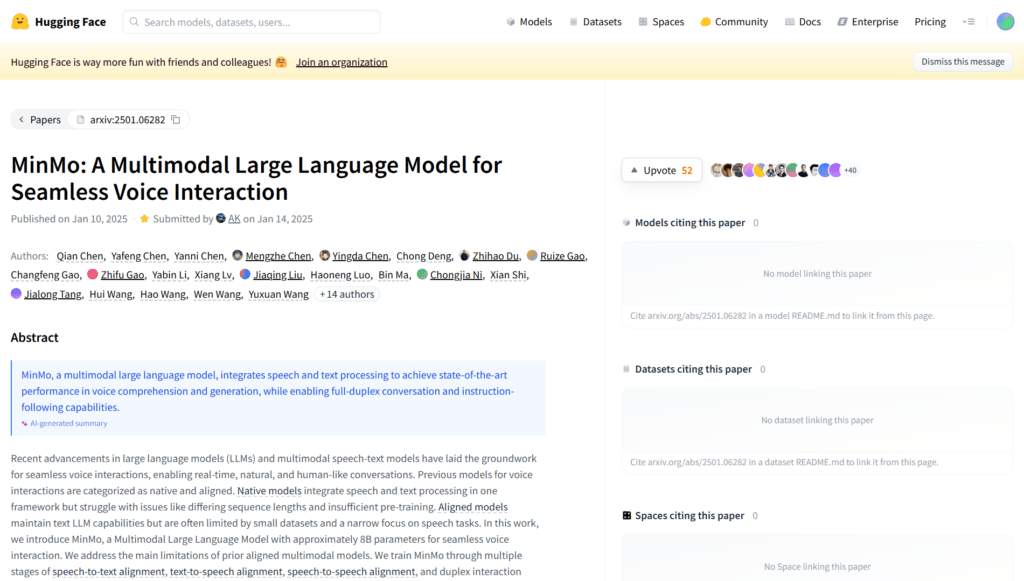
MinMo is a multimodal large language model with approximately 8 billion parameters, designed for seamless voice interaction by integrating speech and text processing in a unified framework.

It achieves state-of-the-art performance in voice comprehension and generation while enabling full-duplex conversation (simultaneous two-way communication) and instruction-following capabilities for controlling speech nuances.

Trained through multi-stage alignment on 1.4 million hours of diverse speech data: speech-to-text, text-to-speech, speech-to-speech, and duplex interaction stages.

The model maintains strong text LLM capabilities alongside superior speech tasks, including automatic speech recognition (ASR), speech-to-text translation (S2TT), spoken question answering (SQA), vocal sound classification (VSC), speech emotion recognition (SER), language identification (LID), age/gender detection, and expressive generation.

A novel simple voice decoder enhances voice generation quality, outperforming prior models.

Key highlights include low latency (speech-to-text around 100ms, full-duplex theoretical 600ms/practical 800ms) and support for emotions, dialects, speaking rates, and voice mimicry via instructions.

Released as a research paper on arXiv January 10 2025 (arXiv:2501.06282), with code and models planned for open-source release soon after.

Project page at funaudiollm.github.io/minmo provides further details, though full weights and deployment are pending as of early 2026.

Ideal for real-time voice AI assistants, conversational agents, emotion-aware speech systems, and applications requiring natural, controllable spoken interaction.

Key Features

  1. Full-duplex conversation support: Simultaneous two-way voice interaction with low latency
  2. Multimodal speech-text integration: Unified processing of audio input/output and text
  3. Instruction-following for speech: Control emotions, dialects, speaking rates, and voice mimicry
  4. State-of-the-art voice benchmarks: Tops ASR, S2TT, SQA, SER, LID, VSC, and generation tasks
  5. Novel voice decoder: Simple yet high-quality speech synthesis outperforming prior methods
  6. Low-latency pipeline: Speech-to-text around 100ms, full-duplex around 600-800ms
  7. Multi-stage training alignment: Speech-to-text, text-to-speech, speech-to-speech, duplex stages
  8. Maintains text LLM strength: No catastrophic forgetting of language capabilities
  9. Expressive generation: Supports nuanced voice control via natural language instructions
  10. Extensive speech data training: 1.4 million hours across diverse tasks and languages

Price Plans

  1. Free ($0): Planned open-source release with code and model weights under permissive license (details pending); no cost for research or personal use once available
  2. Potential Enterprise (Custom): Future hosted or API versions possible but not specified

Pros

  1. Leading voice interaction quality: SOTA on multiple speech benchmarks with natural full-duplex
  2. Highly controllable output: Instruction-based customization of emotion, dialect, rate, mimicry
  3. Low latency for real-time use: Practical full-duplex around 800ms, suitable for conversations
  4. Balanced multimodal performance: Strong speech without sacrificing text LLM abilities
  5. Innovative simple decoder: Achieves superior voice generation with elegant architecture
  6. Research impact potential: Open-source planned, enabling community extensions
  7. Extensive training scale: 1.4M hours data for robust generalization

Cons

  1. Not yet fully released: Code and models promised but pending as of early 2026
  2. Requires heavy compute: 8B parameters need powerful GPUs for inference
  3. No hosted demo mentioned: Project page available but no public interactive try-out
  4. Limited public benchmarks: Performance claims strong but full independent verification pending
  5. Research-focused: Not production-ready deployment guide yet
  6. Latency still noticeable: Full-duplex practical 800ms may feel slightly delayed for some uses
  7. Language coverage: Strong multilingual but specifics not detailed in paper summary

Use Cases

  1. Voice AI assistants: Natural full-duplex conversations with emotional and stylistic control
  2. Real-time translation agents: Spoken Q&A and translation with low latency
  3. Emotion-aware chatbots: Detect and respond with appropriate tone/dialect
  4. Voice mimicry applications: Clone specific voices for personalized audio
  5. Spoken educational tools: Interactive tutoring with expressive speech
  6. Accessibility aids: Real-time speech comprehension for hearing-impaired users
  7. Multimodal research: Extend for combined audio-text-vision systems

Target Audience

  1. AI researchers in speech/multimodal: Studying voice LLMs and full-duplex systems
  2. Voice AI developers: Building conversational agents with controllable output
  3. Accessibility and edtech creators: Needing natural, expressive speech interfaces
  4. Multilingual application builders: Leveraging strong ASR/S2TT capabilities
  5. Open-source enthusiasts: Waiting for weights to experiment and fine-tune
  6. Enterprise voice teams: Potential for production once deployed

How To Use

  1. Wait for release: Monitor project page funaudiollm.github.io/minmo for code/weights availability
  2. Download once out: Get model from Hugging Face or GitHub repo when published
  3. Install dependencies: Set up PyTorch and speech libraries per instructions
  4. Run inference: Load model for speech input/output; use streaming for low-latency
  5. Provide audio/text: Input microphone stream or file for comprehension/generation
  6. Control via prompts: Add instructions like 'speak happily in British accent'
  7. Integrate duplex: Use streaming API for full-duplex conversation loops

How we rated MinMo

  • Performance: 4.8/5
  • Accuracy: 4.7/5
  • Features: 4.9/5
  • Cost-Efficiency: 5.0/5
  • Ease of Use: 4.3/5
  • Customization: 4.8/5
  • Data Privacy: 5.0/5
  • Support: 4.2/5
  • Integration: 4.5/5
  • Overall Score: 4.7/5

MinMo integration with other tools

  1. Hugging Face (Upcoming): Model weights and inference pipelines expected on Hugging Face for easy loading
  2. Project Web Page: funaudiollm.github.io/minmo for demos, updates, and documentation
  3. Streaming Frameworks: Compatible with real-time audio libraries like PyAudio or WebRTC for duplex apps
  4. Voice SDKs: Potential integration with tools like Mozilla TTS, Coqui, or Whisper for extended pipelines
  5. Local Hardware: Runs on GPUs via PyTorch; no cloud dependency required once released

Best prompts optimised for MinMo

  1. Respond to this spoken query in a calm, empathetic tone with a slight Southern US dialect, keeping answers concise:
  2. Translate and reply to the user's spoken English question in natural Mandarin Chinese with a friendly, enthusiastic voice:
  3. Mimic the voice style of a famous narrator while explaining this concept slowly and clearly: [text prompt + audio style reference]
  4. Generate a response with excited emotion and faster speaking rate for this kids' educational question:
  5. Answer this spoken technical query using a professional, neutral tone in formal British English:
MinMo represents a strong advancement in multimodal voice LLMs, delivering SOTA speech comprehension/generation with full-duplex support, low latency, and expressive instruction control. Once open-sourced, it promises great potential for natural voice agents. Currently research-stage with pending release, but its balanced design and scale make it highly anticipated for conversational AI.

FAQs

  • What is MinMo?

    MinMo is a multimodal large language model (approximately 8B parameters) for seamless voice interaction, combining speech and text processing with full-duplex conversation and instruction-following capabilities.

  • When was MinMo released?

    The research paper was published on January 10, 2025, and submitted to arXiv on January 14, 2025; code and models are planned for open-source release soon after.

  • Is MinMo free to use?

    Yes, it will be open-source with code and weights released freely (likely permissive license); no cost once available, though running requires compute resources.

  • What are MinMo’s key capabilities?

    Full-duplex voice conversation, state-of-the-art speech comprehension/generation, low-latency processing, instruction control for emotions/dialects/rates/mimicry, and strong text LLM performance.

  • What latency does MinMo achieve?

    Speech-to-text around 100ms; full-duplex theoretical 600ms, practical around 800ms, enabling near-real-time interactions.

  • How was MinMo trained?

    Through multi-stage alignment on 1.4 million hours of speech data: speech-to-text, text-to-speech, speech-to-speech, and duplex interaction stages.

  • Where can I find MinMo’s project page?

    The official project page is at funaudiollm.github.io/minmo, with further details, potential demos, and release updates.

  • What makes MinMo stand out?

    It combines top voice benchmarks performance, full-duplex support, expressive control via instructions, and a novel simple voice decoder in a balanced multimodal LLM.


Newly Added Tools​

CodeRabbit

$0/Month

Code Genius

$0/Month

AskCodi

$20/Month

PearAI

$0/Month
MinMo Alternatives

Synthflow AI

$0/Month

Fireflies

$10/Month

Notta AI

$9/Month

MinMo Reviews

0.0
0.0 out of 5 stars (based on 0 reviews)
Excellent0%
Very good0%
Average0%
Poor0%
Terrible0%

There are no reviews yet. Be the first one to write one.